Get a responsible approach in promoting your project.
Contact us now!
Contact us now!



In 2026, promoting a website on Google is no longer about the old mantra of “gather keywords, write content, and buy backlinks.” That’s not enough. Search has become stricter toward weak content, more demanding regarding page quality, and much more complex due to AI Overviews, AI Mode, and zero-click behavior. Google explicitly states that AI features don’t require any “special magic SEO,” but the basic principles remain the same: the website must be technically accessible, the content must be useful and understandable, and the pages must be strong enough to be displayed in both classic search results and AI experiences.
Table of Contents
This is good news for businesses. The rules haven’t been turned upside down. But the cost of making a mistake has changed. If your site is slow, its structure is chaotic, its pages don’t match the user’s intent, and the content is just there to tick a box, Google will simply find a better answer—or display its own AI-generated answer without you even clicking.
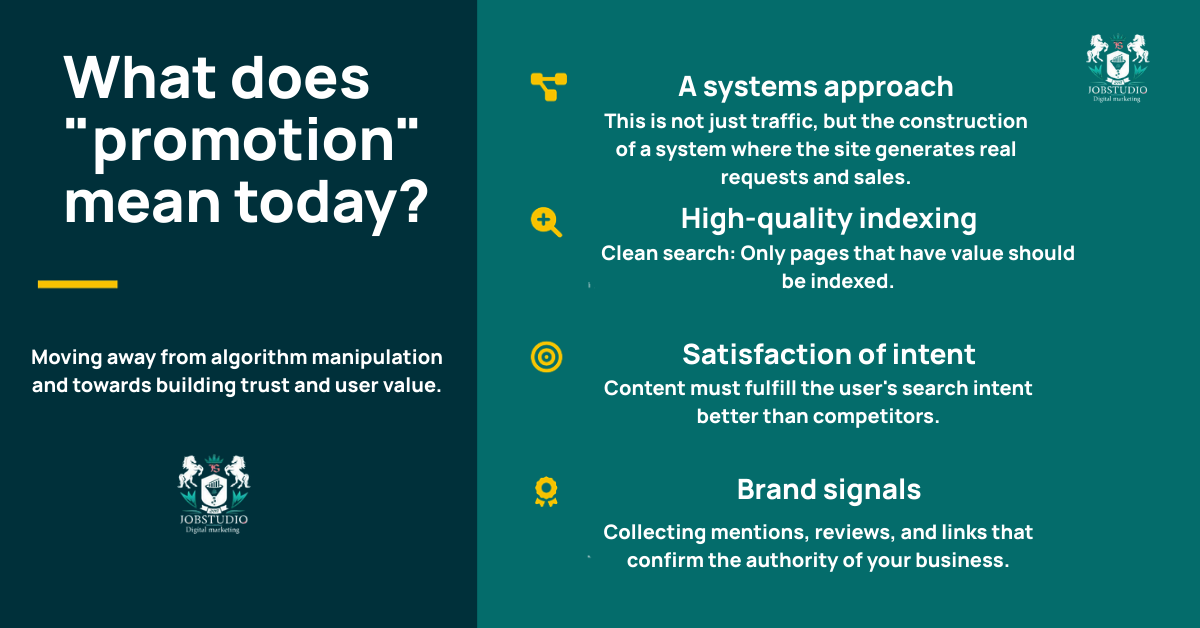
Today, “promoting a website” isn’t just about ranking. It means building a system in which the website:
– gets indexed without
any junk, – fulfills search intent better than competitors,
– doesn’t lose users over technical details,
– collects brand signals, mentions, and quality backlinks,
and most importantly—drives not just traffic, but leads and sales.

In the past, many people thought this way: if you have an SEO page, text, and meta tags, you’re bound to get results. In 2026, this logic no longer holds true. Google increasingly values not the mere presence of content, but its value. In its documentation, the company explicitly mentions helpful, reliable, people-first content: content should be created primarily for people, not to manipulate rankings. Google also advises evaluating whether the material contains original information, completeness, analysis, and real added value, rather than simply rewriting other sources.
In other words, by 2026, SEO will no longer be about “tricking the algorithm,” but rather about eliminating bottlenecks on your site and giving Google a reason to trust you.

Most websites start to grow not after “launching SEO,” but after honestly answering the question: what exactly is holding back growth right now. For some, the problem lies in indexing. For others, it’s a weak site structure. For some, the site attracts traffic but doesn’t generate leads. And for others, they’re simply creating the wrong pages.
You shouldn’t start with text or links. You should start with an audit. And not just a superficial audit—like “here are 150 points in a PDF”—but a thorough analysis.
Please check:
It’s important not to confuse diagnostics with cosmetic fixes. If a page isn’t being indexed—or if it is but has no chance of ranking—a fancy title won’t save it.
The second point is your niche. You can’t effectively promote a website in a vacuum. You need to understand who’s already at the top, how they got there, what page formats Google considers relevant to your topic, and which types of search intent dominate: commercial, informational, local, or comparative.
This is often overlooked. And then a simple scenario unfolds: a business writes an article “optimized for SEO,” but the top results for that query have long been dominated not by articles, but by categories, calculators, local pages, or service pages. And the entire budget goes down the drain because the page type was chosen incorrectly from the start.
Another mistake is to set a goal of “increasing traffic” and stop there. Traffic alone doesn’t pay the bills.
For one business, KPIs are leads.
For another, they’re sales by category.
For a third, it’s visibility in specific cities.
For a fourth, the goal is to rank at the top of commercial search results while simultaneously addressing informational queries through a blog.
The goal determines the entire marketing strategy. If you need quick leads, the strategy will be one thing. If you need long-term organic traffic for the international market, it will be something entirely different.

SEO doesn’t start with the text, but with the page’s search engine accessibility. If Google can’t properly crawl, understand, and evaluate the site, it’s too early to talk about scaling.
The most underestimated problem is poor indexing. A business may have 500 pages, but only 120 of them have real value. The rest are duplicates, technical parameterized URLs, filter pages with no value, pages with thin content, or random technical URLs.
As a result, Google is misallocating its resources. Some important pages are crawled less frequently, some receive weaker signals, and the site appears less cohesive to search engines than it actually is.
That is why, at the start of your SEO campaign, you need to get your indexing in order—not just “add more content.”
Google officially recommends achieving good Core Web Vitals and provides specific benchmarks: LCP—up to 2.5 seconds, INP—up to 200 ms, CLS—up to 0.1. At the same time, the company itself emphasizes separately: good Core Web Vitals do not guarantee high rankings, but they are part of a normal page experience, which is important for both ranking and conversion.
It’s important to understand this correctly. Speed isn’t a magic solution. But a slow website often acts as a constant, hidden cost for SEO, advertising, and sales. You bring a user to your site, and then you’re the one making their experience difficult.
In our experience, technical optimizations often yield results not only in terms of rankings but also in terms of conversion rates. In one case study related to loans, we reduced LCP from 3.8 seconds to 2.3 seconds—and this wasn’t just a “nice technical achievement,” but part of a larger strategy that helped lower CPL and increase the number of conversions.
These are the basics, but it’s precisely these basics where many people go wrong. If the sitemap contains junk, the robots.txt file blocks the wrong pages, canonical tags are set haphazardly, and the URL structure doesn’t reflect the site’s logic, Google ends up with unnecessary noise.
The principle here is simple: the search engine should be able to easily determine which pages are primary, which are secondary, and which are technical and shouldn’t compete for visibility.

Semantics isn’t just a “list of keywords from a service.” It’s a map of demand. And if the map is poorly constructed, the website will either cannibalize itself or let money slip through the cracks.
Effective keyword research doesn’t start with collecting as many phrases as possible, but with understanding the logic behind search intent. Which queries actually lead to a commercial action? Which ones drive initial demand? Which ones help build momentum? Which ones reflect local intent? Which ones are already being captured by competitors?
Poor semantic analysis leads to two problems:
In our JEWELRY case study, refining the semantics was one of the key drivers of growth: we collected 3,779 search queries, filtered out retail-oriented terms, and retained the core terms that best aligned with B2B intent. This wasn’t just a theoretical exercise—it laid the groundwork for actual conversions.
It’s not enough to just collect search queries. They need to be properly organized across pages. One cluster—one landing page. One intent—one strong response.
When this is missing, the usual confusion sets in:
In such situations, Google doesn’t always “guess” which page you wanted to promote. Often, it simply doesn’t fully trust any of them.
Cannibalization isn’t a myth, nor is it a rare occurrence. It happens when a website grows without a clear structure. The site may seem to have plenty of content, but instead of strengthening the pages, they end up competing with one another.
The signs are simple:
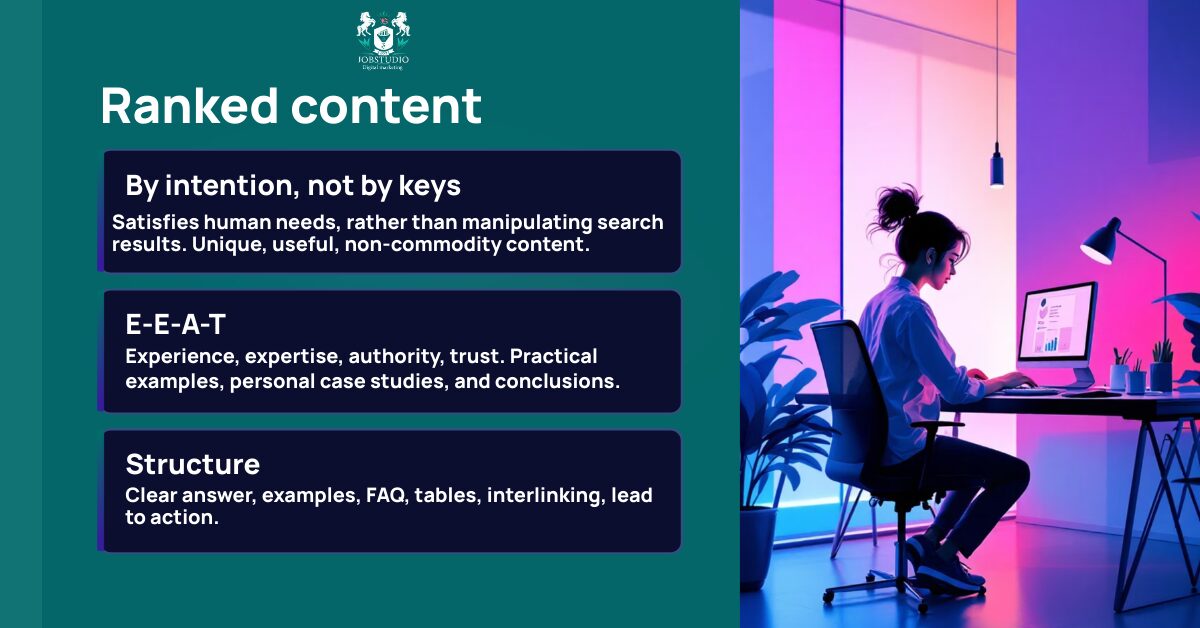
In 2026, content will either solve the user’s problem or become digital dust. There’s almost no middle ground left.
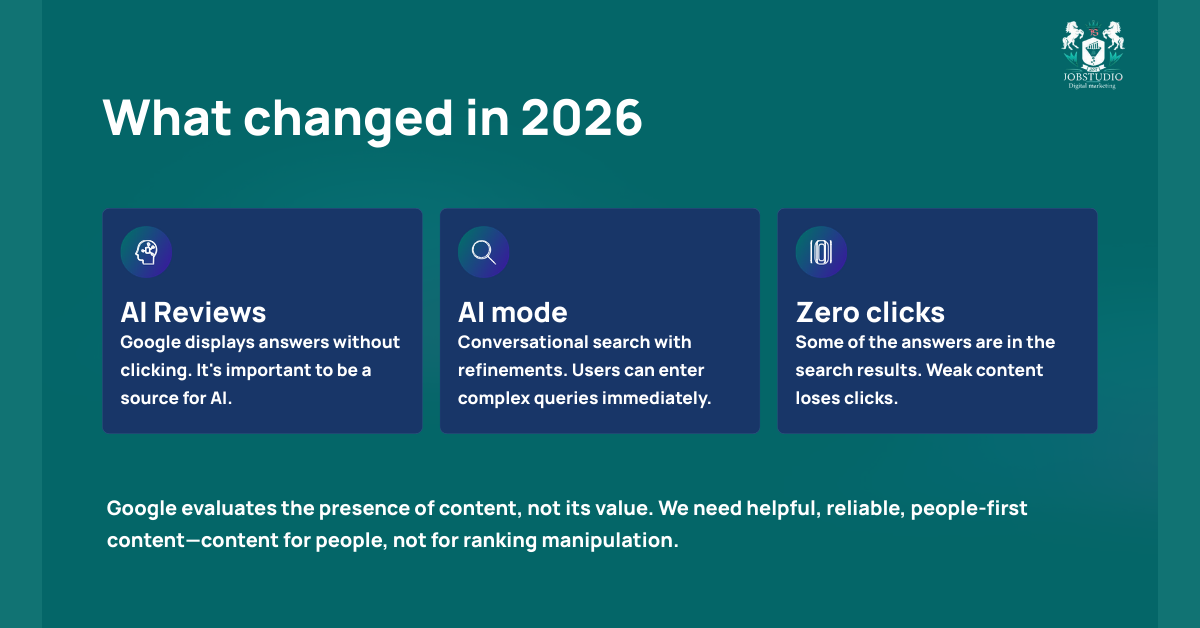
Google explicitly states that it wants to display content that meets people’s needs, rather than material created to manipulate search results. In its guidelines for AI search, the company also emphasizes that unique, useful, non-commodity content that truly adds new value performs better, especially when users enter longer and more specific queries.
If someone is searching for “how to promote a website on Google in 2026,” they don’t need a dated overview of SEO basics from 2018. They need to understand what has changed, where the risks lie, where the opportunities for growth are, and how to avoid blowing their budget.
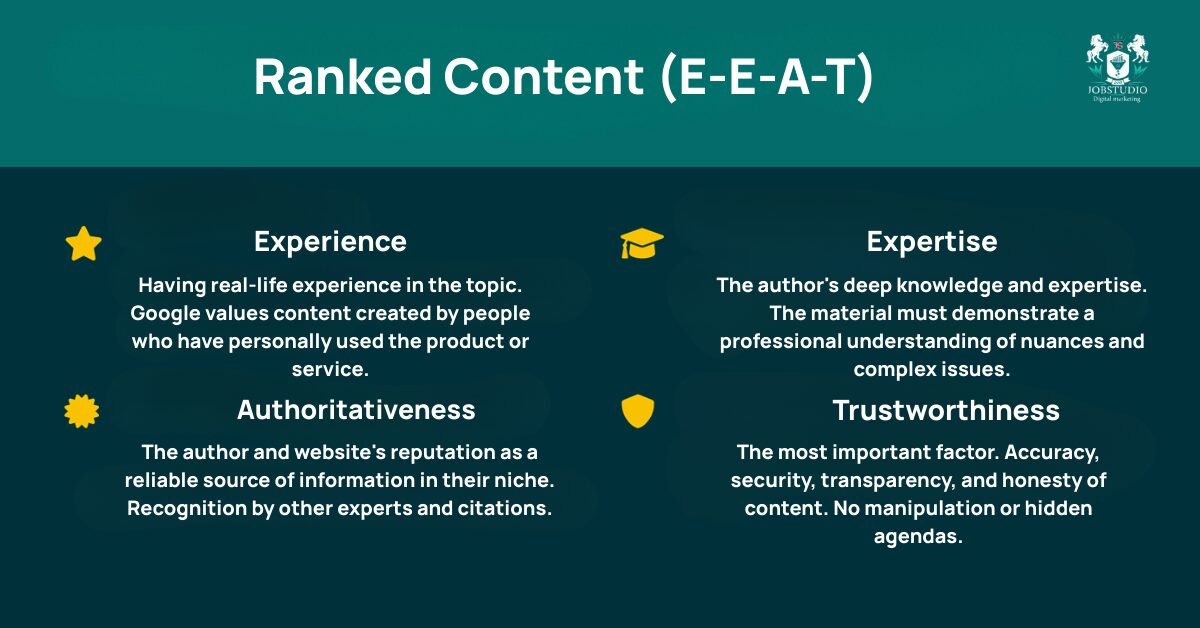
In its materials, Google specifically highlights E-E-A-T as the framework through which its systems assess how useful and reliable content appears to be: experience, expertise, authoritativeness, and trustworthiness. This is not a “single technical factor,” but it is a robust framework for evaluating page quality.
For a business website, this means one simple thing: without real-world experience and concrete details, the content becomes too generic. And in 2026, generic content won’t cut it.
That is why the following are appropriate in a strong article:
A bad article just exists. A good article makes a difference.
The difference between them is that the good one:
In other words, a blog in 2026 isn’t a separate “content hub.” It’s part of the SEO system.

On-page SEO hasn’t gone anywhere. It’s just that you can no longer pass off the basic optimization techniques of the past as on-page SEO.
The Title and H1 tags still define the structure of a page. But their purpose isn’t to cram in as many keywords as possible. Their purpose is to clearly tell both Google and the user what the page is about and why it’s relevant.
The “Description” tag does have an impact, but it’s more of a secondary factor. H2 and H3 headings, on the other hand, help break down the topic structurally. This is important not only for traditional SEO but also for AI systems, which find it easier to process pages where the content is well-organized.
Good internal linking isn’t just an automated plugin that inserts 20 random anchor texts. It’s about the logic of the site’s structure.
A user has read the article—what’s next for them?
Google has indexed the page—which other pages on the site reinforce its topic?
Does the user journey end after the first screen?
Internal links are about distributing weight, improving usability, and ensuring that the website reads like a cohesive system rather than a collection of disparate files.
Google explicitly recommends making important content available in text form, as well as supplementing it with high-quality images and videos where appropriate. The documentation for AI features also states that structured data should match the visible text, and that pages should remain user-friendly.
In practical terms, this means:
images should not be mere visual clutter;
alt text should explain the content;
tables should make comparisons easier; and
brief summaries at the end of each section should help readers quickly grasp the main points.
A page where key points are scattered haphazardly is at a disadvantage compared to a page where the information is structured in a way that makes it easy to understand and quote.
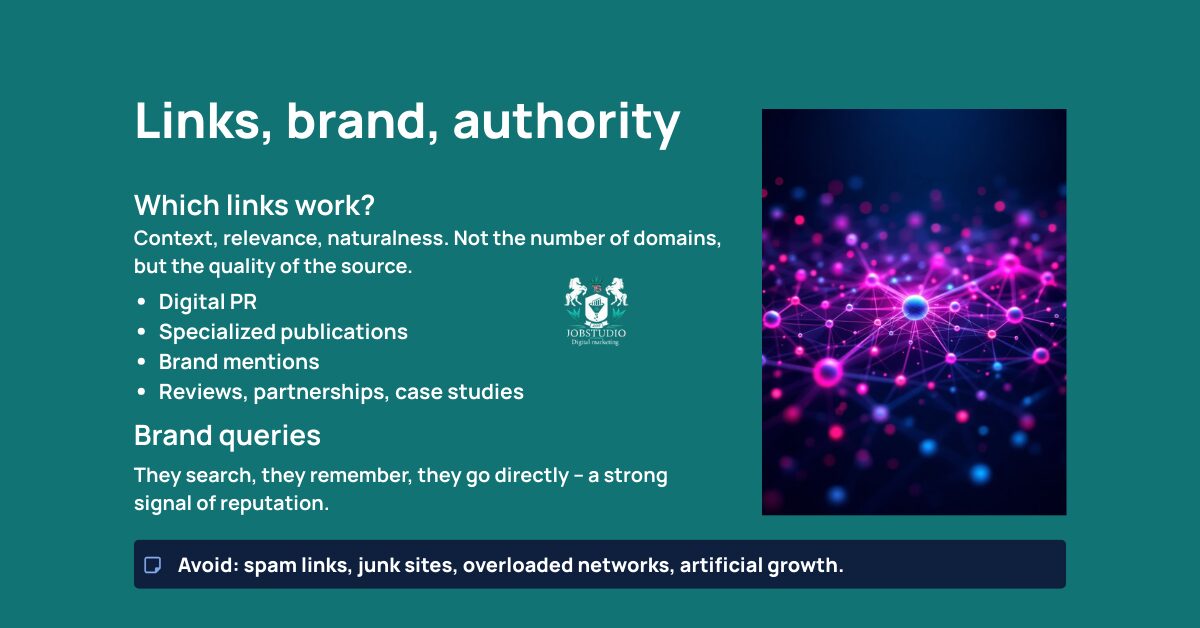
Links aren’t dead. What’s dead is the belief that all links are equally useful.
Links that are contextual, relevant, and fit naturally into the topic are effective. You don’t necessarily need a lot of them. Often, the quality of the source, the logic behind the mention, and the overall profile are more important than simply the “number of domains.”
In B2B and services, the following combination works well:
Google doesn’t evaluate a website in isolation from its reputation. If people search for a brand, mention it, and visit it not only through search keywords but also directly, this is a strong indication that the site isn’t just a random page with text, but a genuine market player.
Brand-related searches aren’t a silver bullet. But in the long run, they reduce reliance on purely “technical” SEO.
The worst-case scenario is when a business wants to quickly “boost its SEO” and starts buying what looks like backlinks but is actually toxic junk.
Links taken out of context, from junk sites, in overloaded networks, with no logical basis for their appearance—that’s not growth. It’s risk and noise.
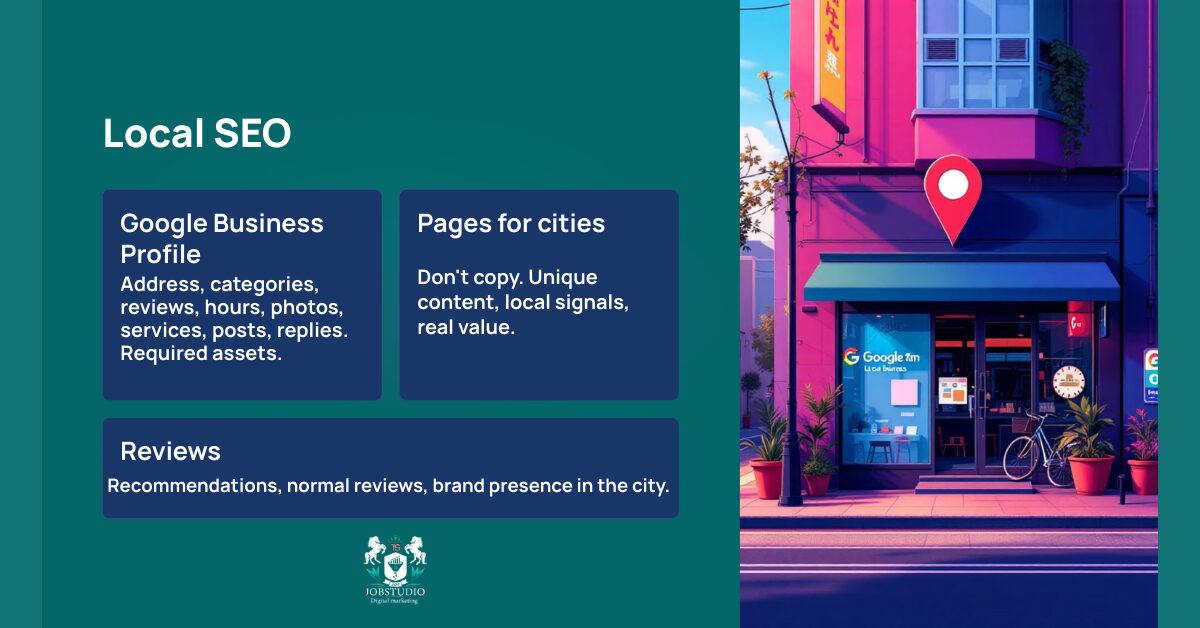
For local businesses, SEO without a local strategy is only half the solution.
Google explicitly recommends keeping your Business Profile up to date if you want to perform well in both search results and AI features. For local businesses, this isn’t just an optional feature—it’s an essential asset: your address, categories, reviews, hours of operation, photos, services, posts, and answers to questions—all of these factors influence trust and visibility.
A business profile is often the first point of contact. If it’s empty or neglected, the website is already at a disadvantage from the start.
A common mistake is to create city-specific pages using a cookie-cutter approach. In 2026, this is almost a surefire way to end up with poor-quality content. A local page must have a valid reason for existing: unique content, local signals, and real value—not just a slightly altered word in the title.
Local visibility is always more closely tied to trust. If you’re recommended, receive positive reviews, and users see your brand’s real presence in the city—that works better than ten generic SEO paragraphs.
This is where many people start to panic. In reality, there’s no need to panic. You just need to shift your perspective.
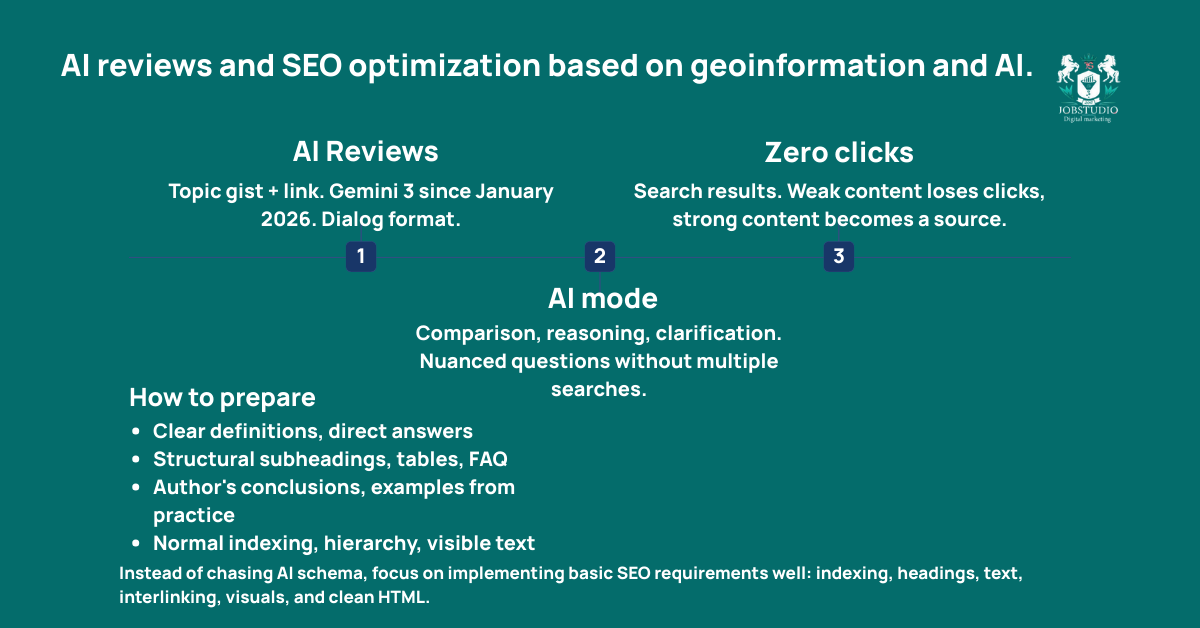
In its documentation for website owners, Google explicitly explains that AI Overviews and AI Mode display relevant links, help users quickly grasp the topic, and can show a broader and more diverse set of useful pages than traditional search results. In other words, it’s now important not only to rank well but also to be a page that can easily serve as a supporting source in an AI response.
In other words, in 2026, it won’t be enough to simply “hold your ground.” You’ll need to be quotable and able to convey meaning.
Google doesn’t provide a separate list of “formats for AI-powered search,” but the logic is clear from its official guidelines: content that is useful, unique, non-commoditized, structured, and meets the user’s needs performs best. In an article on succeeding in AI-powered search, the company explicitly advises focusing on unique, valuable content and a good page experience.
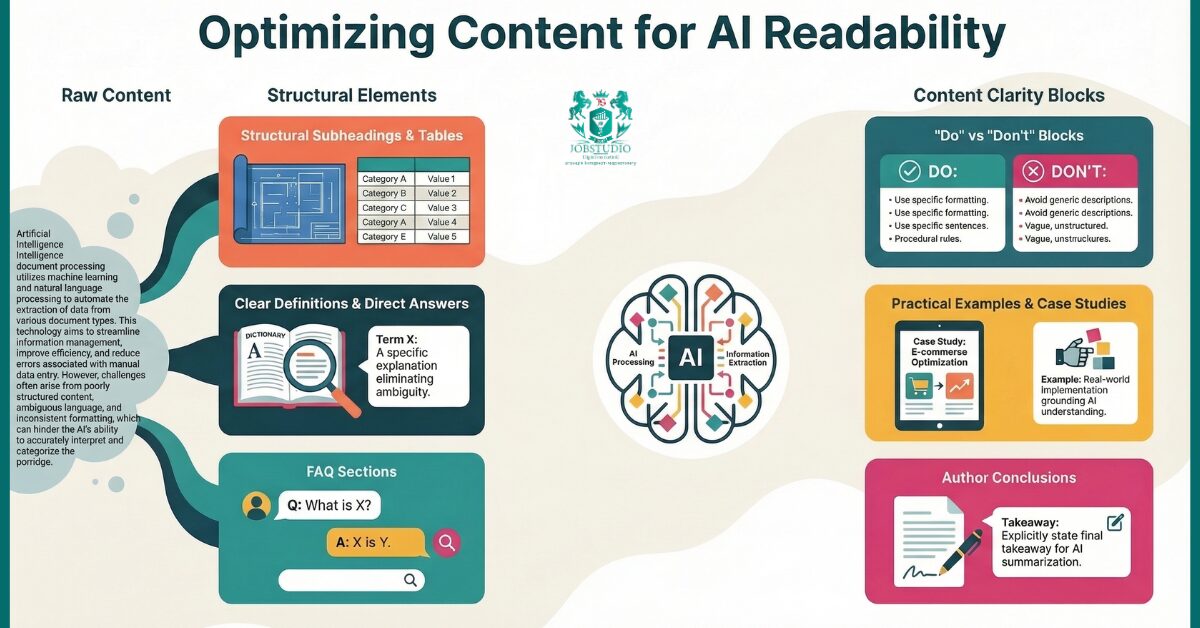
In practical terms, this means that AI finds it easier to work with pages that contain:
In other words, not a jumble of text, but a well-organized document.
There’s no need to invent a “secret AI schema.” Google explicitly states that there are no additional technical requirements or special schema.org markup required solely for AI Overviews or AI Mode. The page simply needs to be indexed, eligible for display in Search, and meet basic SEO requirements.
In other words, instead of chasing after the latest fad, it’s better to do the old but important things well:
That’s where the real change lies. It’s not that SEO is “dead,” but that search results are no longer just a list of blue links.
Google describes AI Overviews as a way to quickly convey the essence of a complex topic to users and provide links for further exploration. In January 2026, the company announced that Gemini 3 had become the new default model for AI Overviews globally, and that AI Overviews themselves now transition even more seamlessly into a conversational format.
For businesses, the implication is simple: some search queries will be resolved right on the SERP. This means there will be fewer clicks on weak and “average” articles. At the same time, however, the value of strong pages—which Google considers a reliable source for its answers—is increasing.
Google explicitly states that AI Mode is particularly useful for queries that require comparisons, reasoning, further research, or complex clarifications. The company also notes that users can ask nuanced questions that previously required several separate searches.
For SEO, this means a shift in user behavior. Previously, users would make 3–5 short queries. Now, they may start with a long-tail query or enter a series of follow-up searches without returning to the standard search results.
In other words, the pages that rank highest will be those that address not only the main query but also related subtopics.
“Zero-click” doesn’t mean that organic search results are no longer needed. It means that users see some of the answers before they even visit the website.
In this model, the way effectiveness is measured has changed. Now it’s important to look not only at clicks, but also at:
Google specifically notes that traffic from AI features in Search Console is included in the overall Performance data under the Web search type, and they consider clicks from AI Overviews to be of higher quality because users tend to spend more time on the site.
In other words, simply counting “how many clicks an article generated” is no longer enough. You need to look at what kind of traffic it is and where it leads.
How Businesses Can Maintain Their Visibility in Google’s New Search Results
The answer isn’t to “fight AI,” but to make web pages more useful than the market average.
Here’s how it works:
In our ElifeTravel case study, the key to success wasn’t a “single magic optimization” but rather a systematic approach: site architecture, hreflang tags, static SEO pages, micro-markup, handling 35,000 legacy URLs, semantic optimization for 79,000 search queries, and indexing monitoring. This is exactly what modern SEO looks like: not a trick, but a system.
Business owners often say, “We wrote great copy. Why aren’t we seeing growth?” Because great copy doesn’t always make up for a poor system.
If pages conflict with each other, if there is no clear hierarchy, and if neither users nor Google can tell what your main focus is, your site will struggle to grow.
Many articles “seem decent” but don’t address the actual need. They cover the topic broadly but don’t tackle the specific issue. And Google is getting better and better at sensing this difference.
A website may have a decent design and even decent traffic, but technically it could be a mess: duplicate content, unnecessary pages in the index, slow templates, overloaded scripts, SPA issues, broken redirects, and incorrect canonical tags. This is silent SEO sabotage.
If the page is fine, but the brand is unknown, nobody mentions it, the backlink profile is weak, and the site doesn’t demonstrate expertise—its growth potential will be limited.
Bad SEO thrives on chaos. Good SEO starts with order.
The first month isn’t about “quickly publishing 20 articles.” It’s a month of assessment.
Here you need to:
This is where the growth framework is formed.
In the second month, we gather semantic data, cluster it, distribute it across pages, develop a content plan, rewrite or create key pages, and optimize internal linking.
This is the point at which SEO stops being a technical fix and becomes a system for capturing demand.
In the third month, external signals are incorporated: backlinks, mentions, digital PR, and brand engagement. At the same time, analytics data stabilizes: Search Console, GA4, conversions, landing pages, and the quality of organic sessions.
And only then can you scale your content and clusters without worrying that the whole thing will collapse under its own weight.
There’s a myth that SEO and PPC are an “either/or” situation. In the real world, it’s almost always “both/and.”
SEO doesn’t work overnight. If your business needs leads right now, Google Ads is the quick fix.
While the website is still building visibility, advertising helps prevent months of lost time. But it’s important not to separate PPC from SEO. Advertising data can reveal which clusters convert better, which offers are effective, and which pages need to be optimized for organic search.
The best combination looks like this:
That’s exactly how we often work on projects where what matters isn’t fancy reporting, but rather tracking leads and sales.
It depends on the starting point. If the website is new, with no history, no structure, no backlink profile, and no proper semantics or a well-developed semantic core, the first noticeable results often don’t appear right away. If the site is already indexed, has some content, and at least minimal authority, growth may be faster. But in normal SEO practice, results shouldn’t be evaluated based on a single week or a “single keyword jump,” but rather after 3–6 months of systematic work. Especially in competitive niches. The worst thing you can do is expect an instant effect and then stop everything halfway through a month later. SEO yields results not simply because “we’re doing something,” but through the accumulation of properly executed actions.
It’s possible, but it’s important to be realistic about the limitations. A small budget doesn’t mean “SEO is impossible.” It means you’ll have to strictly prioritize your work. First, focus on technical aspects; then, target the most valuable commercial pages; and finally, focus on the strongest informational topics that can actually drive traffic.
When you’re working with a small budget, it’s especially risky to spread yourself too thin: writing 30 lackluster pieces, buying 50 random backlinks, and failing to address any bottlenecks. It’s better to do less, but do it right. Often, even a limited budget can yield good results if you focus not on “the entire site at once,” but on the pages and clusters where the money is most likely to be found.
That’s the wrong question. For a business, it’s more important to understand the objective than to pick a “favorite channel.” If you need quick results, advertising offers a short-term solution. If you need stable, scalable visibility over the long term, without SEO you’ll constantly have to pay for every click all over again.
The most effective approach is when SEO and Google Ads work together. PPC quickly tests offers, clusters, and user intent, while SEO gradually captures a portion of that demand in organic search results. This generates not only traffic but also control. In 2026, this is particularly important because some informational queries are directed to AI-powered search results, meaning you need not just a single channel of influence, but a system.
Yes, it works. But for a new website, it’s especially critical to lay the right foundation from the start. The biggest mistake is to build the site however it turns out at first and then “fix the SEO” later. As a result, you end up having to rework the structure, URLs, page logic, internal linking, and sometimes even the templates. A new website has the advantage that it doesn’t yet have years of technical clutter.
If you get the architecture, sitemap, technical indexing rules, meta tag templates, microdata, and content logic right from the start, the site can grow much more healthily than an “old but chaotic” resource. That’s why SEO for a new website isn’t something to consider after launch—it’s part of the preparation leading up to it.
There are several common symptoms. Pages take a long time to be indexed or are indexed sporadically. Rankings fluctuate for no apparent reason. Important URLs aren’t showing up in search results, but technical pages or junk parameters suddenly appear in Search Console. The site is slow on mobile, templates are overloaded with scripts, there are duplicates, broken redirects, and confusion with canonical tags or language versions.
Another red flag is when the content seems fine, but growth is still weak. This often means the problem isn’t with the “content” itself, but rather that the website is technically holding itself back. In such cases, you don’t need to “boost” SEO; you need to first eliminate internal obstacles.
AI can be helpful in your work, but it doesn’t replace valuable content on its own. It’s perfectly fine to use it as a tool to speed up drafting, structuring, brainstorming, making comparisons, or conducting supplementary research. However, simply churning out cookie-cutter texts without any real-world experience, examples, or added value will yield poor results.
Google doesn’t reduce the issue to “AI or no AI”; instead, it evaluates the quality, usefulness, and originality of content. Therefore, in 2026, the winner won’t be the one who generates pages faster, but the one who knows how to combine tools with real expertise. AI can speed up production, but it doesn’t automatically build trust. Trust is still built through experience, structure, facts, clarity, and practical value.
Yes, they are necessary. But not in the crude form they’re often sold in. Links remain a sign of authority, especially when it comes to competitive commercial topics, B2B, local services, or niches where there are established players with a track record. The problem isn’t with the links themselves, but with the desire to buy “something cheaper and in larger quantities.”
In 2026, a smaller but higher-quality profile works much better: mentions in the topic, posts, digital PR, partner content, and relevant sources. If a website has no external signals at all, it’s harder for it to build trust. But if the profile is artificial and cluttered, that’s not growth either—it’s dead weight. Links should reinforce the brand, not mask its weaknesses.
They change the click distribution, but they don’t eliminate organic traffic!
For simple informational queries, some users may indeed get a short answer right in the search results and not click through. This means that articles of low or average quality risk losing some of their traffic. But for high-quality pages, the situation isn’t so clear-cut. Google displays links in AI Overviews and explicitly states that these features are designed to help people discover a wider variety of websites and sources. Therefore, it’s now important not just to “write for informational traffic,” but to create pages that can serve as authoritative sources: with a clear structure, a straightforward answer, the author’s expertise, examples, and a natural user journey after landing on the site.
In 2026, it won’t be the website that’s just “done a little bit of everything” that comes out on top. The winner will be the one where SEO is implemented as a cohesive system: technique, structure, content, authority, analytics, and adaptation to new AI-driven search results. No magic. Just facts.
.webp)