Get a responsible approach in promoting your project.
Contact us now!
Contact us now!




If you are reading this text right now, it means you have a question. Perhaps even a slightly painful one: who to choose for SEO so that it is not just a formality, but actually brings in money.
And here, you know, the most interesting thing is not even that there are three options—freelancer, full-time specialist, or team/agency. The most interesting thing is something else: almost every business has tried SEO at least once with the idea of “well, we’ll quickly improve the website,” but ended up with the feeling that “something isn’t working right.”
Table of Contents
In such situations, Iryna Kissa, CEO of JobStudio, says something simple that somehow reassures many people: SEO is not magic or a lottery. It is a system. And a system is either put together or it falls apart.

You have to admit, it sounds logical. Because when SEO is done by one person, they may be a good specialist, but they still have to choose: today, technical or content? Semantics or analytics? Links or UX? And it is precisely these “choices” that very often become the reason why the result is slower than you would like.
But the team does things differently: it doesn’t choose “either/or,” it just does both at the same time. And that’s why profits come faster — not because someone is “more magical,” but because in business, speed almost always comes from the process.
Okay, let’s not get too carried away. Let’s break down why this is happening and how you can make the right choice.

Imagine a conversation I’ve heard hundreds of times. The owner or marketer opens the analytics, sighs, and says, “We need twice as much
traffic. Preferably within a month.”
Sounds reasonable, right? And, to be honest, no one is to blame for thinking that way. Advertising has spoiled us. With PPC, you can just hit the gas: raise your budget, tweak your bids, and tomorrow you’ll have more traffic.
But SEO works differently. It’s probably most like going to the gym. You might want abs in a week, but your body has its own rules. And so does Google.
Iryna Kissa likes to repeat a phrase that sounds like a joke, but contains half the truth: “Google is not obligated to love your website.” It doesn’t care that you have deadlines, sales plans, seasons, or that the owner is tired of waiting. It compares, evaluates, and ranks. If a website is technically weak or does not meet demand, it will simply give way to a competitor. Calmly. Without emotion.
By the way, here’s another trap that often happens: “more traffic” does not equal “more money.” Because the traffic may be “wrong.” You can bring thousands of readers to an article on “how to choose something,” but sales will not move if the landing pages do not convert.
So, the first thing to do is to slow down a little and ask yourself honestly: what result do we want? Traffic? Applications? Sales? Reputation? Displacement of competitors? Otherwise, you will run fast, but not in the right direction.
There is a myth that SEO is all about “keywords.” And if you “insert keywords,” Google will start sending you customers.
Unfortunately, this has not been the case for a long time. And fortunately so, because imagine the chaos that would ensue in search if everything were decided by “correct keys.”
SEO today is more like running a store. You need everything to work: the technical side, the structure, the content, the usability, the measurement of results, and external trust signals.
Iryna Kissa puts it in the most human terms possible: “SEO is when you fix not just one thing, but the whole mechanism.”
The mechanism either comes together quickly—if there is a team—or “creaks” for months if everything rests on one shoulder.
An important point for 2026: changes in search results must be taken into account at the start of promotion and included in the work plan (structure, content, analytics, page priorities). These changes are related to the fact that search engines are increasingly integrating AI responses/reviews, expanded blocks (FAQ, PAA, videos, maps, shopping), as well as “zero click” — when the user receives part of the answer directly in the results without going to the website.

You know, one strong specialist can sometimes really work wonders. But there is a limit. And it is obvious: there are only 24 hours in a day.
One specialist can conduct an audit, collect semantics, write meta tags, prepare technical specifications, and check links. But when you need to increase speed, improve structure, implement analytics, sort out multilingualism, do interlinking, strengthen links, and also track SERP movement at the same time, that’s when the “dead zones” begin.
Not because the person is bad. But because it is impossible to be a techie, content strategist, link builder, UX designer, and analyst all at once.
The team covers these “dead zones.” If one person misses something, another picks up on it. If something is risky, there is someone to consult with. If a quick fix is needed, there is someone to do it. And this, without a doubt, is one of the key reasons why the pace is faster.

This is not “philosophy.” This is practice. Irina Kissa has said more than once that half of the problems with SEO arise not because of the contractor, but because the business did not decide on the basics at the start. So, here are these five questions — as insurance against chaos.
Do you have a ten-page website or an online store with thousands of products? Are there filters, categories, multilingualism? Are you planning to expand?
Because a large resource always means a stream of tasks. And if you “fix one thing” today, something else will come up tomorrow. There is no such thing as “done and forgotten.” Either there is a process, or everything falls apart.
As Irina says, a large website without an SEO system is like a warehouse without accounting. It seems like everything is there, but it’s impossible to find anything.
Competition is a tricky thing. It depends not only on the niche, but also on geography.
Grooming in a small town and grooming in Kyiv are two different leagues. Renovating apartments in the suburbs and in the center of the capital are also two different leagues.
And this is where the team often “pulls ahead” with the speed and “breadth” of its work. Because when competition is high, you can’t afford to work slowly. You’ll simply be left behind.
Unfortunately, the budget is not an “uncomfortable topic,” but a reality.
SEO requires resources. Not always huge, but stable. Because if the budget does not cover at least the basics — technical adjustments, content, tools, external reinforcement — the process becomes an imitation.
Our CEO once said something that stuck with me: “When the budget is small, SEO doesn’t become cheap — it becomes long.”
This is where many people fall short. Because the goal sounds like “we want SEO.”
What exactly do you want? More applications? Cheaper leads? To oust your competitors? To increase trust? To enter a new region?
SEO is a tool. And a tool must work for a specific task. Otherwise, you will get bogged down in “doing something just for the sake of it.”
Very different scenarios.
If SEO is your primary channel, you need a steady pace and systematic work. If it is secondary, you can start smaller.
But even when SEO is not the main channel, the team often brings in profits faster because it quickly closes the “gaps” that block growth.

High competition is when “being good” is no longer enough. You have to be the best in several areas at once: speed, structure, content, trust, UX, external signals.
It is almost impossible for one specialist to do this without help. Because while he is working on one area, competitors are catching up in others.
A team provides the most valuable thing: parallelism and quality control. It seems like a small thing, but that is what gives competitors an advantage.
Online stores and portals are constantly undergoing “perpetual renovation.”
New categories are added. Products run out. Seasonal pages appear. The filter structure changes. Redesign can “kill” SEO if it is not controlled. And technical pages are sometimes accidentally opened for indexing — and hello, junk in search results.
The team here works like a control room: it keeps the system from falling apart.
Yes, there are cases when the “base” is sufficient. Especially if the niche is narrow, competition is low, and the site is small.
But even there, the team often gets results faster — simply because everything is done in weeks rather than months. And when you need to “push” a website, speed matters.
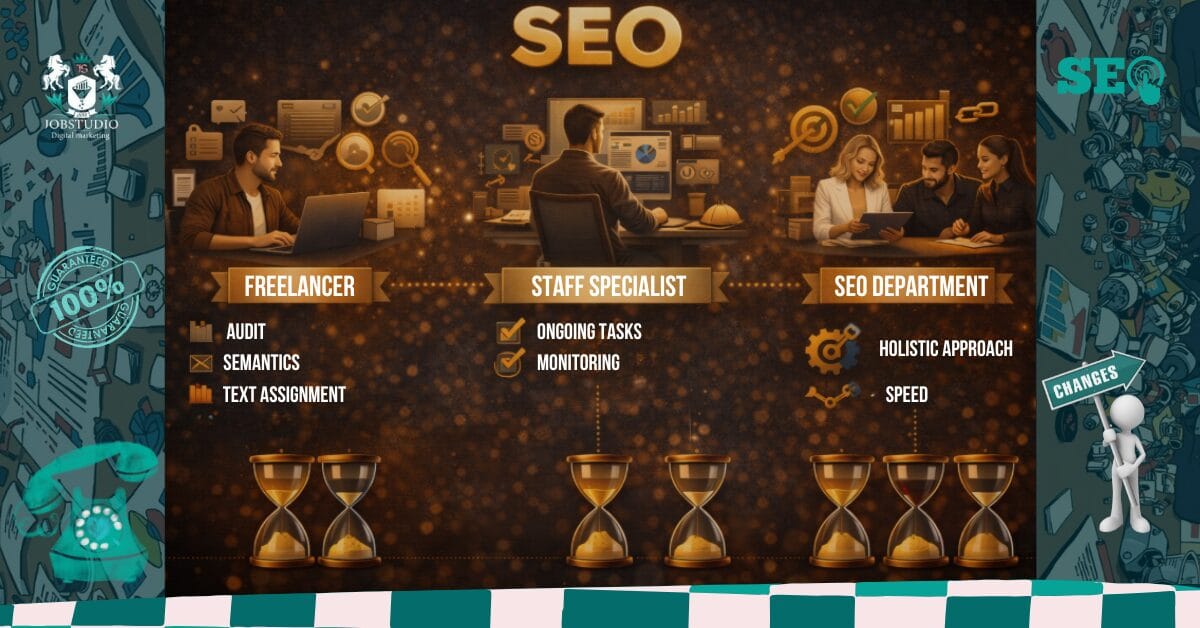
Freelancers are a good option when you need to complete a specific task.
For example, conducting an audit, compiling a semantic core, preparing technical specifications for texts, and checking for technical errors. Freelancers often get started quickly and respond quickly, which is convenient.
The JobStudio team, by the way, has a positive attitude toward freelancers — they just clearly distinguish where it works and where it doesn’t. Because “freelancer” is a format, not a sentence.
Most often, freelancers don’t make quick profits not because they are weak, but because there is no system around them.
He did an audit — and you need someone to implement the changes. He wrote the technical specifications — and you need someone to write the content. He said the site is slow — and you need someone to fix it.
And if you gather people together for each specific task, delays will start to occur. Someone is busy. Someone did something wrong. Someone disappeared. Someone burned out.
We call this the “patchwork effect”: when you seem to be constantly doing something, but there is no big picture.
Full-time SEO is a powerful format if you have a large website and a constant stream of tasks.
The staff member is immersed in the product. They quickly approve edits. They see the processes from the inside. They are available during working hours and can take on tasks immediately.
If you are ready to build an internal SEO department, this can be very powerful.
But staff are not “just hired.”
It’s time for searching. It’s adaptation. It’s a workplace. It’s taxes. It’s the risk of downtime due to vacation or illness. Ultimately, it’s a story about how one person cannot cover the entire range of tasks.
You will still need a developer, designer, copywriter, and analyst. And if you don’t have them, you will again encounter bottlenecks.
A command is when you have immediate access to a function.
JobStudio employs PPC specialists (Middle/Senior), SEO optimizers and link builders (Middle/Senior), SEO/PPC manager, PHP programmer and tester, content manager/copywriter, graphic designer, UX/UI designer, and account manager.
And you know, the most valuable thing here is not even the “list of positions.” The most valuable thing is that these are people who are used to working together. They are not coming together for the “first time” on your project. They don’t spend a month agreeing on who is responsible for what. They get started — and you can feel it right away.
There is also a nuance that our manager always emphasizes without embellishment: a team can often replace a single super-expensive top specialist whom the business either cannot find or simply cannot afford. And this sounds pragmatic, not just “for the sake of pretty words.”
And here it is appropriate to say one more thing that customers like to hear, because it is about trust.
At JobStudio, we have worked with various niches — from financial aggregators, legal services, and car pawn projects to cosmetics, confectionery, industrial equipment, jewelry, B2B, building materials, grooming, and even cryptocurrency topics. This is not to “brag,” but rather to show that the team is used to adapting. Plus geography. We have promoted projects in Ukraine, Georgia, the Philippines, Vietnam, and the US. In some places, local SEO is important, in others — competition in the international market, and in others — a different language and user behavior. And what’s interesting is that the principle of the system is the same everywhere, just with different emphases.
Yes, the team has its drawbacks. It would be strange if it didn’t.
Communication sometimes goes through a manager, which may seem slower than chatting directly with a freelancer. Some tasks are put on hold because the team is working on several projects at the same time. And sometimes the business wants something “right now,” but the processes require coordination.
But practice shows that this can be remedied with discipline. A weekly plan, priorities, short status updates, and a transparent list of tasks ensure that the team does not “slow down” but moves the project forward steadily.
Here, it is important to emphasize the team’s “work style.” Because it’s also about speed. Iryna Kissa sometimes jokes that the morning at JobStudio begins not with coffee, but with a review of the previous day’s results. It sounds mundane, but that’s exactly what the system is. We are in touch from 9 a.m. to 7 p.m., we formulate questions properly, set priorities, and are not afraid to test hypotheses and try out what might work. In short, “our everything” is cause-and-effect relationships and completing tasks on time. It’s not romantic. It’s routine, but it’s powerful work.
Here is the heart of the matter.
One person works sequentially: audit, semantics, technical specifications, edits, content, links. And everything drags on.
The team works in parallel. While the SEO specialist structures pages according to demand, the programmer cleans up technical errors. While the content manager prepares materials, the designer tweaks elements that influence behavior. While analytics is being set up, the link builder strengthens authority.
Hence the speed.
SEO mistakes often cost months. And the worst thing is that sometimes they are not immediately visible.
Incorrect filter structure can create thousands of junk pages. Incorrect canonical — “paste” weight in the wrong place. Duplicates — blur relevance. Poor interlinking — drive important pages into the shadows.
The team reduces the risk of such issues. Because decisions are not made by one person alone. There is a second pair of eyes, there is control, there is discussion. And that really saves time.
Unfortunately, anything can happen in freelancing. A person may disappear. They may get sick. They may simply burn out. There are
risks with full-time employees too: vacation, sick leave, dismissal.
The team keeps up the pace. It doesn’t stop completely, even if someone drops out. And in SEO, pace is half the battle.
There are things that can be done quickly and yield tangible results.
For example, tidy up the technical side of things: remove duplicates, configure the sitemap and robots, create normal URLs, correct meta tags, clean up pages that should not be in the index, and improve speed.
This was exactly the case with V.O.G DOG. The website was young — about a year and a half old — and there was chaos “under the hood”: URLs were sometimes in English, sometimes in transliteration, meta tags were almost non-existent, there were only four links, and the structure was chaotic. We cleaned things up, localized it for Kyiv, launched content based on real queries, added catalogs, and connected behavioral analysis through Microsoft Clarity.
The result? In two months, traffic increased by 281%. The share of queries in the TOP 10 jumped from 10% to 82.5%. And activity on the site increased by another 25.5%. This is no longer just “nice.” This is a business effect.
This is one of the strongest reasons — and at the same time the most underestimated.
The team eliminates “dead zones” because decisions are reviewed, tasks are not left unchecked, risks are highlighted immediately, and someone always asks, “Is this really the right thing to do?”
The CEO of JobStudio often says: it’s better to spend a day on verification than a month on rollback. And it’s hard to argue with that.
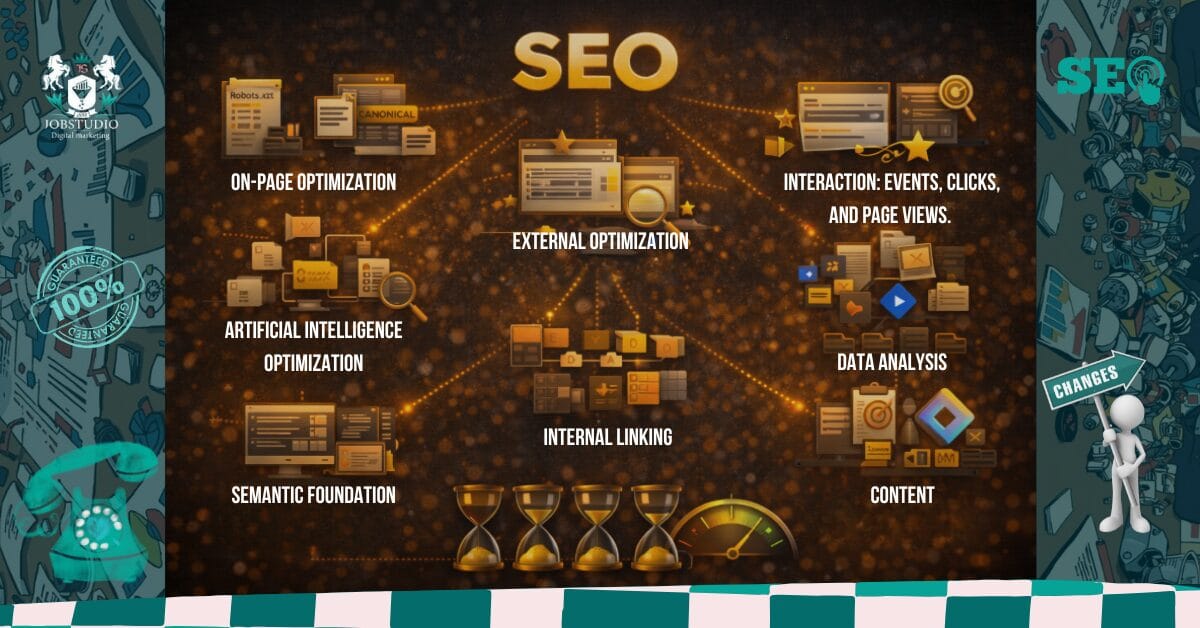
It’s a base that doesn’t seem to “sell,” but without it, nothing sells.
When duplicates get into the index, when the sitemap is incorrect, when robots block important content or open unnecessary content, when canonical is set randomly — Google wastes its resources. And then you wonder why your website isn’t growing.
Semantics is not just about “collecting keywords.” It’s about understanding what people are looking for and how they phrase it.
For grooming in Kyiv, it wasn’t abstract “grooming services” that worked, but live queries such as “first Yorkie haircut” or “Maltese haircut.” People search the way they speak. And if your website responds in live language, it will get attention.
Meta tags are your “shop window” in search results. If they are weak, even good positions may not generate clicks.
That’s why our team doesn’t just “write” them, but thinks them through: query, intent, promise, trigger, logic.
Reorganization is about managing attention and weight. Without it, a website often looks like a warehouse without navigation.
Multilingualism is either done right, or it’s painful.
The ElifeTravel case is a perfect example. A large international tour aggregator on Laravel, 8 languages. The task was not to “promote the finished product,” but to build SEO into the development so that the site would not go into the “sandbox” at the start.
There were many technical nuances: the /location structure, static filter pages /sr/ instead of chaos with GET parameters, hreflang, Laravel surprises with the URL register. And also — 35,000 old URLs that required page-by-page 301 redirects so as not to lose weight.
Speed isn’t just about comfort. It’s about competitiveness.
If a website is slow, people close the tab. Google sees this. Conversion rates drop. SEO slows down. PPC becomes more expensive. Everything is connected, no matter how much we want to separate it.
Behavioral metrics can be viewed in great detail.
At V.O.G DOG, we connected Microsoft Clarity and observed where people were getting stuck, where they didn’t understand what to click, and what they were missing. Then we adjusted the structure, and it resulted in a 25.5% increase in activity.
SEO without measurement is a matter of faith. And businesses need facts.
That’s why the team sets up GTM and GA4, defines goals, maps events, segments traffic, and sees what works.
A link is not “buy a pack.” It’s rhythm and quality.
The team does this carefully: without sudden movements, with control over indexation and donors. Because one careless step can cost trust.
Manual selection takes longer, but is more reliable.
V.O.G DOG added salons to 28 local directories and posted materials on high-quality resources. This boosted local SEO.
To outperform strong competitors, you need to know their strengths.
The team analyzes where they get their links, what their pace is, what anchors they use, and what donors work in the niche. This saves time and money.
Links may drop out of the index. Donors may disappear. Constant monitoring is required.
SEO without analytics is like driving at night without headlights. You seem to be moving, but where exactly — that’s not certain.
Iryna Kissa often says, “If we can’t measure it, we can’t control it.”
And that’s one of the reasons why the team delivers results faster. Because the team doesn’t just “do SEO.” The team drives growth.
The biggest illusion is that “positions have grown once and will remain unchanged.”
The issue moves every day. Blocks change. Maps, videos, and questions and answers are added. Competitors slip in new pages.
That’s why we look not only at the place, but also at the snippet, SERP structure, URL changes, and title. Because sometimes one “small” mistake in CMS creates a problem that then quietly eats away at visibility.
Let me be clear: many people only look at “traffic.” And then they are genuinely surprised: “Why is there no more money?”
Because it’s not just how many people came that matters. What matters is where they went, what they did, and whether there was any logic to it.
That’s why we look at entry points, behavior, and segments. And that’s why we use tools like Microsoft Clarity, heat maps, scrolls, and clicks. These aren’t “toys.” They’re a way to understand where the site is losing money.
Technique is not a “one-time thing at the start.”
The website is changing. Developers are releasing updates. The content manager is adding pages. Someone has connected a module. And suddenly — bang — pages have disappeared from the index or errors have started popping up.
The team treats it as a routine. Like hygiene.
Businesses are not interested in hearing “we optimized canonical.” Businesses are interested in what it achieved.
Therefore, reporting is not just a checkbox. It is a way to speak the language of the owner: applications, calls, orders, conversions, traffic share, top share.
We always follow simple logic here: less water — more sense. Because if reports turn into essays, no one reads them. And if they are short, honest, and tied to money — then they are useful.
And here it is important to add one more thing that customers often underestimate. The team usually covers not only SEO “in a vacuum.” It covers the entire marketing ecosystem around growth.
For example, if you need to quickly boost sales, we connect and optimize contextual advertising (Google Ads, Google Shopping), clean up “floods,” set up the right audiences, and track real conversions. If there is a problem with fraud, we fight it. If the business works through CPA systems or affiliate programs, we analyze their effectiveness and prevent traffic from turning into meaningless statistics.
By the way, we often start with an audit of current contractors’ advertising (SEO/PPC) to immediately understand where the budget is going. We also connect end-to-end analytics, call tracking, perform A/B or split testing, check usability, and strengthen landing pages. Sometimes the honest truth is that the website seems to be “at the top,” but it doesn’t sell. And then, without conversion landing pages, without UX adjustments, without tests — even if you rewrite the texts a hundred times, the effect will be weak.
In short, a team is not just an “outsourced SEO and marketing department.” It is a set of processes that bring together everything that affects money.
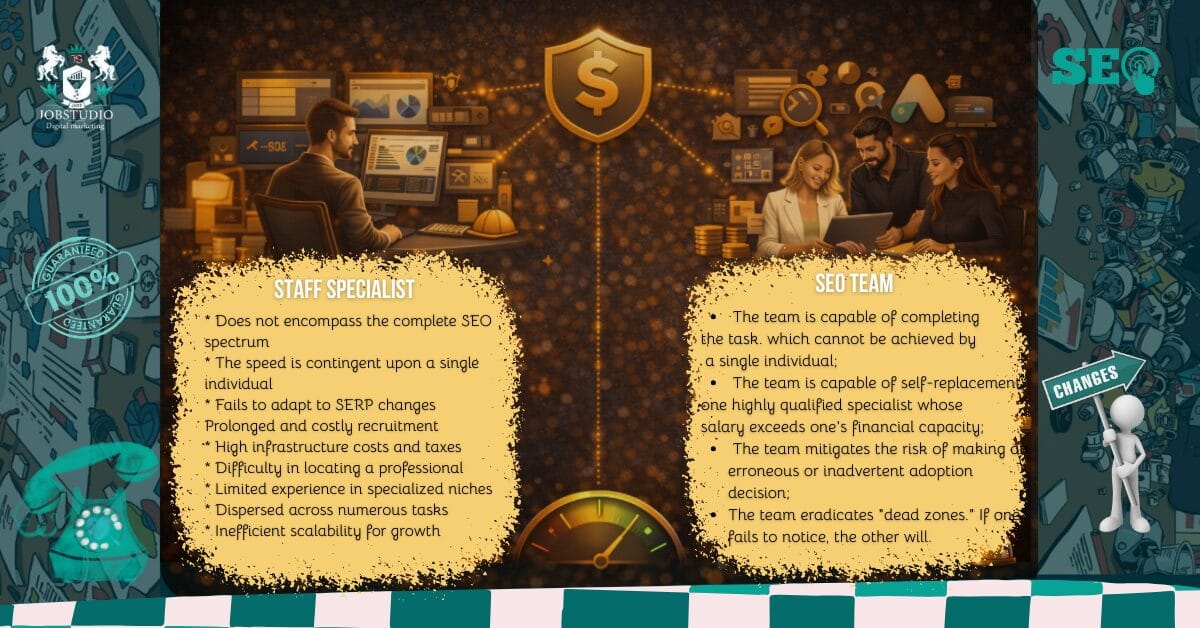
There is one thing that businesses often don’t like to count. Not because they don’t know how, but because… it’s unpleasant. When you hire someone, it seems like you’re “only paying their salary.” But then you start adding up the real costs, and it’s not so fun anymore.
A full-time employee is not just a salary. It’s a computer. A desk. Rent or office space. Electricity, internet, telephone, basic subscriptions, management costs.
The team takes care of this part. You pay for the work and the result, not for the infrastructure.
You hired an SEO specialist. He’s great. But he needs a developer, copywriter, designer, analyst, and sometimes a PPC specialist.
And you start “selecting” people. Then coordinating. Then resolving conflicts. Then meeting deadlines.
The team closes it with a single decision. And that speeds up the process.
Taking time off due to illness, vacation, or dismissal is painful.
And SEO doesn’t like breaks. It’s like training. If you stop, you’ll fall behind.
The team prevents this from happening.
One person can be just as confident in being wrong as in being right.
The team reduces the risk of wrong decisions because there is always someone to ask: “Are you sure that’s the right thing to do?”
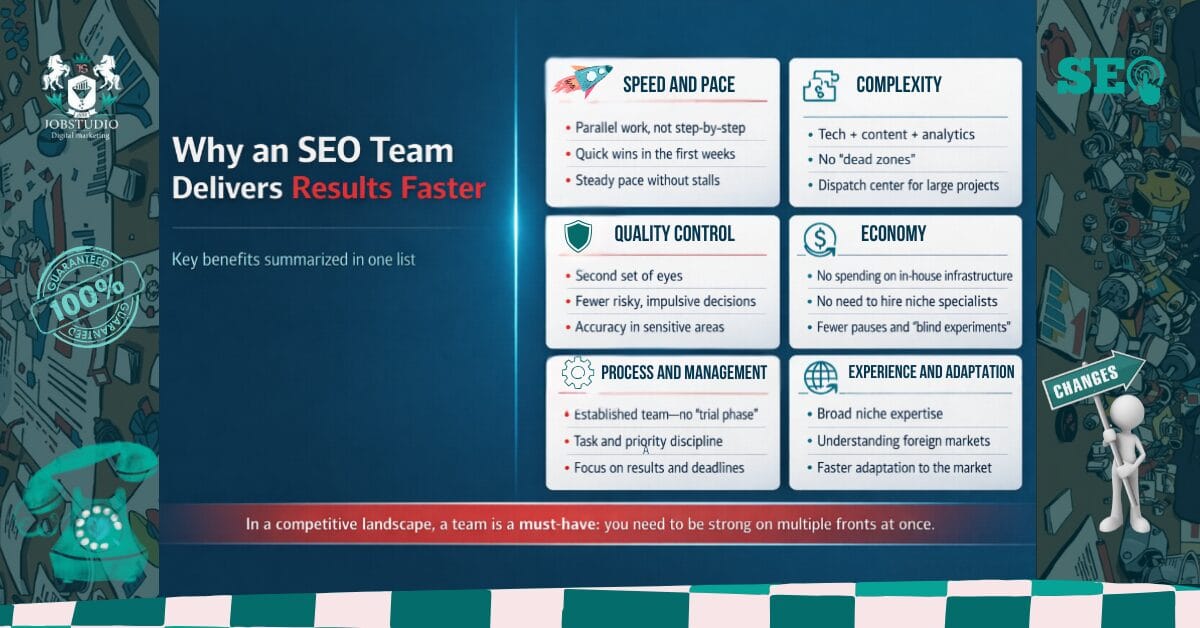
If you have a small website and just need to tidy things up, a freelancer may be the ideal solution.
If the website is updated daily—new pages, new products, new promotions—then hiring a full-time specialist becomes a logical decision.
But it’s important not to fall into the trap of thinking that a full-time SEO specialist can replace a team if you want to make a breakthrough.
When you need to grow rather than “maintain,” a team is the shortest route.
Consider the case of a B2B jewelry company. It wasn’t about “let’s optimize a little.” It was about stopping wasting the budget on retail and starting to attract real wholesalers.
We found 18 critical errors, cleaned up the semantics (3,779 queries), cut out retail noise, optimized impressions by time of day — and saved about 20% of the budget. And the result after 5 months? 41,800 clicks, 237 conversions, and 101 wholesale partner registrations.
First, if competition is high and your budget is limited, you need a very strong freelancer and realistic expectations.
Secondly, if the budget is adequate and the website is “old and tired,” the team will win because it will cover the whole picture, not just a piece of it.
Thirdly, if the website is simple and the queries are low-competitive, you can start with basic optimization.
When someone tells you, “We guarantee top 10,” it’s either manipulation or incompetence.
You can guarantee the process, transparency, and scope of work. But not the “place.”
Iryna Kissa usually puts it this way: we don’t sell fairy tales, we build a system that grows.
A good contractor does not start with “we will now write the content.”
He asks: what is conversion, what is marginal, which region is important, is there seasonality, is analytics connected, what works, what doesn’t.
Because without it, SEO is like shooting in the dark.
Magical SEO is “let’s buy links and we’ll be at the top.”
A growth system is when someone explains the logic to you: what we do, why we do it, how we measure it, and how we adjust it.

Speed in SEO is not about “secret techniques.” It’s about eliminating bottlenecks.
One specialist is a bottleneck, even if they are exceptional.
A team is a stream. And that is obviously why a team is more profitable.
It doesn’t really matter who does SEO: an employee, a freelancer, or an agency.
It is important when it will pay off and what price you will pay in terms of time.
Consider SEO as an investment. SEO is an asset that can work for years.
If you really want results, start with diagnostics.
Evaluate the website. Identify bottlenecks. Develop a 30/60/90-day plan.
Then SEO ceases to be a “dark room” and becomes a manageable process.

The first effects can probably be seen in the first few weeks — especially after technical adjustments and index normalization. But stable growth usually takes several months. SEO gains momentum.
Maybe. But Google evaluates new sites with caution. Therefore, the focus should be on technical purity, correct structure, local relevance, and content that responds to people’s queries.
In the V.O.G DOG case, the website was new, but systematic work yielded strong results in a short period of time.
Because the team works in parallel. While one person is working on technical corrections, another is preparing the structure, a third is working on content, and a fourth is working on analytics.
At first glance, yes. But if you need to hire an additional developer, designer, and copywriter, the total cost and time may end up being greater than working with a team.
It depends on the scale. If the site requires daily updates and quick internal approvals, staff will be useful. But you still need a team if you want growth without “dead zones.”
Without a doubt, yes. PPC provides quick traffic, while SEO provides long-term stability.
In a B2B case study involving a jewelry company, advertising optimization not only resulted in budget savings, but also led to 101 wholesale partner registrations — which is very telling.
Pay attention to the questions they ask. If they only talk to you about “trends” and don’t ask about your business, goals, conversions, or analytics, that’s a bad sign.
A competent contractor begins with diagnostics.
No. And if someone promises you that, forgive them, but it’s more like marketing than real responsibility.
In SEO, you can guarantee the work, the process, control, and transparency, but not the “place.”
It is important to incorporate SEO into the development process.
In the ElifeTravel case, we were working on the project when the website was only about one-third complete. We submitted over 30 technical specifications, configured multilingual support, URL structure, redirects, and analytics to ensure that the project would launch “index-ready” rather than “problem-ready.”
.webp)