Imagine: you open a chat and see a message from a client: “We have ordered an independent audit of your advertising/SEO work from a third-party studio.” The first reaction is the same for many: “That’s it, now they’ll find ‘horrors’, the client will leave, the account will be ‘twisted’ — and goodbye.”
Table of Contents
But wait a minute. An independent audit is not a verdict. It is a tool. And it can either strengthen the project or become a theater of the absurd with 80% of Google’s recommendations. The difference lies in the rules of the game.
The main thing is not to take it as an attack. “Account verification” is normal: in mature projects, quality control becomes a regular practice. An independent audit is not a “verdict” but a way to find areas for growth, ensure the quality of processes, and eliminate unjustified expenses.
What is an independent PPC/SEO audit and what it is NOT
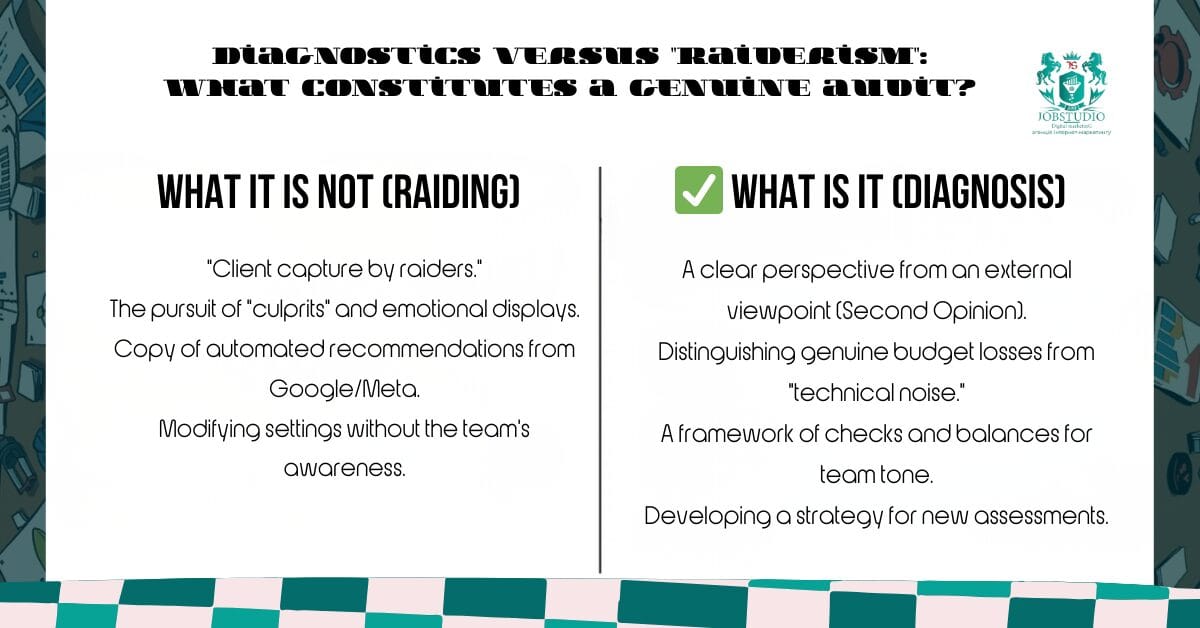
Let’s be honest: in the market, an audit is often a weapon for “raiding” a client. A new contractor comes not to help, but to stir things up, find a hundred minor mistakes, and present them as a catastrophic drain on the budget. This is emotional manipulation, where every comma is turned into a “fatal mistake” just to lure you over to their side.
A true independent PPC/SEO audit is of a completely different nature. It is not hysterics about “everything is lost,” but a sober view from the outside that helps:
Separate real losses from technical noise: Distinguish minor flaws that do not affect the outcome (or are part of the current strategy) from real holes where money is leaking.
Create a system of checks and balances: Give your current contractor an incentive to stay on their toes, knowing that the numbers are being checked impartially.
Build a roadmap of tests: Find not the “culprits,” but new growth points that may have been obscured by the daily routine.
We are in favor of fact-checking, not emotional shows. Would you like me to elaborate on this approach in a full-length post for your audience, while maintaining the same “Netflix-style” drive?
Trust your business development to certified professionals!
And what it is not: Let’s get this straight right away. A real debriefing is not:
did not “turn on the checklist and come to a conclusion in an hour”;
not “copy-paste Google/Meta recommendations + the phrase ‘this will have a significant impact'”;
did not “log into your account and start changing settings without your knowledge.”
If an audit begins with “give me editing access,” it is no longer an audit, but a risk.
Why clients order audits (healthy reasons)
An audit is not a confirmation of “suspicions” or the professional incompetence of your specialist. It is a standard procedure for checking the effectiveness of capital use. It is not a conflict. It is pragmatism.
Typical triggers:
there is traffic, but no sales, or CPA/ROAS is unsatisfactory;
growth has stalled: “everything seems fine,” but without any breakthroughs;
preparation for budget scaling: they want to double-check the basis;
replacement of the marketing specialist who kept track of all traffic sources;
Need for transparency: the client does not understand what is being done and why.
The most insidious case is when “everyone is satisfied.” This is the trap of stability. The project is working, growing slightly… and gradually losing opportunities.
The psychology of the process: how to approach it correctly as a contractor
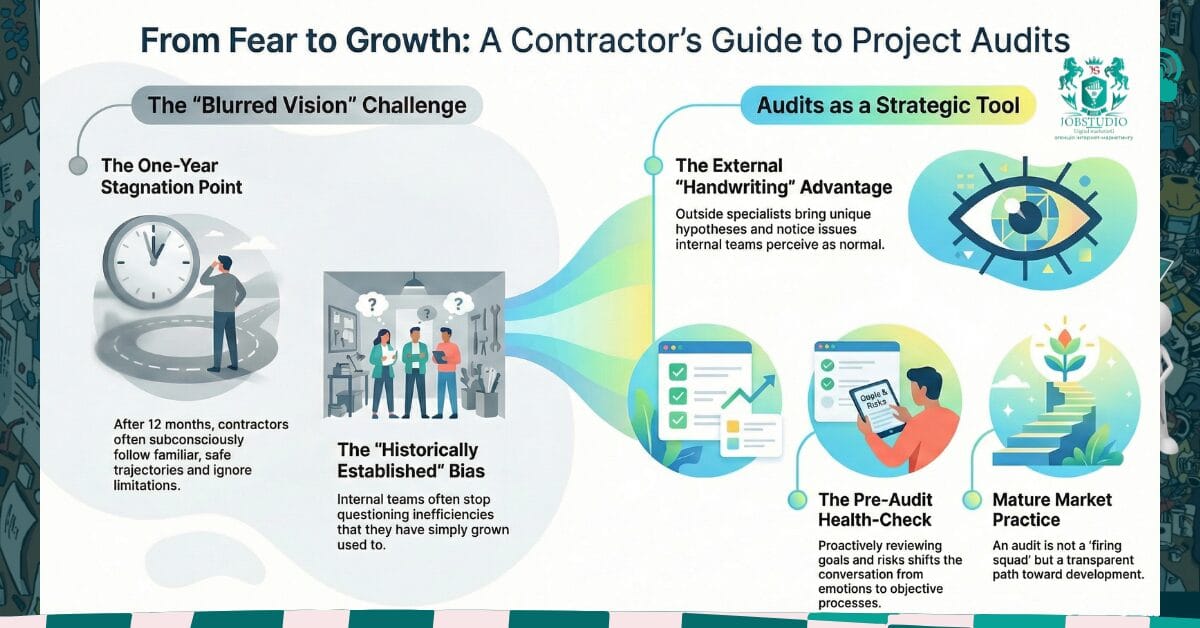
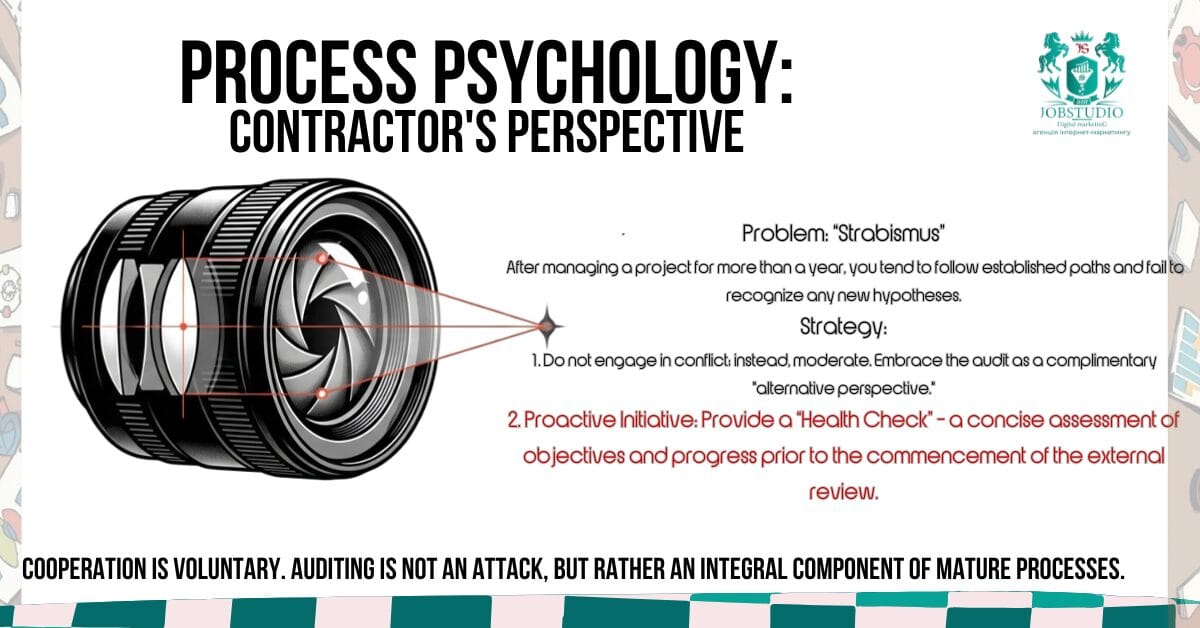
My approach is simple: I am not afraid of audits; audits are necessary. When you have been working on a project for a long time (more than a year is a long time), you become blind to certain things: you see the system from the inside, you know all the limitations, you have already made dozens of decisions, and you subconsciously follow familiar paths.
Stop “draining” your budget, call in the experts!
.
And an external specialist:
has a different “style,”
otherwise forms hypotheses,
notice things that you have long accepted as “the way things have always been.”
A separate useful tactic, if the client has given advance notice: offer a “pre-audit” (health check) — a brief review of goals/tracking/risks and a list of current tests. This relieves tension and shifts the conversation from emotions to process.
It is worth remembering that performance reviews are standard market practice. The results of an audit can serve as a basis for improving the current strategy or, conversely, as a signal to terminate cooperation. In any case, it is a transparent process aimed at developing the project, not looking for reasons to blame. Sometimes the client leaves. Sometimes you stop working with the client. This is normal. An audit is not a “shooting,” but part of mature processes.
The pros of independent auditing: real benefits for clients and contractors
For the customer
objectivity and cost control, of course, we are talking about a decent auditor who does not aim to acquire a new client;
understanding where exactly the budget is being spent / what is blocking growth;
roadmap (priorities, quick wins, hypotheses).
For the contractor
free “competitive insight” and new ideas;
quality control of team processes;
Arguments for the client: why it was set up this way, what was tested, why “trendy” things were not done.
Audits are only expensive if you perceive them as a threat. In that case, you are paying not for analytics, but for your own indecision, continuing to ignore hidden budget losses. But auditing becomes an extremely profitable tool if you look at it pragmatically: as a source of new hypotheses and a list of specific steps for scaling. It is not an expense for verification — it is an investment in eliminating errors that take away part of your profit every day.
Cons and risks: what could go wrong
Here’s what really spoils the process:
Incompetent auditor → “water” and superficial advice without figures and logic.
Conflict of interest: audit as another agency’s “selling hook.”
Manipulation: “this will have a significant impact,” but without cause-and-effect relationships and priorities.
The risk of damaging settings if editing access is granted (or “tested” in combat campaigns).
Breach of confidentiality: screenshots/cases with project identification, public discussion of figures.
If an audit is “useful” but leaves the account in the red, it was not an audit but an intervention.
Rules for safe auditing (must-have)
Here are the must-haves that are worth mentioning right away:
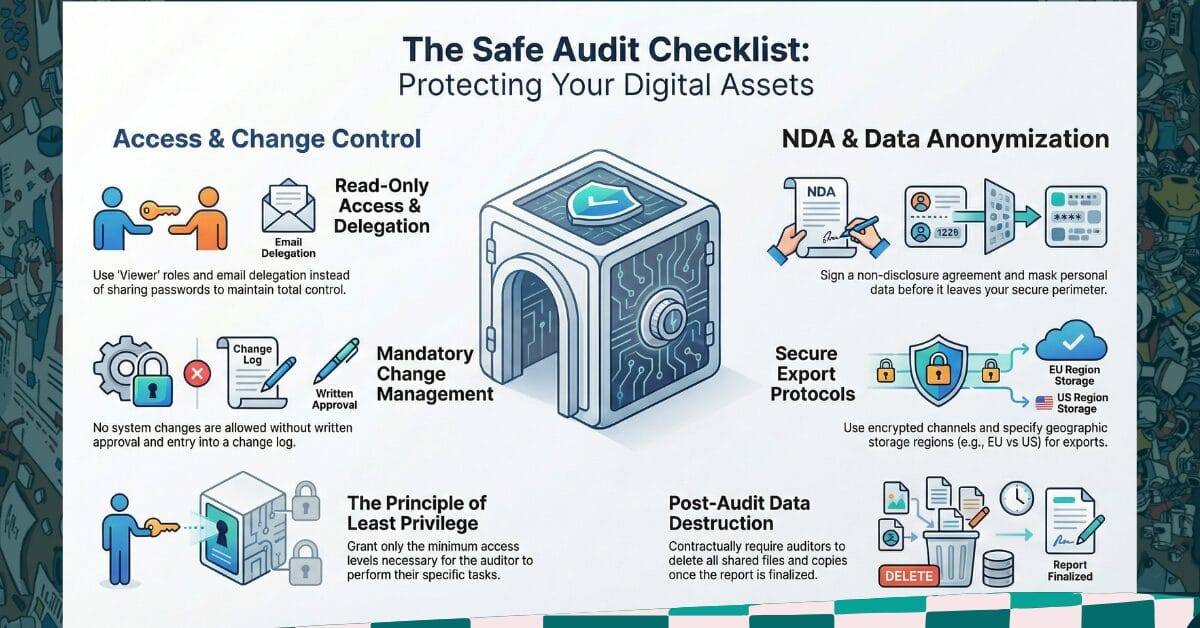
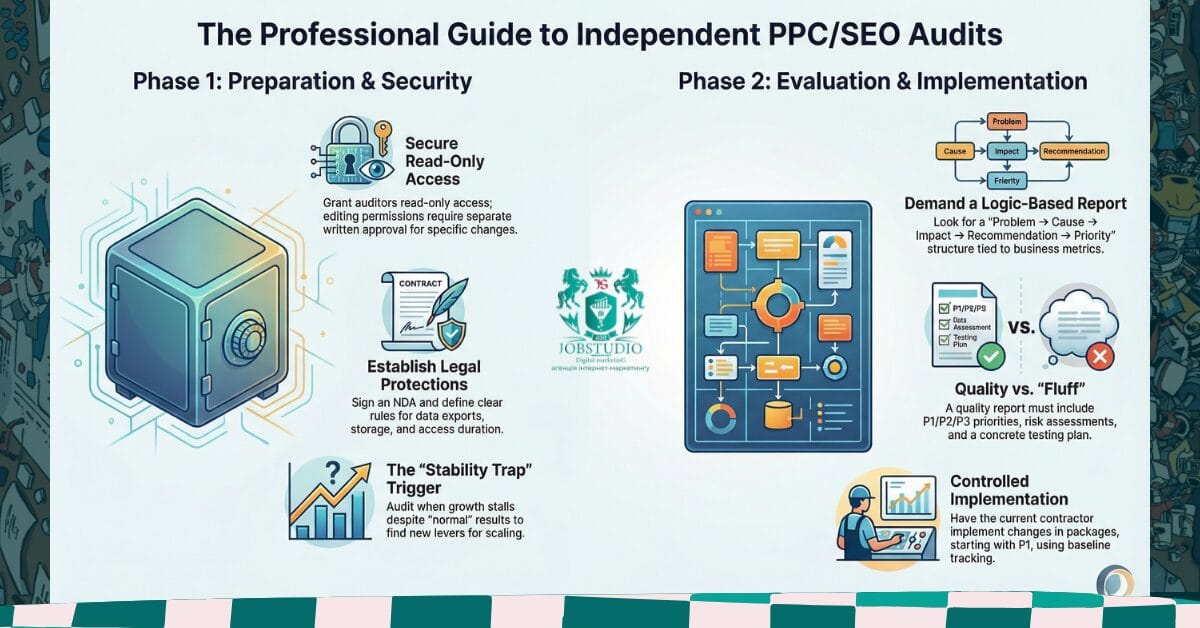
Read-only access.
No changes are permitted without written consent. All aspects are recorded in the contract.
NDA / confidentiality. No publication of data or screenshots with identifying information.
Agreed format of results. What exactly should be included in the report and how we assess the quality of the audit.
Additionally, something that is often overlooked: not only access, but also data. If the auditor requests exports from Ads/GA4/GSC, agree on where the files will be sent, who will have access to them, and how long they will be stored.
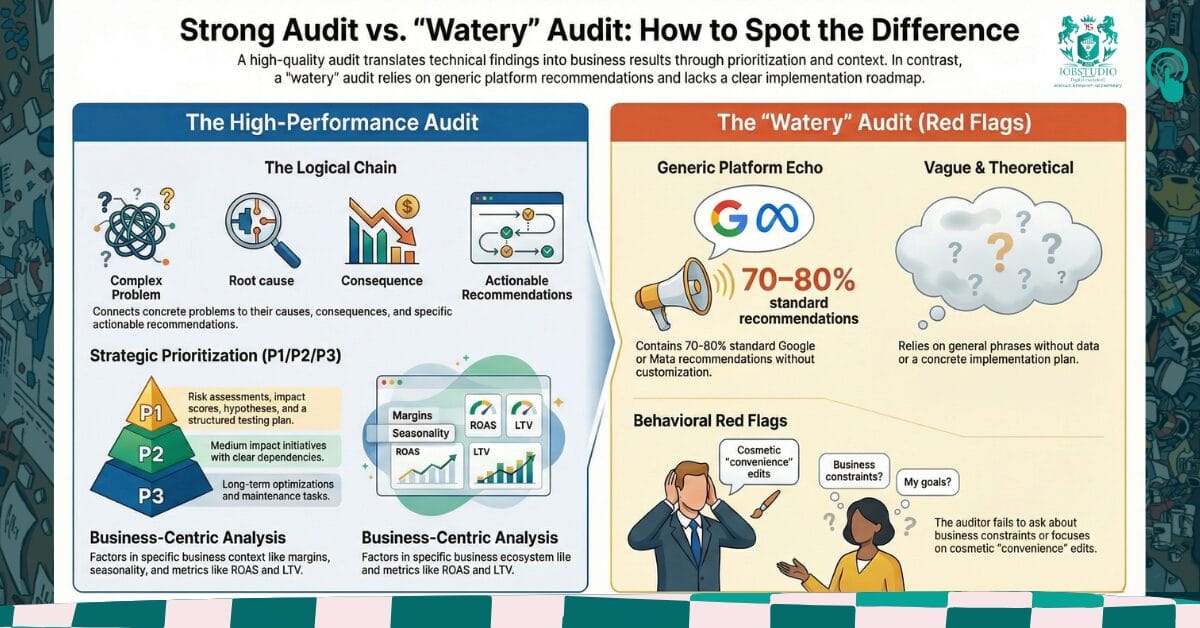
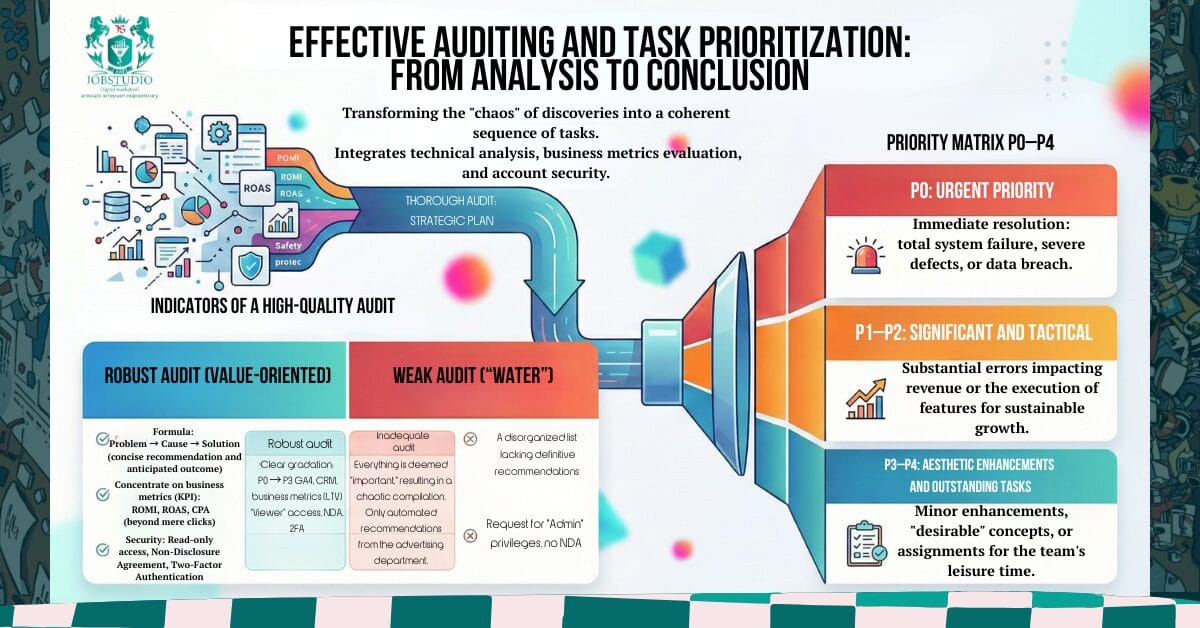
How to distinguish a thorough audit from a “watered-down audit”
Strong audit:
specific problems → cause → effect → recommendation;
prioritization (P1/P2/P3), impact and risk assessment;
list of hypotheses and test plan;
linkage to business metrics (CPA/CPL/ROAS/margin/LTV);
Taking into account the business context: not “how to do it correctly according to the textbook,” but “how to do it correctly for this model (margin, seasonality, logistics, LTV).”
Get a free consultation
Fill out the form and our managers will consult you today
Weak audit:
70–80% of “Google/Meta recommendations”;
general phrases without data;
lack of priorities and implementation plan.
A separate indicator of an auditor’s quality is not only their report, but also their behavior: a strong auditor asks questions about the business and its limitations and does not ask for edits “for convenience.”
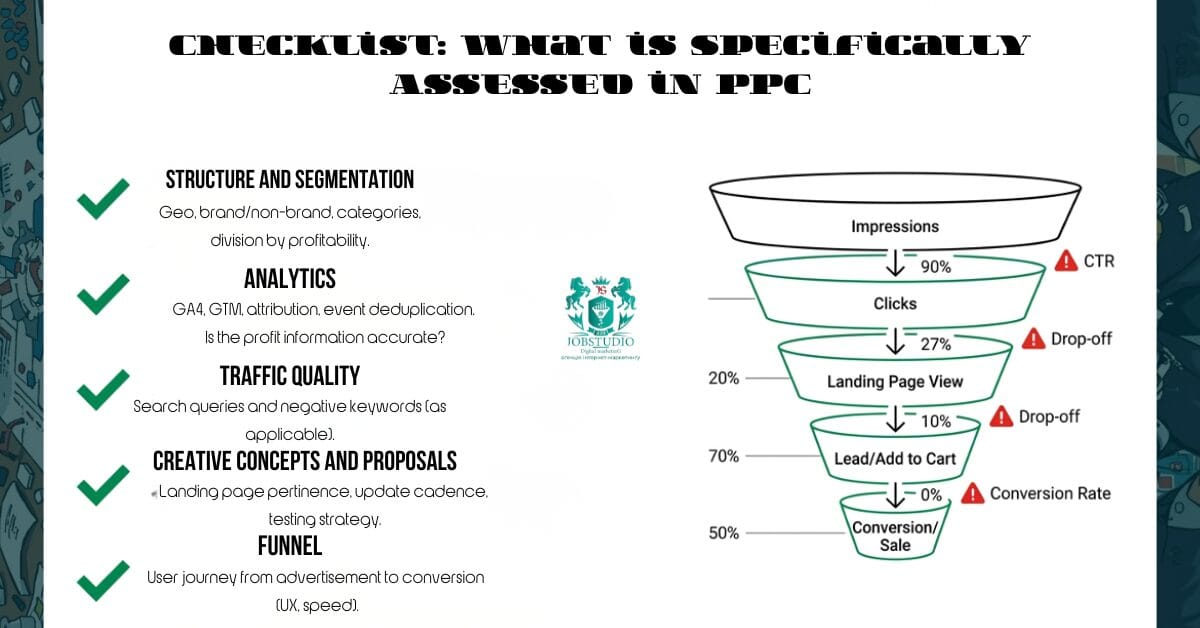
What exactly is checked in PPC (context/target/PMax)
Funnel: announcement → landing → conversion (UX/speed/trust), etc.
Separately — about AI, because it is now part of SEO/PPC.
The role of AI in PPC and ad auditing (how to take it into account)
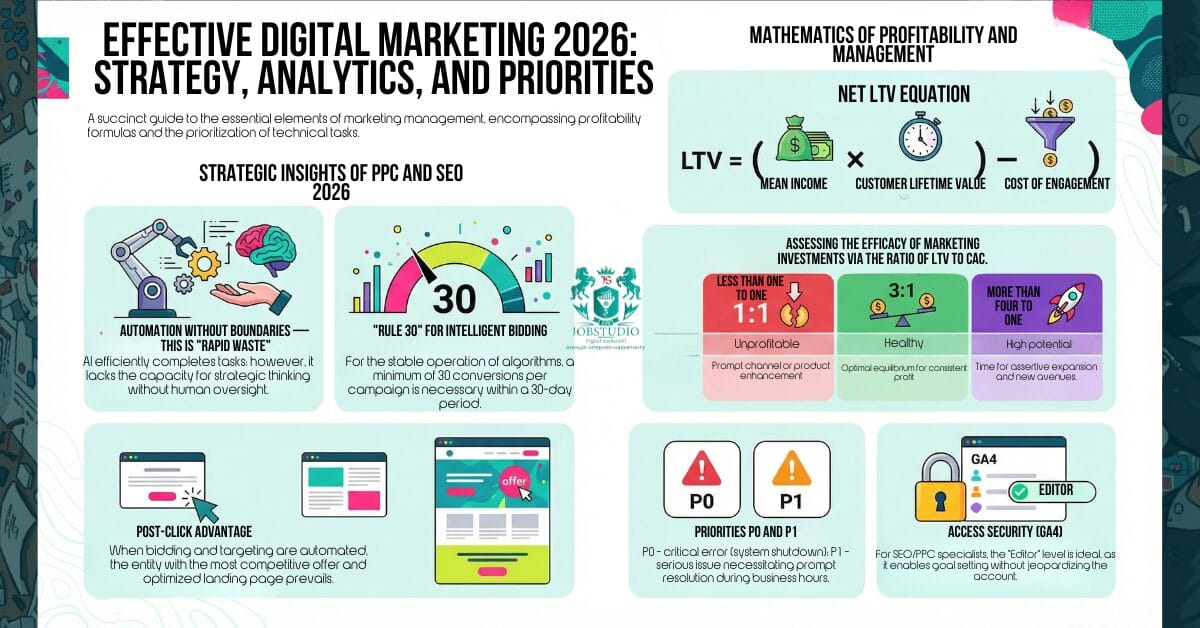
AI is already “inside” Google Ads/Meta — and this affects both campaign management and how to audit them correctly.
1) In PPC AI, it is not autopilot, but a quality multiplier . PMax, broad match, automatic strategies, and asset generation work better when they are more precise:
conversion goals and value (correct events, deduplication, attribution);
quality signal (feed, landing pages, offer, segmentation by margin/categories);
rules and restrictions (geo, brand, negative signals where possible).
Therefore, in a thorough PPC audit, not only “campaigns” are checked, but also what exactly AI receives as input data: what conversions, what audiences/signals, what quality of feed and pages.
Get a responsible approach in promoting your project. Contact us now!
Get a development plan your site!
Let’s clarify over the phone the purpose and objectives of the site
Get a consultation
2) AI is useful in advertising audits, but dangerous without verification. AI can quickly:
highlight anomalies in reports,
generate hypotheses for tests,
Organize your conclusions into a structure of “problem → cause → impact → recommendation.”
But it can also “confidently” recommend best practices without context, without knowing the margins, warehouses, LTV, or how the sales department works. So the rule is simple: AI is for speed, people are for responsibility. A high-quality audit shows where the data confirms the conclusion and what will be the metric of success after the changes.
3) How to immediately recognize an “AI audit without understanding”
lots of general advice, little “where/why/what if”;
no P1/P2/P3 priorities or risks;
no ties to business metrics and restrictions;
The conclusions are dominated by “platform advice” rather than an analysis of your situation.
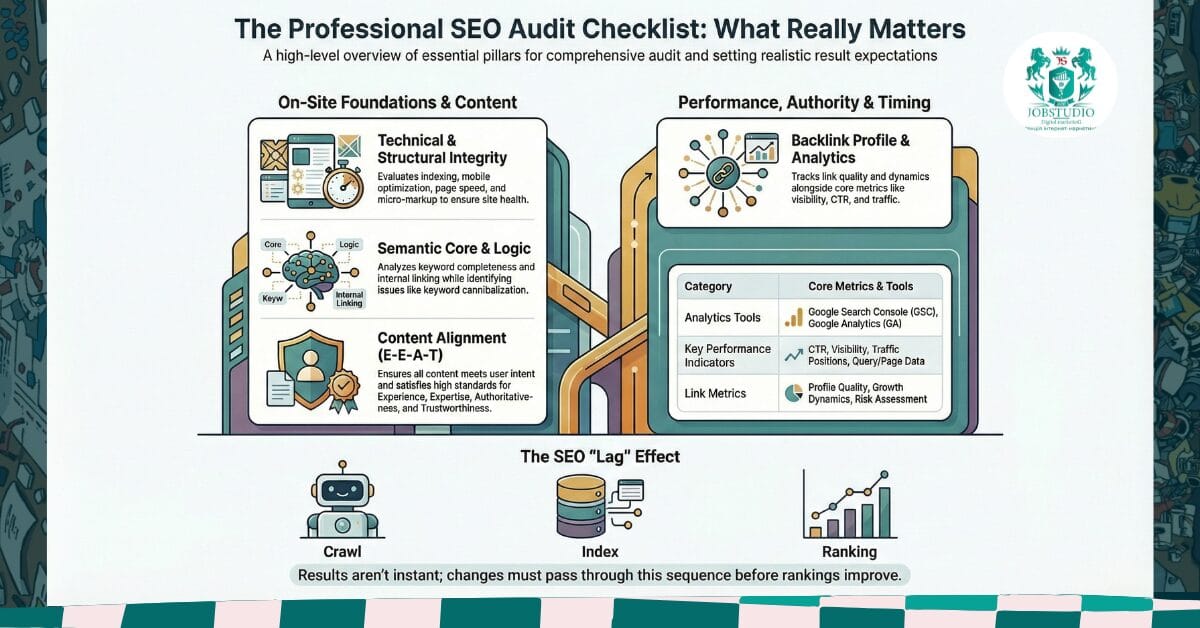
What exactly is checked in SEO
Technical condition (indexing, duplicates, canonicals, redirects, speed, mobile, multilingualism, micro-markup. Of course, this list could go on.).
Structure and semantics (quality and completeness of the semantic core, cannibalization, internal linking).
Position traffic (GSC, pages/queries, visibility, CTR).
Important note: in SEO, some changes have a lag (crawl → index → ranking). Therefore, a thorough audit does not promise “results tomorrow” but sets realistic assessment horizons.
How the audit process works (and how to frame it correctly)
Client goals: what we consider success.
Access permissions: read-only + NDA.
Scope of analysis: period, countries/regions, products, channels.
Report: problems + priorities + action plan + list of tests.
Meeting-review: questions/answers and implementation coordination.
A very practical point: scope. Audits have limits. Otherwise, “let’s check PPC” easily turns into “let’s also check the website/CRM/sales department.” This can be done, but as separate stages, not chaotically.
How a contractor should respond to a client when they announce an audit
Here is a simple position:
“I agree. Auditing is standard practice, so let’s do it safely.”
“Rules: read-only, no changes without written consent, NDA.”
“Ask the auditor to formalize recommendations in a measurable way: what, why, what effect, what risks, what priority.”
“I suggest we analyze it together — that way we can weed out the ‘water’ and turn what’s valuable into a test plan.”
So you’re not fighting — you’re moderating the process.
Conclusion: balance between control and growth
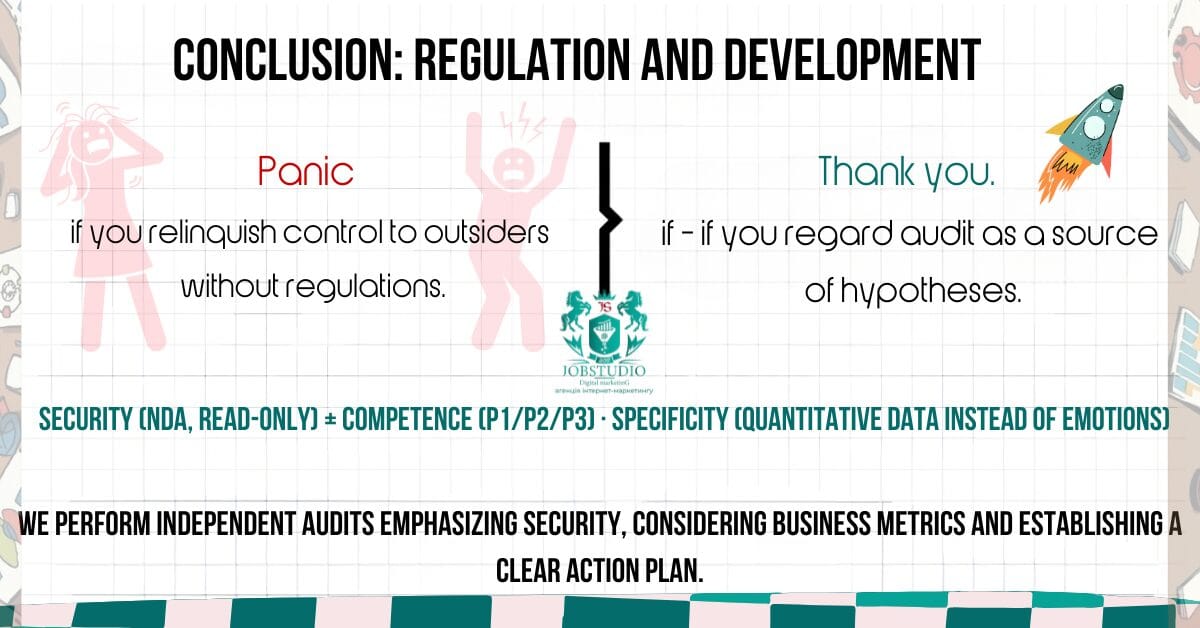
Panic — if you give control of the process to outsiders without rules. Be grateful — if you turn auditing into a source of hypotheses and a tool for growth.
The formula is simple: control + growth. Auditing works when there is security, confidentiality, competence, and specificity.
How are you?
How often have you had your advertising or SEO audited?
What was most useful: specific tests and priorities or vague recommendations?
If you need an independent PPC/SEO audit, we will do it safely, taking into account P1/P2/P3. This is our priority when working with numbers and a clear action plan.
Frequently Asked Questions
Is it normal for a client to request an independent PPC/SEO audit? Yes. This is part of a mature collaboration, especially when the project is long-term or scaling is planned.
What access can be granted to the auditor so that they do not damage the settings (view only or edit)? View only (read-only). Editing — only after written approval of specific changes.
Is it necessary to sign an NDA and how can data confidentiality be protected during an audit? It is advisable. Also, agree on rules for exports/files: where they are sent, who has access to them, and how long they are stored.
How to verify an auditor’s competence and avoid receiving “copy-pasted recommendations from Google/Meta”? Request a logical approach of “problem → cause → impact → recommendation → priority” + reference to business metrics and constraints.
How to distinguish a high-quality audit from a “watered-down” one: what criteria should a report contain? P1/P2/P3 priorities, figures, causality, risks, implementation plan, and list of tests.
Is an audit necessary if the results are “generally normal” but growth has stalled after a year of operation? Yes. That is when it is most valuable: it helps to escape the “stability trap” and find new levers for growth.
What should you do if the auditor’s recommendations contradict your strategy or actual results? Bring them up for joint discussion and test them with hypotheses/tests. Business context is more important than “universal advice.”
Who should implement the recommendations after the audit: the current contractor, the auditor, or both? Ideally, the current contractor. Implement in packages (starting with P1), record baseline metrics before changes, and have a rollback plan. Audit = diagnosis, implementation = controlled process.
Ready to get a selling / advertising / branding website?




.webp)