


Get a responsible approach in promoting client project.
Contact us now!
Contact us now!



 Order a call
  Get an offer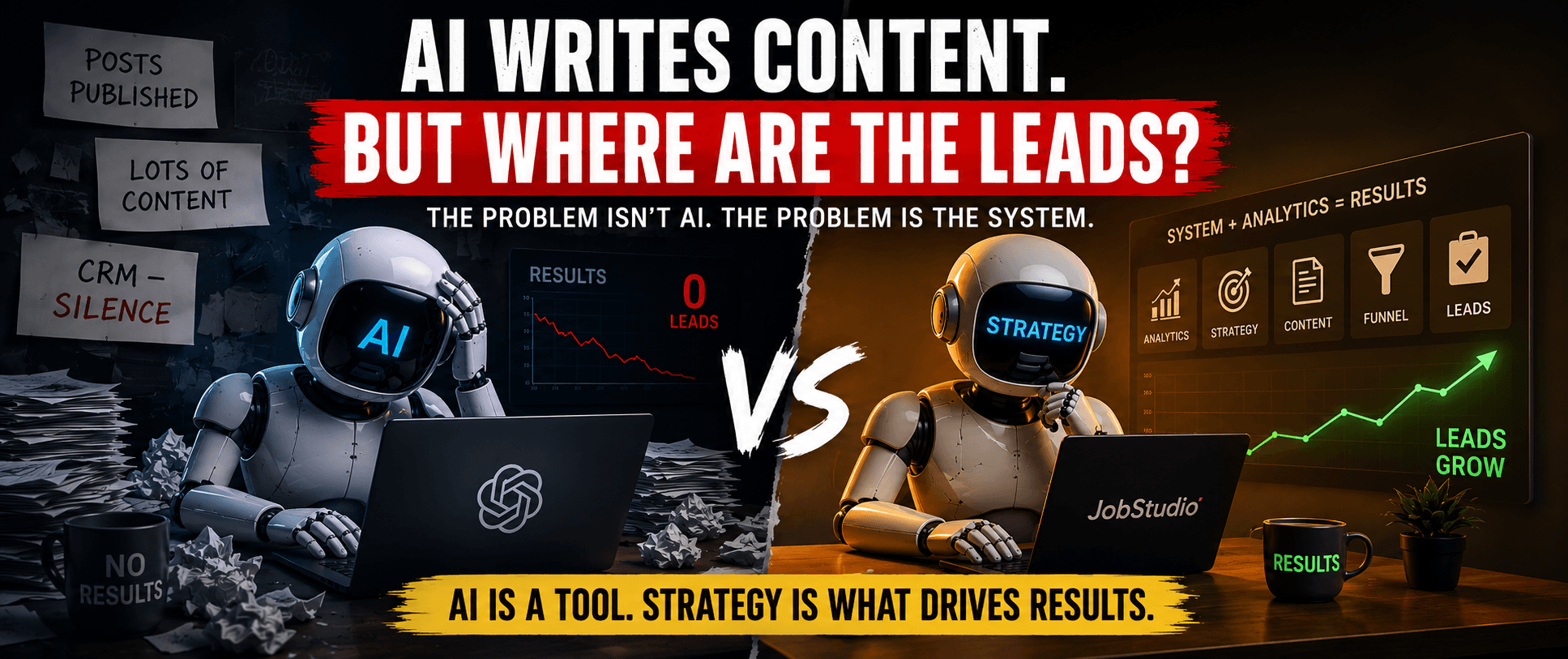
AI has given businesses speed.
You can put together a text in just a few minutes. A post—even faster. Blog ideas, a script for Reels, a newsletter, headline options—it all comes together almost instantly.
At first glance, this solves one of the main problems in marketing: there has always been a shortage of time, people, and resources for content. But in our work at JobStudio, we often see something different.
Table of Contents
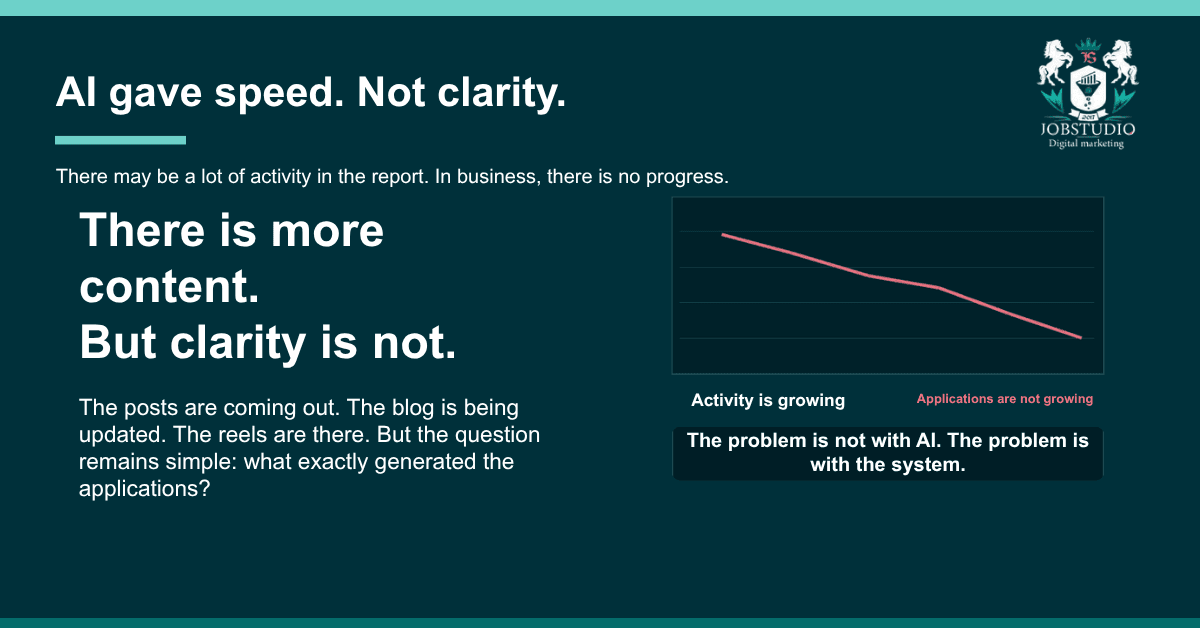
There’s more content now. But there’s no more clarity. The company regularly posts content, updates its blog, creates short videos, tests AI-generated images, and sends out newsletters. The report shows a high level of activity: there are posts, reach, views, and engagement.
And then the analytics open up—and the questions begin. Which topics attracted the right audience? Which pieces of content built trust? What generated leads? What simply garnered random views? Which content is worth scaling up? What should have been removed from the plan a long time ago?
If you don’t have any answers, AI won’t save content marketing.
It just makes noise faster.
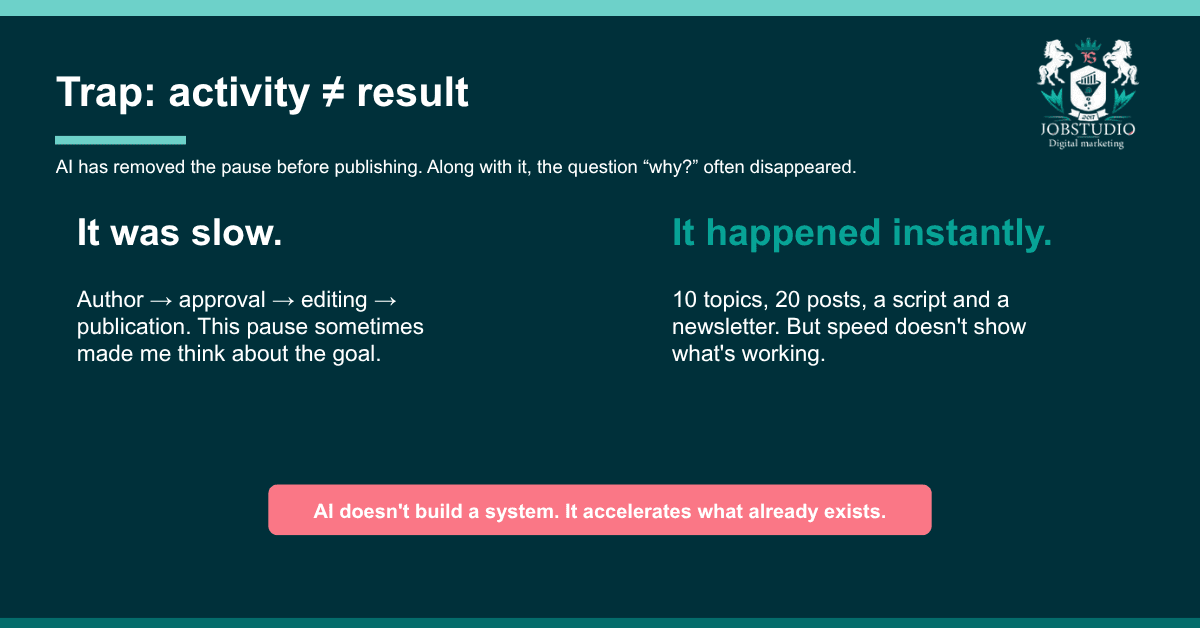
In the past, low-quality content was created slowly. We had to find an author, gather topics, write the text, get it approved, edit it, and publish it. That took time. Sometimes it was precisely that pause that made the team stop and think: Why do we need this piece? Who is it for? And what is it supposed to achieve?
With AI, the pause is gone. Now you can quickly come up with blog topics, ideas for social media, headlines, article outlines, LinkedIn posts, and video scripts.
That’s convenient. But that’s where the trap begins. When creating content becomes too easy, businesses start to confuse activity with results.

The content plan is filled out—that means marketing is working. Posts are going out—that means the brand is active. The blog is being updated—that means SEO is moving forward.
Not always. Based on JobStudio’s experience promoting client pages, the problem is rarely that a company doesn’t post enough. The problem is that it doesn’t see the path from content to a lead: a person sees a topic, gets interested, clicks through, understands the value, submits a lead, and then becomes a high-quality lead or a customer.
If this path doesn’t exist, the AI won’t build the system. It will simply flood the website, social media, and email newsletters with content that serves no clear purpose.
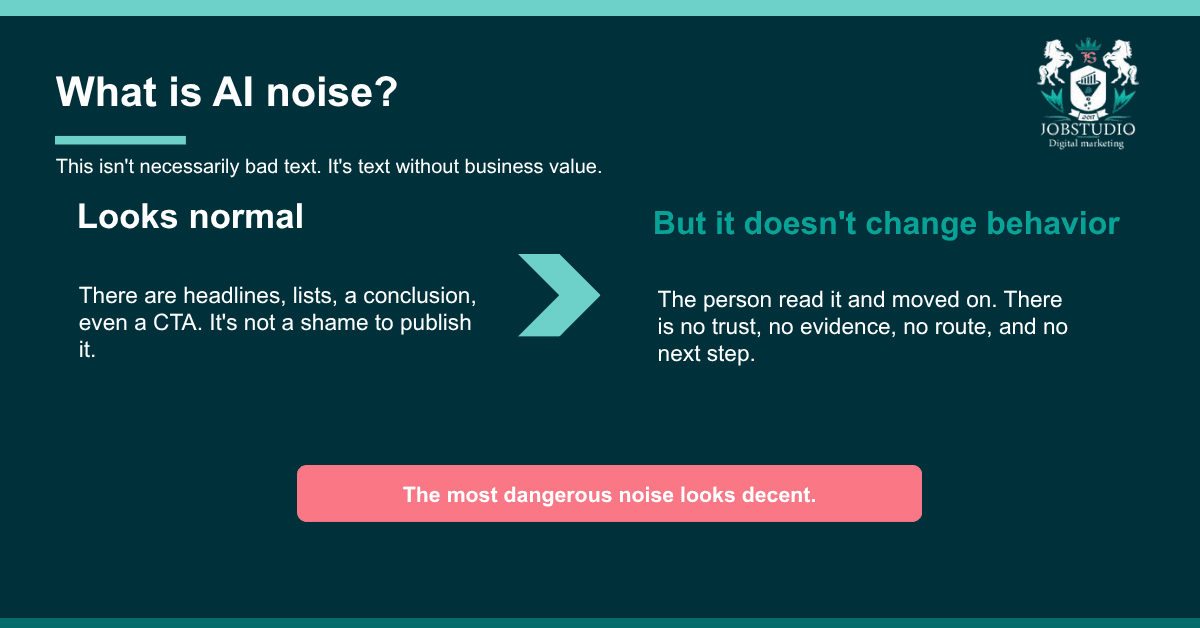
AI noise is content that looks normal but has no business value. It may be well-written. It may include headings, lists, a conclusion, and even a call to action. At first glance, everything seems fine with it.
But it’s missing the most important elements: the brand’s positioning, real-world experience, evidence, statistics, examples, an understanding of the audience, and a connection to the sales funnel and metrics.
Content like this doesn’t necessarily look bad. And that’s exactly why it’s dangerous. It’s easy to spot bad writing. It’s weak, empty, and full of strange phrases or mistakes. AI-generated content often looks decent. You wouldn’t be embarrassed to publish it. It doesn’t trigger any internal resistance. But nothing changes as a result.
The person read it—and moved on. She didn’t understand why you, in particular, could be trusted. She didn’t see any proof. She didn’t feel that you understood her problem. She didn’t take the next step.
Ultimately, the business ends up with not a marketing asset, but a background of information. The most dangerous AI-generated content isn’t bad text. It’s text that looks decent but doesn’t change the customer’s behavior in any way.
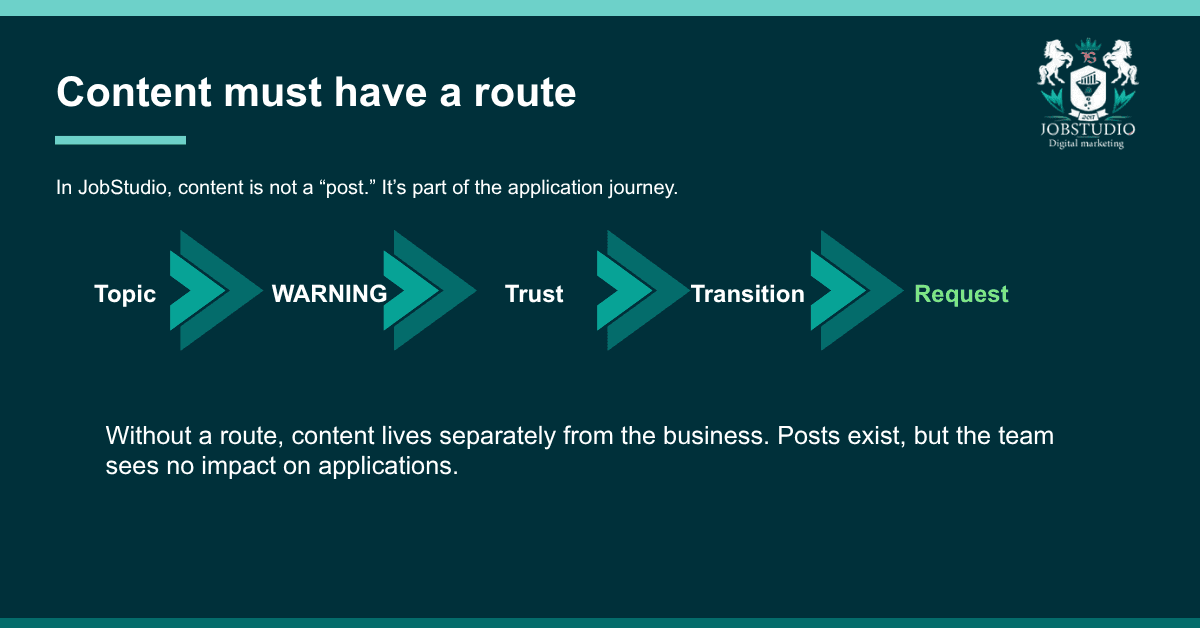
At JobStudio, we don’t view content as individual posts. For us, content is part of the application process.
Every piece of content should answer these simple questions: Who is it intended for? What problem does it address? At what stage of the funnel does it operate? What action is it meant to prompt? And how will we know if it worked?
Without this, content exists separately from the business. It could be on Instagram, Facebook, LinkedIn, a blog, or a newsletter. But if the team doesn’t understand how the content influences the customer journey, it’s not a system. It’s just a collection of activities.
Analytics isn’t just for producing a nice-looking report. It’s necessary for making decisions: which topics to keep, which formats to scale up. Which materials to update. Which CTAs to strengthen. Which channels generate low-quality leads. Which posts attract the wrong audience. Where content breaks the path to a lead submission.
AI can generate text. But it can’t tell whether that text motivates a person to make a decision. That’s a job for the analysts.
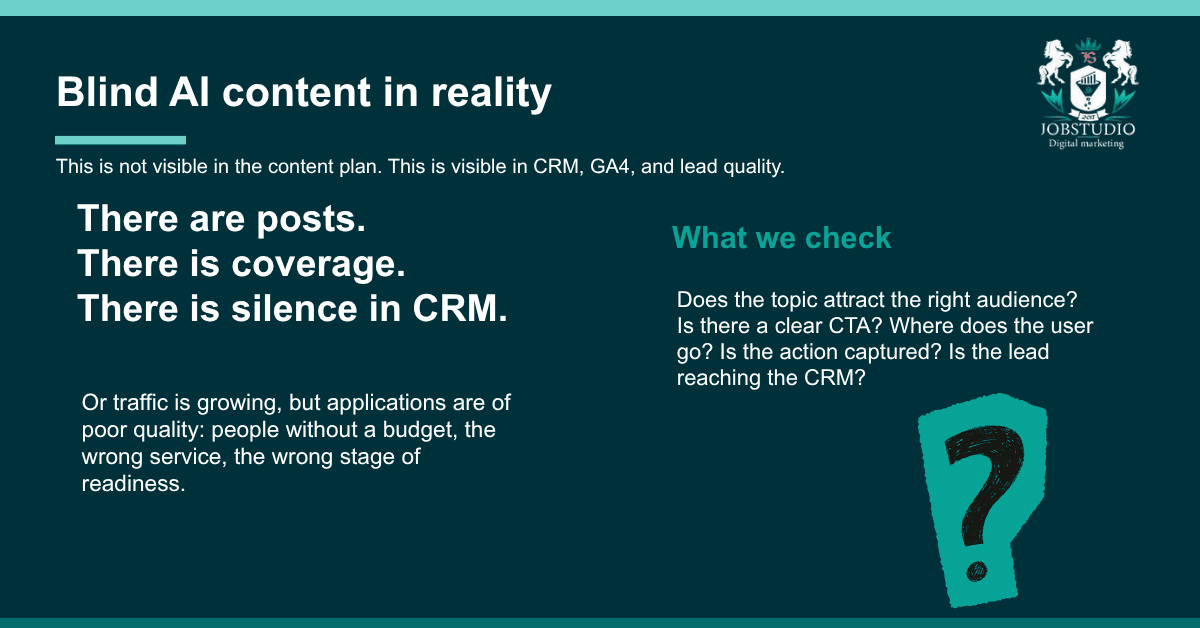
This is one of the most common scenarios. The company regularly publishes posts, articles, Reels, carousels, and email newsletters. The report includes metrics such as reach, views, likes, saves, clicks, and reactions.
But the number of applications isn’t increasing. The initial reaction is often this: we need to create even more content. Post more often. Test more. Add more AI. Generate new topics.
But quantity alone won’t solve the problem if the content itself isn’t tied to the customer’s pain points, the offer, the landing page, and the next step.
In such cases, we don’t just review the content plan. We look at the big picture: what audience the topic attracts, whether it matches actual demand, whether the content includes a clear call-to-action (CTA), where the user is directed, what they see on the website, whether they can quickly submit a request, whether this action is tracked in analytics, and whether the lead is routed to the CRM.
Sometimes the problem isn’t that the content is “bad.” The problem is that it hasn’t been finalized for the application.
There are posts, there’s reach, but the CRM is silent. This isn’t a content management system. It’s activity without a plan.
AI easily generates common topics: tips, mistakes, trends, checklists, benefits, and explanations of “what is” and “how to.”
Topics like these may seem useful. But without analyzing the audience, they often remain superficial. The content seems to answer questions. But not the ones that influence the customer’s decision.
Before placing an order, a person is concerned not only with “what is SEO” or “why is content important.” They’re concerned about other things: whether the work will pay off, how much time it will take, how to tell if the contractor is actually doing the work, why the previous strategy didn’t work, how to monitor the process, and what to do if there’s traffic but no sales.
If these objections are not addressed, the content may be on the right topic but lack impact.
If the AI receives a general prompt, it generates general text. As a result, different companies start sounding the same: “we help businesses grow,” “personalized approach,” “comprehensive solutions,” “effective strategy,” “high-quality content,” “modern tools.”
Formally, everything is correct. But the customer doesn’t see the difference. This is critical for B2B content. Here, trust is built not on fancy words, but on specifics: what exactly you’ve observed in projects, what mistakes keep recurring, what the analytics show, which metrics have changed, what conclusions can be drawn, and what the business should check right now.
At JobStudio, we don’t try to sound like a marketing pitch. It’s important for us to share practical insights: where applications get lost, what goes wrong in the funnel, and how to check for it.
One post received reach. Another received engagement. A third received comments. A fourth received clicks. But which one of them brought the person closer to submitting an application?
If there is no answer, the content cannot be scaled intentionally. We can only guess. And guesswork is a weak foundation for growth.
A good content management system should generate not only posts but also insights. Which topics attract the right audience. Which formats build trust. Which CTAs drive action. Which materials are worth revising. Which channels generate a lot of attention but few business results.
Without this, AI simply increases the volume of content. But it doesn’t provide any control.
AI isn’t ruining marketing. He shows that the problem wasn’t with AI, but with haphazard marketing.
If there’s no analytics, AI won’t be able to generate it. If there’s no positioning, AI won’t be able to come up with a strong differentiator. If there’s no understanding of the audience, AI won’t be able to identify the customer’s real pain points. If there’s no integration with CRM, AI won’t be able to show which materials generated high-quality leads.
AI isn’t a strategist. It’s an enhancer. It enhances what is already there.
If there’s a system in place, AI helps you work faster. If there is no system, the AI is more likely to generate noise.
Therefore, the main question is not whether AI should be used. The question is this: Does the business have a system into which AI can be integrated?
Without the AI system, it becomes a draft generator. With the system, it becomes a tool that speeds up the team’s work.
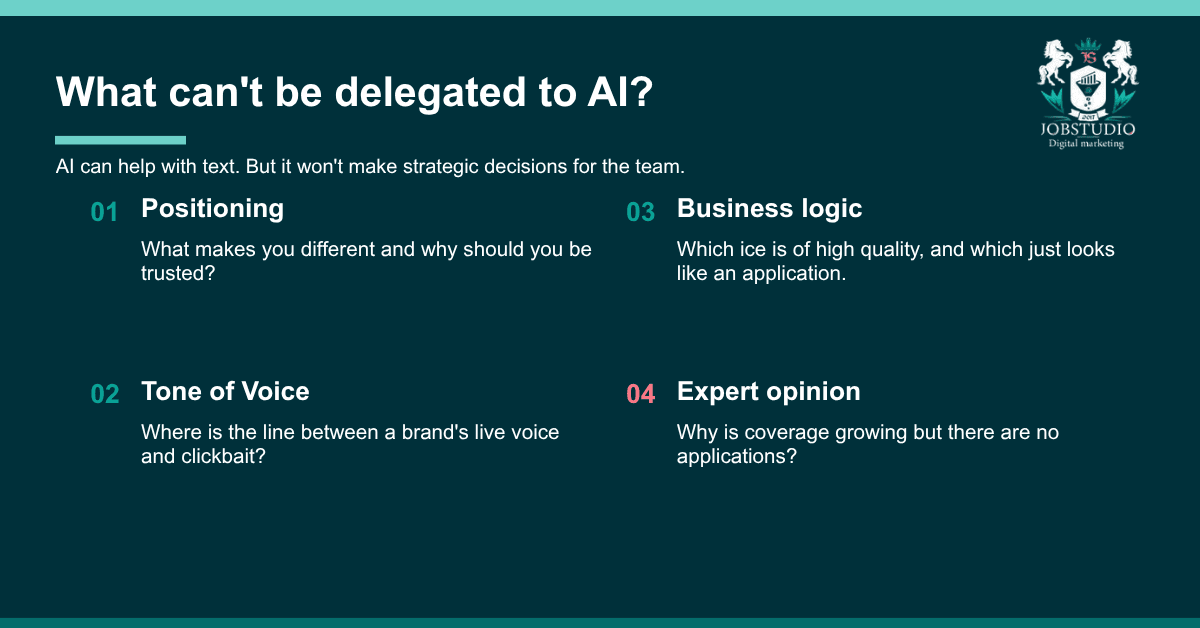
AI won’t determine what sets a business apart from its competitors. He can suggest different ways of phrasing things, help with ideas, and organize thoughts. But he won’t make strategic decisions for the team.
Positioning is the answer to several important questions. Who are we to the client? Why should they trust us? What is our real advantage? What problem do we solve better than others? What is the most important outcome for the client?
If this is missing, the AI starts generating correct but empty text. They sound professional, but they don’t give the customer a reason to choose you.
AI can mimic a style, but it doesn’t understand a brand’s boundaries without rules. For JobStudio, it is important that the content sound pragmatic and evidence-based, without bombast, toxicity, or empty promises.
We don’t say, “We’re the best.” We show you exactly what to check, where your budget might be going to waste, and how that affects your applications.
If the tone of voice isn’t defined, AI quickly veers toward one of two extremes: either formulaic expertise lacking a human touch, or clickbait that grabs attention but undermines trust.
This is particularly dangerous in B2B.
Here, the client isn’t buying a fleeting emotion that lasts 5 seconds. They’re buying the assurance that the team understands their business.
AI doesn’t know what kind of ice you consider to be high-quality. He doesn’t see what happens after a lead is submitted. He doesn’t know which customers go on to make a purchase. He doesn’t know which leads the managers are unable to close. He doesn’t know where advertising is generating a lot of leads but few actual sales.
And that’s what matters when it comes to content. Content may attract an audience that actively reads but doesn’t buy. It may generate reach among professionals but not among business owners. It may be effective at driving engagement but not at delivering commercial results.
AI cannot decide on its own which topics to scale. This requires data and business context.
AI can help organize data. But the conclusion must be drawn by a specialist.
Why has reach increased, but there are no leads? Why does the article drive traffic but not generate leads? Why do Reels get views but don’t attract the target audience? Why does the content get likes but doesn’t drive sales? Why is the blog growing in terms of page count but not improving traffic quality?
This isn’t just text generation anymore. It’s analytics. This is exactly where you need a team that looks not only at the content, but at the entire system: SEO, PPC, the website, GA4, CRM, lead quality, and the conversion funnel.
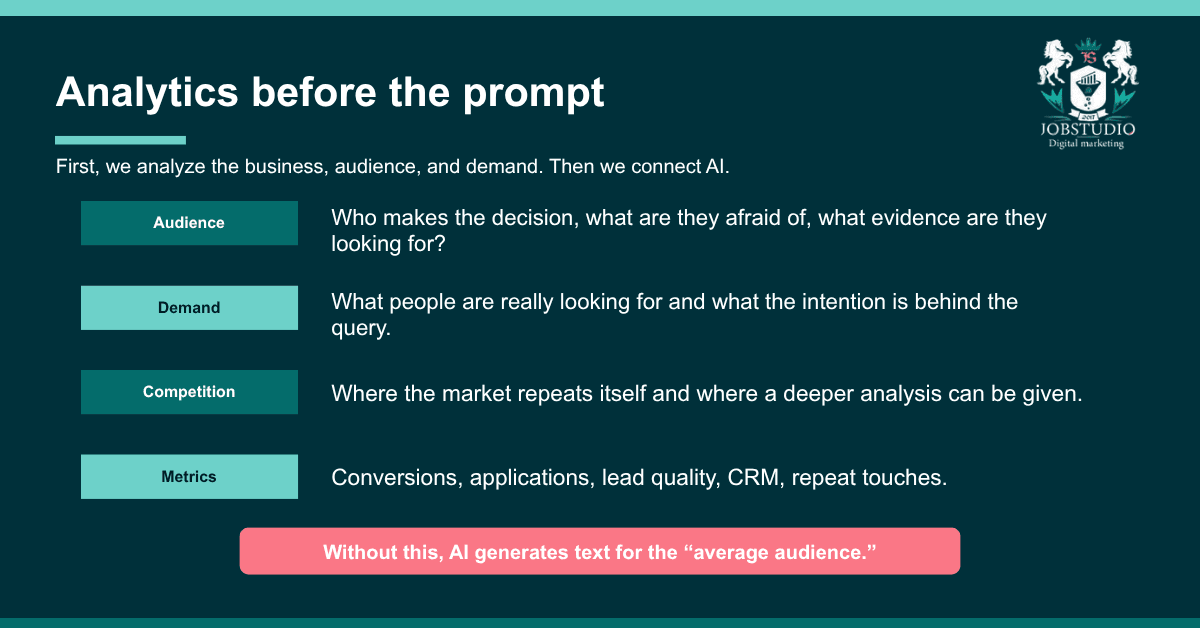
Before creating content, we need to understand who we’re talking to. Not “business owners” in general. More specifically: who makes the decisions, how well the person understands marketing, what annoys them about contractors, what objections they repeatedly raise, what questions they ask before making a purchase, what they’re afraid of, and what kind of evidence is important to them.
This is especially important for JobStudio because our audience isn’t usually looking for “yet another post about marketing.” She is looking for answers to specific questions: where do leads go missing, why is the budget being spent but results are poor, how to vet a contractor, why there is traffic but no sales, what the analytics show, and what to do first.
If the AI doesn’t receive this context, it generates text for a hypothetical average audience. And the average audience rarely purchases complex B2B services.
AI does not replace semantics. Before creating SEO content, you need to understand what people are actually searching for, what intent lies behind the search query, whether the topic has commercial potential, what pages already exist on the site, whether there will be any duplication, and what kind of content might lead to a consultation, an audit, or a request.
Without this, you can create many articles that will generate traffic but won’t bring in customers. For businesses, this is a trap: organic traffic is growing in the report, but there are no leads.
Traffic is growing, but the leads are low-quality. People visit the site, read the content, and sometimes even fill out the form, but they either don’t have a budget, are looking for a different service, or aren’t ready to discuss a partnership.
And that raises the question: are we really improving our SEO, or are we just filling the website with text? SEO doesn’t just require more content.
SEO requires better answers to users’ actual search queries.
Competitor analysis isn’t meant for copying topics. It’s necessary to see what everyone has already written about, where the content is superficial, where examples are lacking, where there are no figures, where the CTA is weak, and where the material doesn’t lead to the next step.
At JobStudio, we don’t look at our competitors with the mindset of “let’s do the same thing.” On the contrary, compelling content often emerges where there is a gap.
If everyone is offering general advice, you can share an audit. If everyone is talking about trends, you can show what to look for in analytics. If everyone is promising more content, you can explain why more isn’t always better.
JobStudio’s stance is simple: don’t just copy topics; instead, provide more clarity, evidence, and practical value.
Likes aren’t a strategy. To evaluate AI-generated content, you need to look at the bigger picture: reach, CTR, retention, comments, website visits, time on page, inquiries, lead quality, branded searches, repeat engagement, conversions, CRM data, and the content’s impact on brand trust.
Content that received likes didn’t necessarily help the business. The content that led the right person to submit an application is a different story.
Therefore, before scaling AI-generated content, we need to understand exactly what we’re scaling: attention, casual views, or content that helps businesses generate high-quality leads.
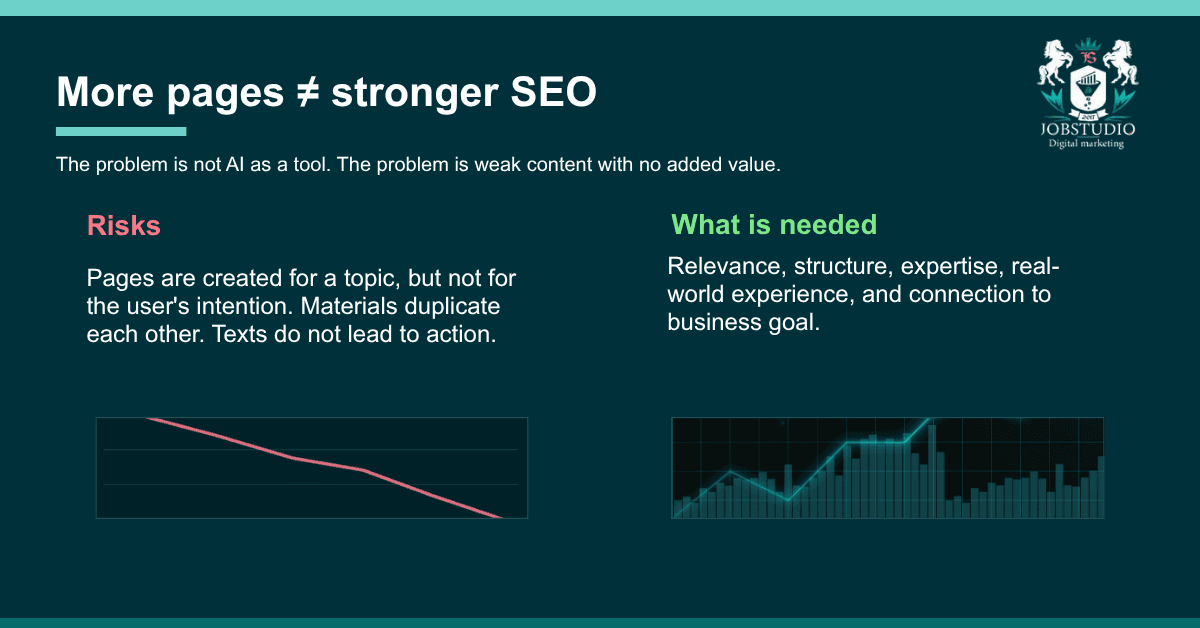
The problem isn’t that the text was generated by AI. The problem is that it offers no added value.
In SEO audits, we often see similar risks. Pages are created around a topic, but not with the user’s intent in mind. Several pieces of content duplicate one another. The texts are superficial and fail to address real questions. They lack real-world experience, examples, a call-to-action structure, and a clear commercial purpose.
In this situation, the website may appear active, but it won’t become stronger. More URLs don’t mean better results. More articles don’t mean more credibility. More text doesn’t mean a better answer for the user.
It is particularly dangerous when AI is used to mass-produce similar pages. Formally, they are different, but in essence, they all say the same thing.
For the user, this isn’t helpful—it’s just an extra layer of information. For SEO, it risks diluting the site’s quality.
SEO requires more than just content. SEO requires relevance, structure, expertise, real-world experience, and a clear connection to business goals.
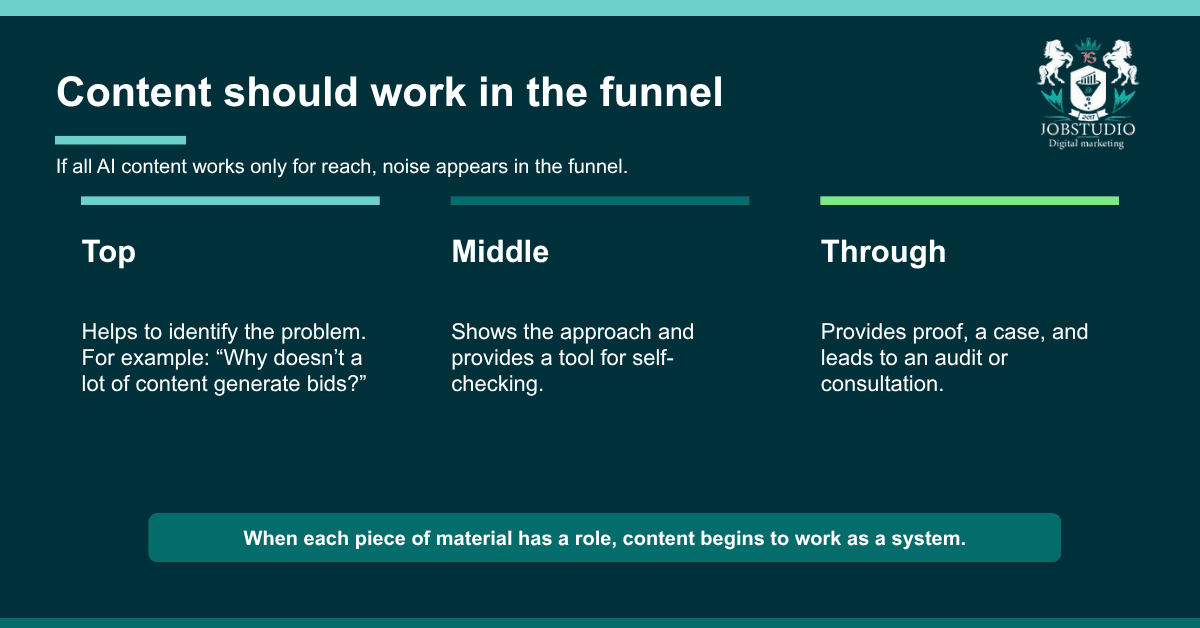
Content shouldn’t be focused solely on reach. In a normal system, every material has a role.
At this stage, the content should capture the attention of the right audience. It addresses a problem, explains the risk, provides insight, and demonstrates that the brand understands the customer’s situation.
For example: “Why does a lot of content not generate leads?” Content like this doesn’t necessarily lead to a sale right away. But it should help people recognize their problem.
At this stage, the content should demonstrate the approach. This section includes checklists, analyses, explanations, examples, and resources that help people evaluate their own systems.
For example: “What should content analytics include so you’re not just guessing?” It’s not enough to just explain things here. We need to give people a tool for self-assessment.
At this stage, the content should prompt a call to action. This requires evidence, case studies, explanations of the process, “before and after” examples, and a clear transition to an audit, consultation, or analysis.
For example: “As the audit showed, the content was attracting the wrong audience.” If all AI-generated content is focused solely on reach, noise creeps into the funnel. If every piece of material has a role, the content begins to function as a system.
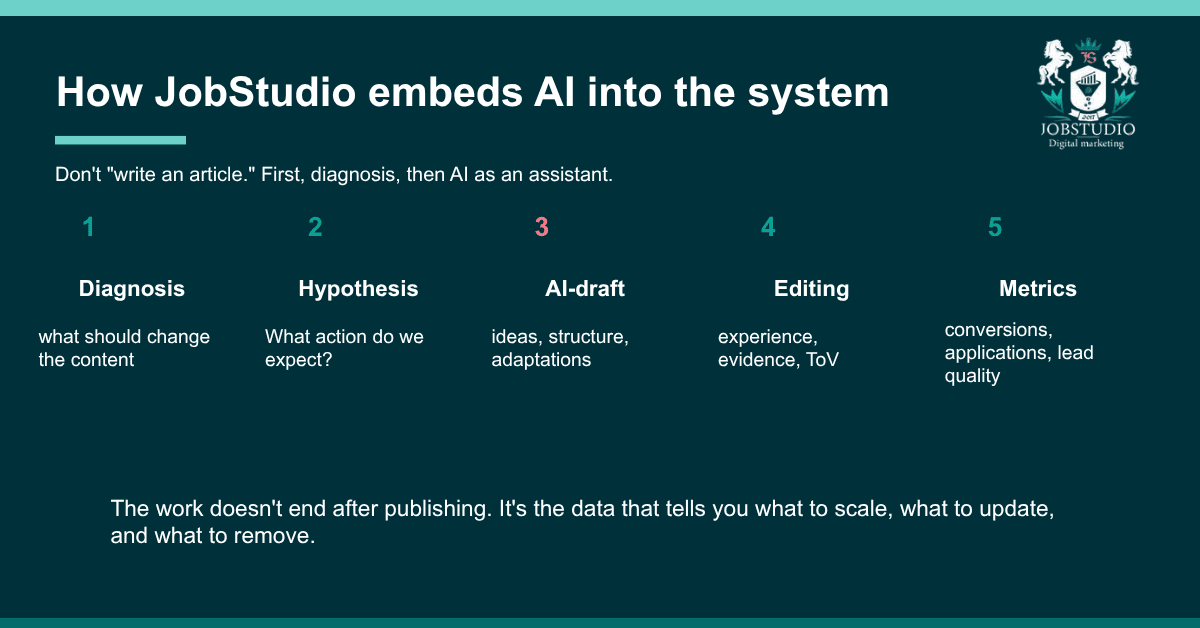
At JobStudio, working with AI-generated content doesn’t start with a prompt.
First, we break down the business objectives. What does the content need to change? What kind of leads do we need? Where is the funnel currently falling short? Which channels are already working? What can we see in the analytics, and what remains a blind spot for now?
Next, we look at the audience—not in the abstract, but through real questions, pain points, objections, and decision-making scenarios. In B2B, people rarely submit a request after just one post. They need several touchpoints: to recognize the problem, understand the approach, establish trust, see proof—and only then take the next step.
Next, we assess demand. For SEO content, it’s important to understand what people are searching for, the intent behind the topic, which page should address it, and how the content relates to our services.
Next, let’s look at the competition. Not to repeat their topics, but to find a gap. Where everyone else is offering general advice, you can provide an in-depth analysis. Where everyone else is talking about trends, you can show what to look for in analytics.
After that, a hypothesis emerges. Content isn’t created just “because we need to publish something,” but with a specific logic in mind: this article should address an SEO need and lead to an audit; this post should gauge audience interest; this case study should build trust; this format should drive traffic.
Only then does the AI receive the task.
And this isn’t just “write an article.” It’s a clear set of specifications: target audience, problem, JobStudio’s position, examples, evidence, structure, tone of voice, CTA, and the desired reader action.
AI helps draft content, suggest headline options, shorten text, adapt material for another channel, or prepare FAQs. But it’s the team that adds the meaning, experience, funnel logic, and final conclusion.
It is during the editing stage that the text ceases to be an AI draft and becomes brand content. The work doesn’t end once a post is published. We look at what gained reach, what generated clicks, what brought in inquiries, the quality of the leads, which topics are worth developing, what needs to be updated, and what’s best to remove.
Without this, AI-generated content remains just production. With analytics, it becomes a managed system.
The company produces 20–30 articles per month. There are posts. There’s a blog. There’s consistency. There’s activity.
But the topics are generic. The CTAs are weak. UTM parameters aren’t being used. There’s no integration with the CRM. It’s unclear which materials are generating leads. The content doesn’t address the customer’s actual objections. The team doesn’t see what’s worth scaling.
The article gets views, but doesn’t drive traffic to the service. The post gets engagement, but doesn’t bring people to the website. People watch the video, but it doesn’t result in a single inquiry. Result: The content is there, but it has no measurable impact on the business.
The content was organized into a funnel. For each topic, we identified the target audience, pain point, format, channel, metrics, CTA, connection to the service, and expected result.
AI is used for drafts, ideas, and adaptations. But the team is responsible for shaping the final logic. After publication, the materials are reviewed to determine: what generated reach, what drove clicks, what generated leads, which leads were high-quality, and what needs to be updated.
The result: less chaos, more control. Content isn’t just being published—it’s driving trust, clicks, inquiries, and high-quality leads.
The most common mistake is to start with a prompt rather than a strategy. Businesses immediately ask the AI to write a post or article, but fail to define the goal, audience, pain point, CTA, and metrics.
The second mistake is to create content without analyzing your audience. As a result, the content addresses general topics but fails to address customers’ actual questions.
Third, don’t judge results based solely on likes and reach. For B2B, that’s not enough. It’s important to track clicks, inquiries, lead quality, and the impact on trust.
Another common problem is failing to link content to GA4, CRM, or lead submissions. Without this, it’s impossible to understand which content actually impacts the business.
Businesses also often fail to check the quality of their leads. Content may generate inquiries, but not the right ones. If the team doesn’t analyze the quality of those inquiries, it may end up scaling the wrong topics.
It’s also worth mentioning the tendency to copy competitors, a weak tone of voice, and the lack of case studies, statistics, and real-world examples. And most importantly—the belief that consistency is, in and of itself, a result.
But posting regularly without analytics isn’t a strategy. It’s just a posting schedule.
AI-generated noise is easy to spot if you focus not on the text’s grammatical correctness but on its purpose. It lacks a clear target audience, a specific pain point, a brand position, examples, evidence, a connection to the sales funnel, and a clear CTA. It resembles competitors’ content and was created just “for the sake of it.”
Content like this may seem normal. But it doesn’t give the business any control.
Content that works looks different. It is based on analytics, addresses a specific query, targets a clearly defined audience, conveys the brand’s position, includes an experience, example, or case study tied to a specific stage of the sales funnel, and leads to the next action.
This type of content is analyzed after publication. The team reviews its performance and can then decide whether to expand on the topic, change the CTA, update the content, or remove underperforming content.
This type of content can be scaled because it’s clear why it works.
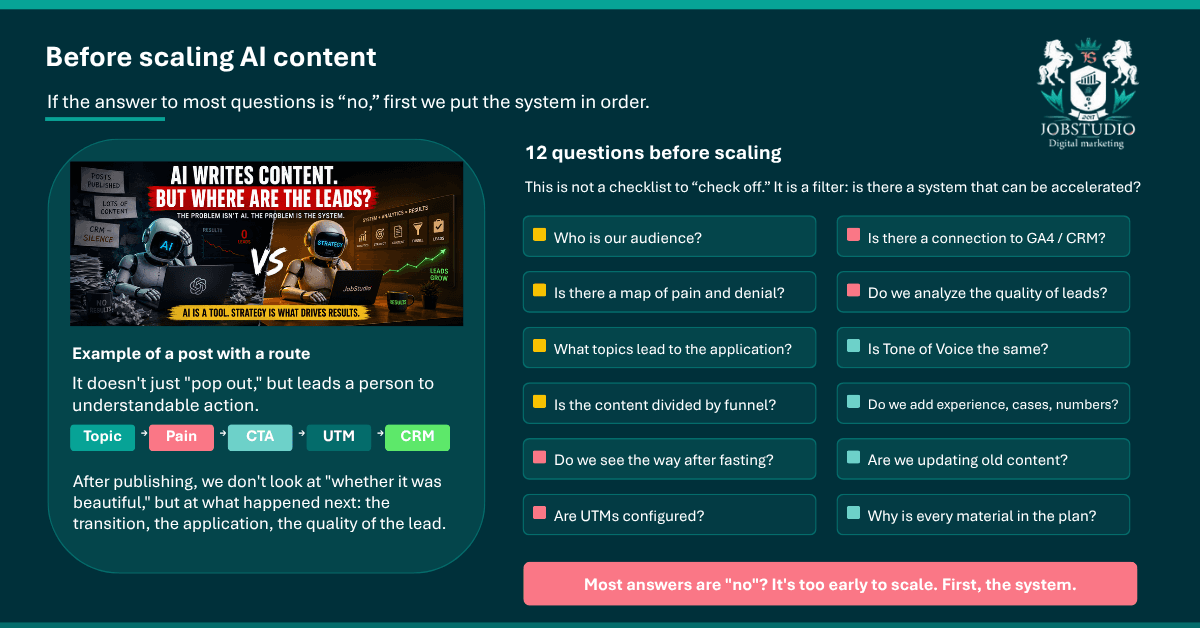
Before increasing the amount of AI-generated content, it’s worth honestly answering a few questions.
Is it clear who our audience is? Do we have a pain points and objections map? Do we know which topics lead to a lead generation form submission? Is our content segmented by funnel stages? Can we track the user’s journey after a post or article? Are UTM parameters set up? Is there integration with GA4 or CRM? Do we analyze lead quality? Do we have a consistent tone of voice? Do we include real-world examples, case studies, and statistics? Do we update old content? Can we explain the purpose of every piece of content in the content plan?
If the answer to most of these questions is “no,” it’s too early to scale up. First, we need to get the system in order.
When anyone can generate text, quantity is no longer an advantage. The advantage lies in what AI cannot create on its own: first-hand experience, real-world case studies, data, expert insights, a strong tone of voice, a deep understanding of the audience, honest analysis, and the ability to show what works and what doesn’t.
AI can write text. But it cannot replace an audit, CRM data, an expert’s opinion, or experience working with a real sales funnel.
That is precisely why, in the age of AI, human handwriting is becoming an advantage rather than a weakness. People quickly get tired of repetitive content. But they respond to pieces that offer a clear stance, real-world experience, concrete details, and honest analysis.
For JobStudio, this is fundamental: content shouldn’t just fill up the feed. It should highlight where applications, budget, and control are being lost in the business.
No. AI can help with ideas, structure, drafts, text adaptation, and headline options. But strategy, analytics, expertise, examples, statistics, brand positioning, and final editing should remain the team’s responsibility.
Otherwise, the content quickly becomes generic and similar to hundreds of other pieces.
Because AI doesn’t know which topics actually influence leads, which formats work for your audience, which content addresses objections, and which leads are high-quality for your business.
Without analytics, he creates content, but not a system.
AI noise is content that was created quickly but without a clear purpose.
It may look fine, but it doesn’t address the customer’s pain points, doesn’t provide evidence, doesn’t lead to a lead, doesn’t differentiate the brand, and isn’t measured using business metrics.
You shouldn’t just look at reach and likes.
Key metrics include CTR, website traffic, time on page, saves, comments, inquiries, lead quality, branded searches, repeat engagement, conversions, and CRM data.
It is these metrics that help us understand whether the content is driving business results, rather than just generating engagement.
That is, if it is created on a massive scale without analyzing user intent, structure, expertise, and added value.
The problem isn’t with AI as a tool, but with poor content: it duplicates topics, doesn’t address the user’s query, and serves no useful purpose on the site.
Not from the prompt.
First, you need to define the goal, audience, customer pain point, funnel stage, channel, success metric, proof, and CTA.
Only then does AI become a useful tool rather than a generator of random text.
Because businesses give AI general tasks: “Write a post,” “Write an article,” “Give me 10 ideas.”
Without a tone of voice, case studies, statistics, positioning, and context, AI generates run-of-the-mill text for a run-of-the-mill audience.
Content like this may be well-written, but it doesn’t set the brand apart.
Every material must serve a purpose.
Some texts grab attention. Others explain the problem. Still others address objections. Others showcase case studies. And still others lead to an audit or consultation.
If there is no purpose, content becomes noise.
At least once a month.
You need to look at which topics generated reach, which drove clicks, which generated inquiries, which impacted lead quality, and which simply filled out the content plan.
Without such an analysis, a business ends up repeating random actions.
Yes, if there’s a lot of content but no clear result.
An audit helps you identify which topics are effective, where there is duplication, which materials lack a CTA, which pages aren’t aligned with the sales funnel, and what needs to be changed so that the content drives leads.
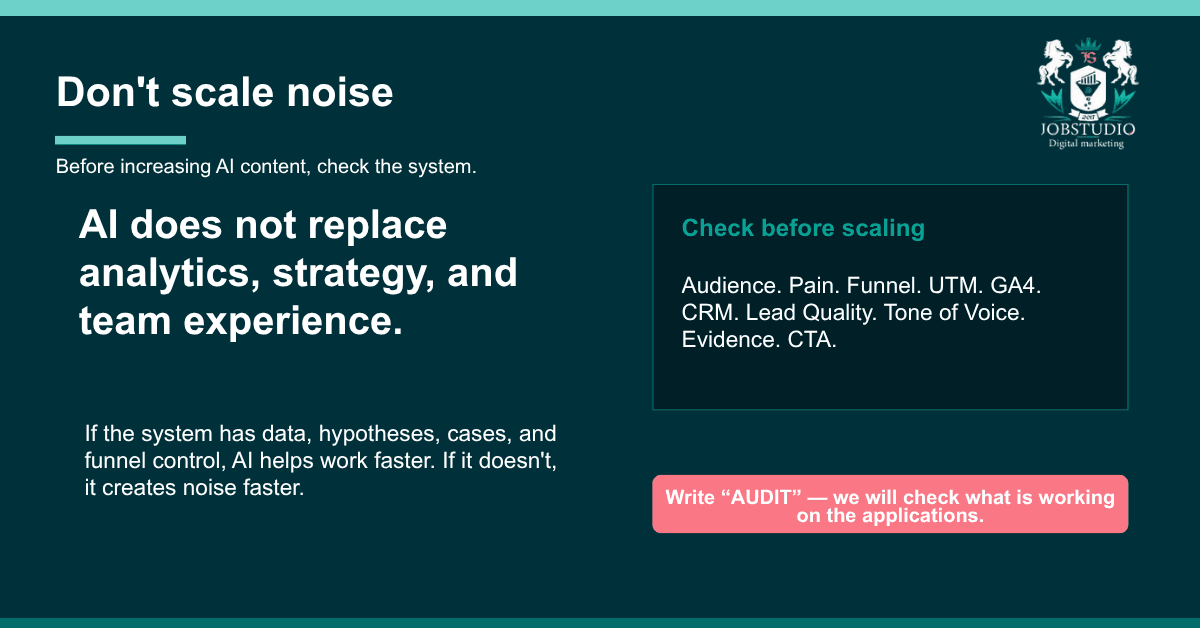
AI accelerates what is already in the system. If the system contains data, hypotheses, metrics, case studies, and funnel tracking, AI helps you work faster. If that’s not available, AI helps generate noise more quickly.
Don’t scale your content until you see that it’s benefiting your business.
Type “AUDIT”—we’ll check which materials drive leads, build trust, and deliver business results, and which ones are just cluttering up the feed.
.webp)
 Contacts
 Language
 Book a call
 Order a proposal


