


Get a responsible approach in promoting client project.
Contact us now!
Contact us now!


 Order a call
 Get an offer
The Ukrainian alcoholic beverage manufacturer already had experience exporting and had been operating in the U.S. through a local partner. The company wanted to expand its network of B2B partners. Our task was to determine how a potential importer or distributor in the U.S. finds the manufacturer, what they learn about it compared to its competitors, and whether they can easily reach out to discuss a partnership.
Table of Contents
We analyzed search demand in the U.S., reviewed Google search results for industry- and brand-specific queries, and compared how the manufacturer and its competitors are represented in Google AI Overviews and ChatGPT responses for the U.S. market. We also analyzed the structure of the page linked from the ChatGPT response and assessed how easy it was for a potential partner to find information about the products and terms of cooperation.

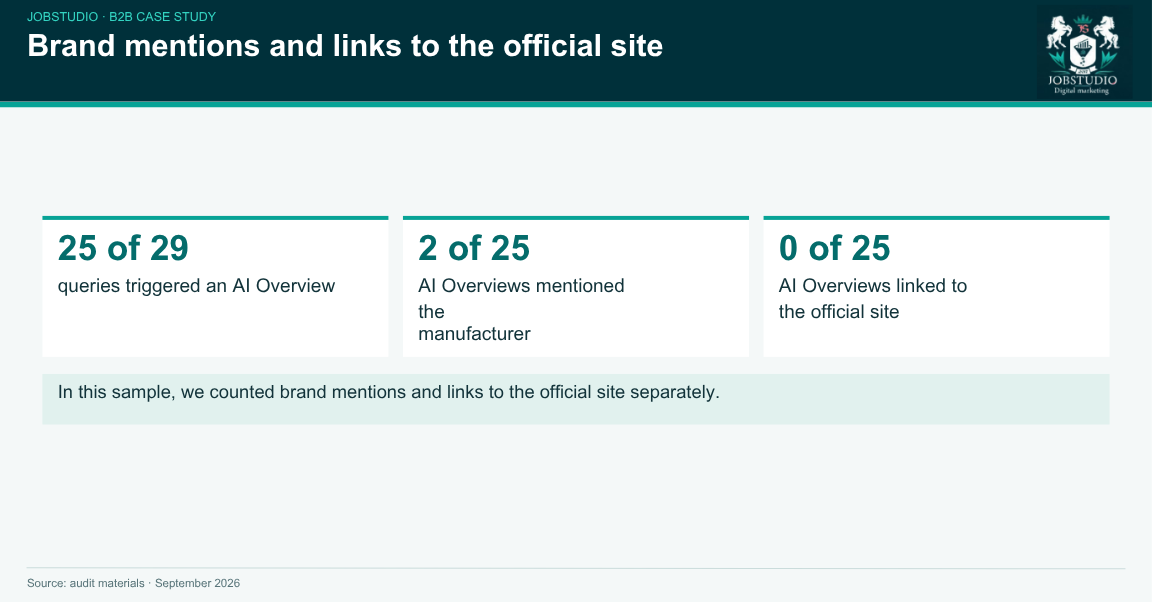
In the verified sample, Google AI Overviews mentioned the manufacturer but did not link to its official website. Google obtained information about the company from third-party sources. Based on the audit results, we identified which B2B inquiries should be addressed first, what should be added to the Export and Partners pages, and how to streamline the process from learning about the manufacturer to requesting a partnership.
Below, we show what data led us to these decisions.
| Project | Distiller |
|---|---|
| Field | Alcohol production, international B2B cooperation |
| Market Research | United States |
| Audit Areas | SEO, Google AI Overviews, International Pages, and the Path to a Call to Action |
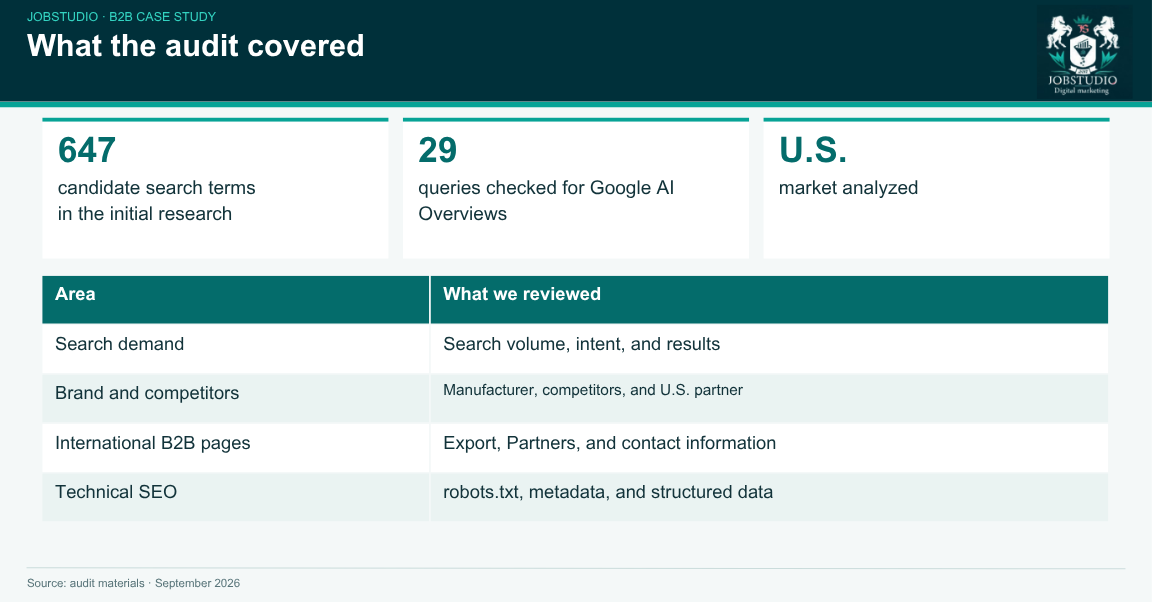
| Basis for the Analysis | 647 search hypotheses, search results, 29 queries to test AI responses |
A Ukrainian alcoholic beverage manufacturer was already operating in the U.S. through a local partner and wanted to attract new importers and distributors. Our task was to determine whether potential partners could find the company in U.S. Google search results and ChatGPT responses, how competitors were positioned in this context, and whether the website helped users progress from learning about the manufacturer to requesting a partnership.
During the audit, the manufacturer’s official website did not appear in Google search results for verified priority search terms targeting the U.S. market. At the same time, competitors appeared in the search results for the manufacturer’s own branded search terms. We identified two distinct scenarios: what a potential partner sees when searching for a supplier, and what they find once they already know the company’s name.
Separately, we analyzed the structure of the page linked to in ChatGPT’s response. We checked whether it was possible to quickly find information about production, product range, and exports, and to determine who to contact regarding partnerships. Based on the audit results, we recommended adding this information to the Export and Partners pages and including a direct contact option for B2B inquiries. The official website should help partners evaluate the manufacturer and begin negotiations, while the U.S. partner’s website should explain the terms of local sales and distribution.
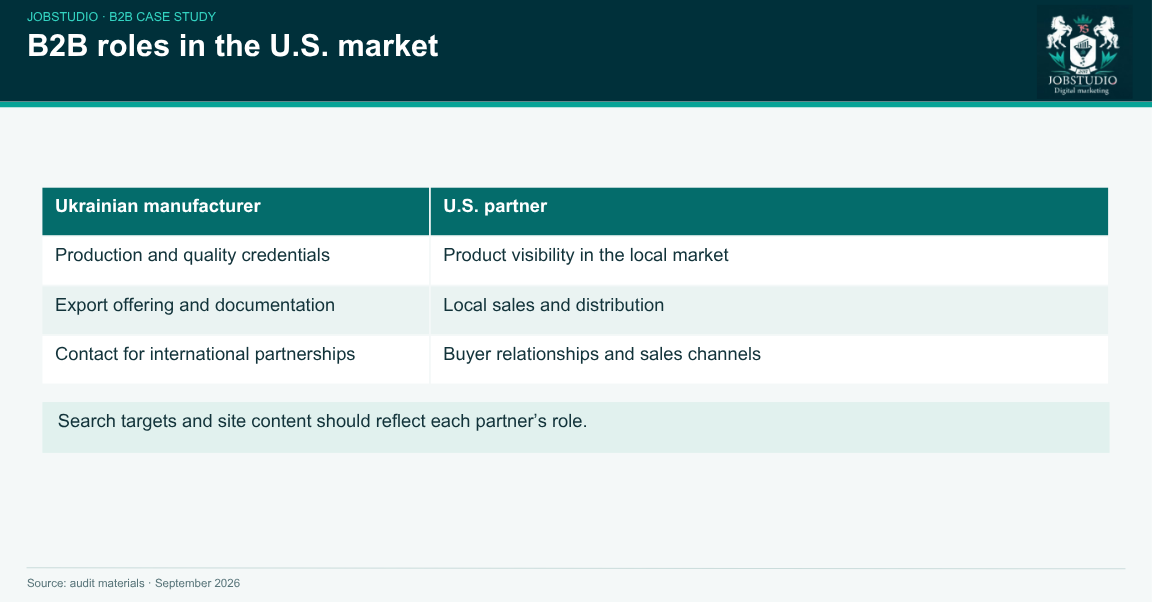
We identified which search topics align with the business’s goals, compared competitors, checked the brand’s visibility in AI responses, and prepared recommendations for the “Export” and “Partners” pages on the manufacturer’s website. Based on the audit results, we determined which website pages should be updated first and what content should be added to them.
The analysis was based on the following scenario: a potential importer or distributor is looking for a manufacturer in the U.S., compares companies, reviews products and documents, and decides whom to contact.
To assess demand, we collected and analyzed 647 search hypotheses. This constitutes the semantic pool; the detailed analysis of search results focused on selected queries from various groups. We categorized them into “wholesale,” “private label,” “supplier/bulk,” “manufacturer/producer,” and queries regarding the Ukrainian origin of products. We compared search frequency with the composition of search results: specifically, which entities gain visibility and what needs these pages fulfill.
We reviewed our client’s brand results—Nemiroff and Khor—the presence of their U.S. partner, SPYRT Worldwide, and 29 queries in Google AI Overviews. We then evaluated their international pages and the technical findings outlined in the audit.
The data reflects the searches recorded in the September 2026 study. The Ahrefs frequency is an estimate, and the sample of AI responses represents the queries analyzed at the time of the study.
Out of 647 search hypotheses, 26 phrases received a non-zero frequency score from Ahrefs. Their combined estimated monthly search volume in the U.S. was 2,750. This figure does not equal the number of unique buyers and is not a forecast of website traffic. A zero frequency score for other phrases also does not prove the absence of demand.
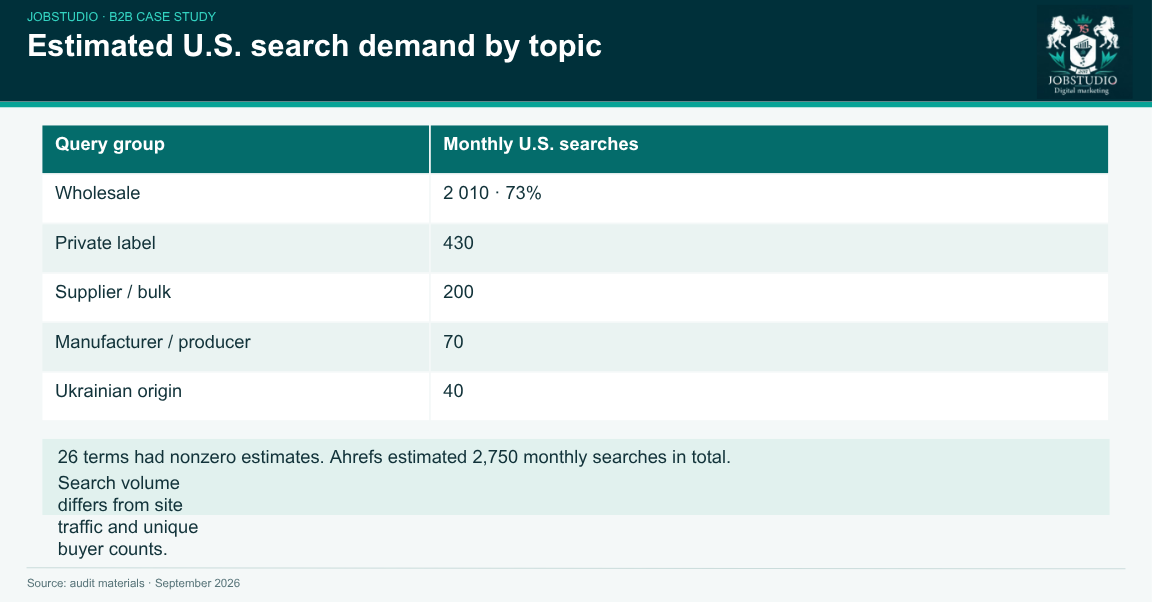
“Wholesale” seemed to be the most promising in terms of volume. However, a search for “wholesale liquor” and “wholesale alcohol” yielded stores, local wholesalers, catalogs, and various types of suppliers. Someone with this search query isn’t necessarily looking for a foreign manufacturer to work with directly.
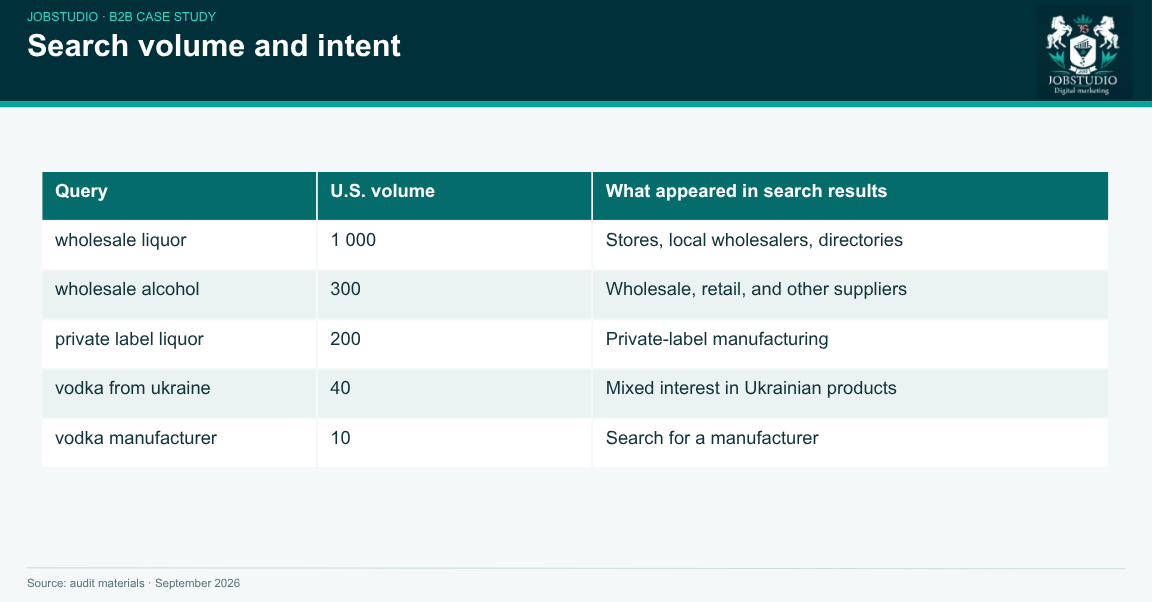
On the manufacturer’s website, the buyer should verify the product’s origin, availability, and partnership terms. A local seller may fulfill a different need: finding a product and purchasing it in the U.S. That is why we separated these scenarios as early as the stage of selecting search criteria.
We have identified inquiries regarding the manufacturer, exports, Ukrainian origin, and private-label production for further review. Each group requires a corresponding proposal and page content.
For example, “vodka from Ukraine” specifies the origin, but it may also be of interest to the end consumer. A private label page makes sense if the company has proven capabilities and is willing to operate under this model.
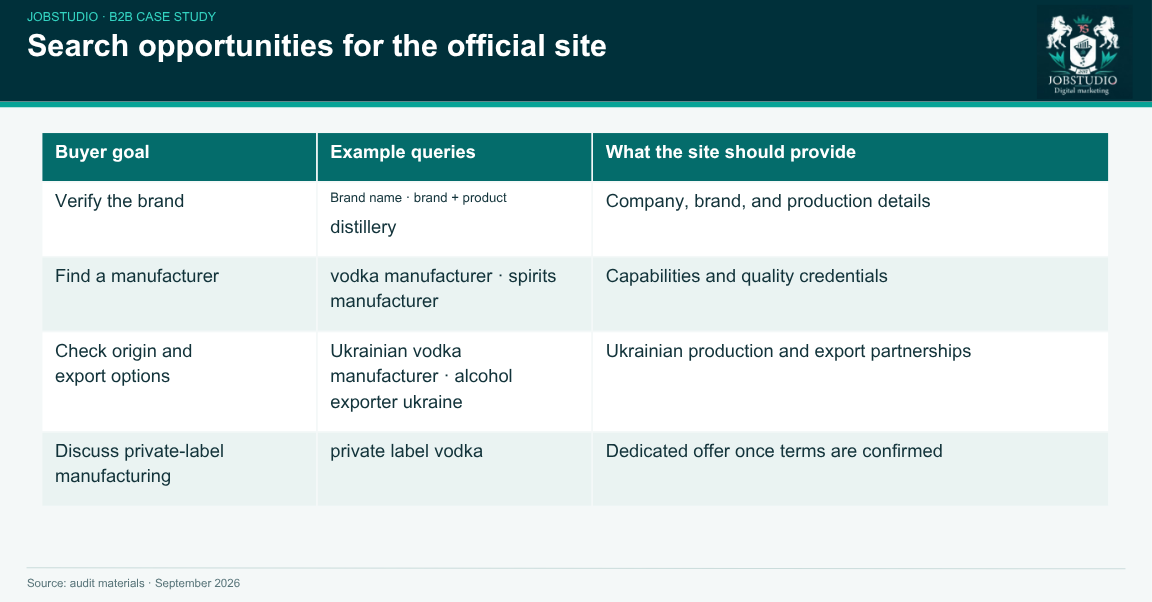
Tim Soul describes a similar principle in a post about business potential on LinkedIn. He explains that traffic potential and ranking difficulty aren’t enough: a topic must also be evaluated based on its ability to represent the business’s product. For our client, we applied this logic to the selection of search topics: to what extent does a search query align with what the manufacturer can offer its partner?
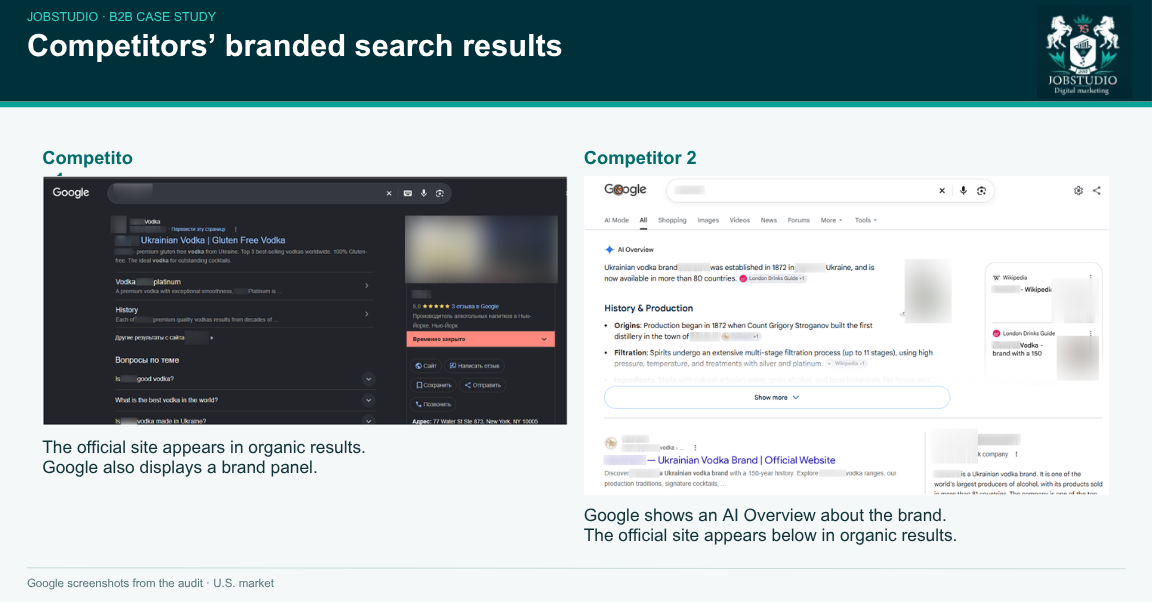
In the U.S. search results recorded based on our brand query, third-party sellers and SPYRT Worldwide were prominent. The official website did not appear at the top of the results. For Khor and Nemiroff, the check showed prominent official brand results.
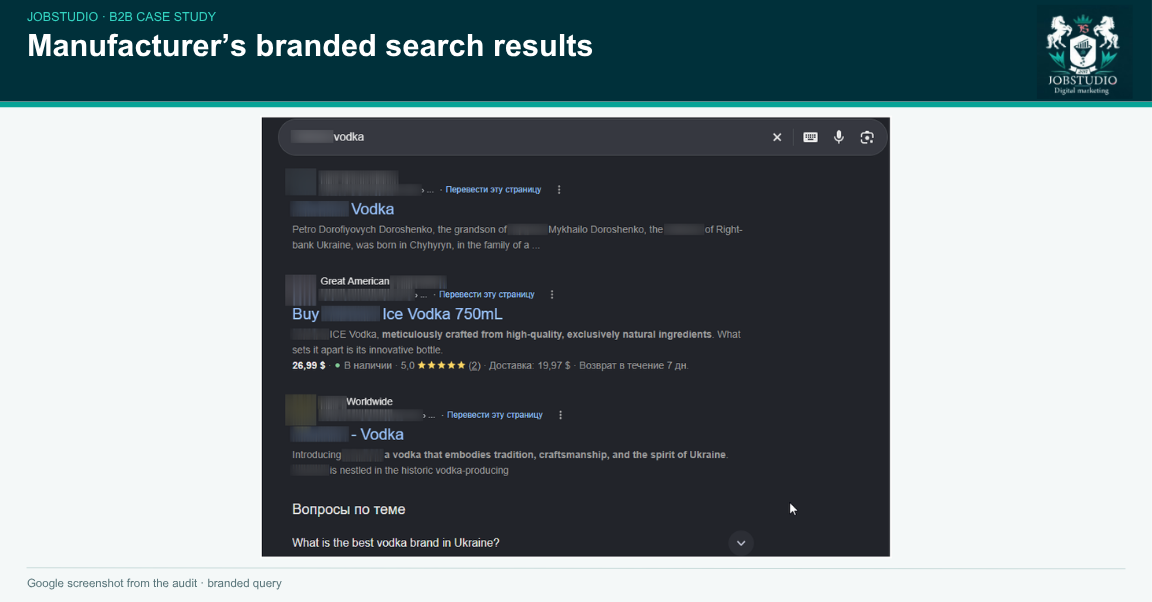
The American partner’s website introduces visitors to its products. To enable an importer or distributor to evaluate the possibility of collaboration, we recommended adding content to the Export and Partners pages on the manufacturer’s official website. These pages should include information about production capacity, export experience, and available documentation, as well as a direct contact for partnership inquiries.
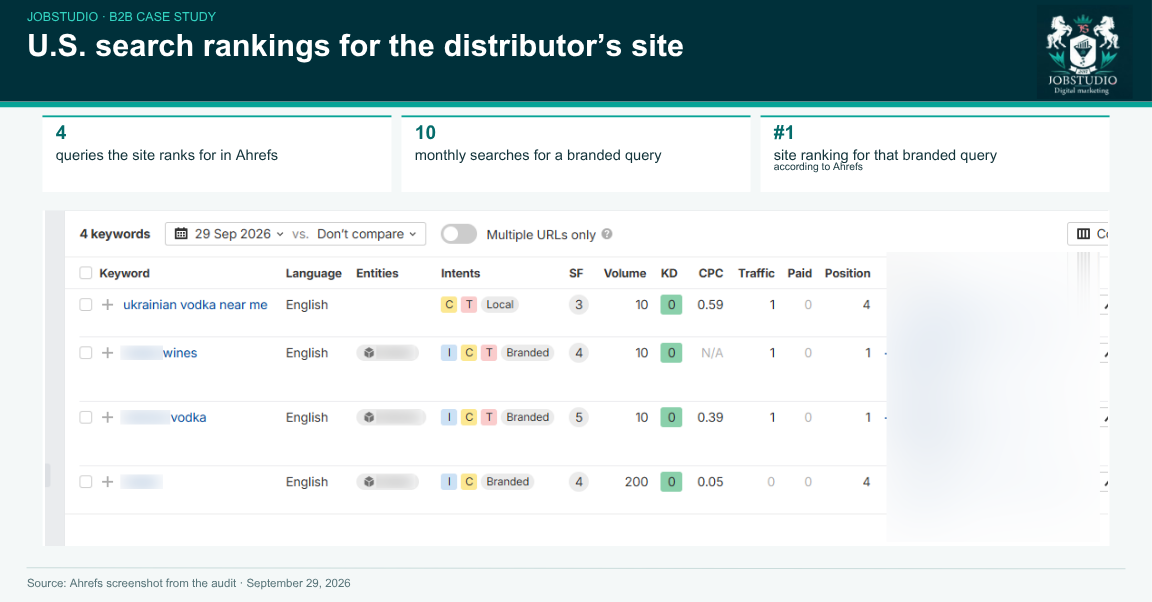
We analyzed SPYRT Worldwide separately. In the Ahrefs snapshot for the U.S. shown here, the domain had four visible organic keywords, including the top position for a brand-related query. The estimated search volume for this phrase was 10 searches per month. This indicates the partner’s presence in brand-related searches, but does not suggest that its visibility fully captures the demand for the manufacturer.
The data from Ahrefs and the Google screenshots represent different snapshots, so we do not equate the ranking from the tool with all search results checks. What’s more important for the strategy is this: the local partner already represents the brand, while the official website needs to provide a clearer overview of production and international partnerships.
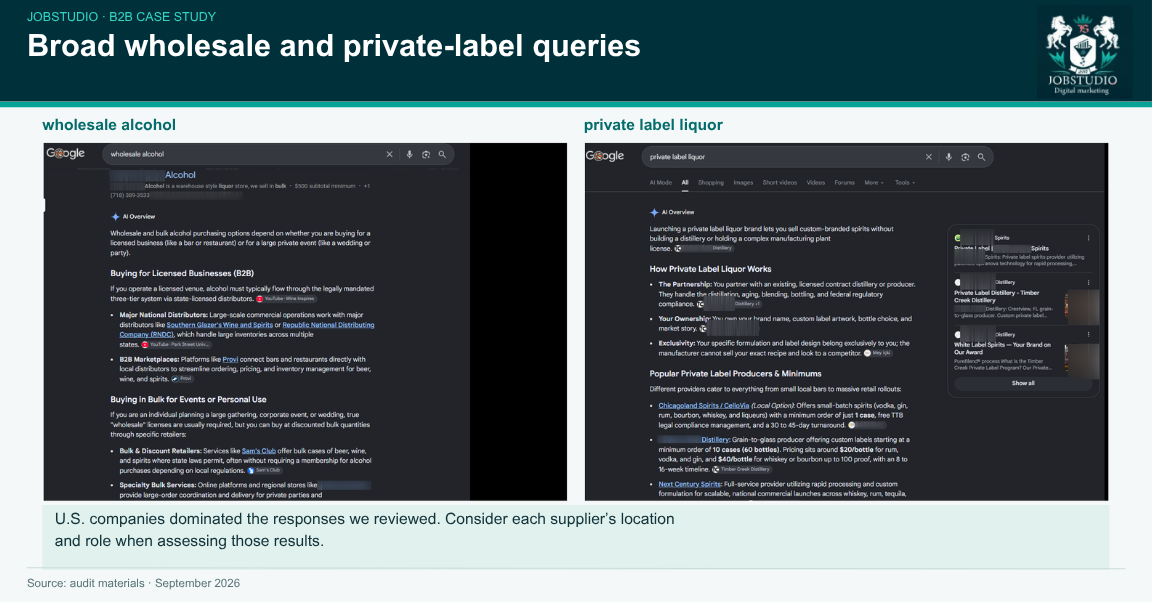
When searching for the broad terms “wholesale alcohol” and “private label liquor,” American companies dominated the verified AI responses. This helped refine the evaluation criterion: the absence of a Ukrainian manufacturer in a localized result does not, in and of itself, explain its visibility in an international B2B search.
Next, we reviewed search queries that directly refer to Ukraine. For “vodka from Ukraine,” Google listed Nemiroff and Khor; our client appeared indirectly, through the production of Ukrainian Freedom. In the verified results for “vodka distillery ukraine,” Khortytsia, Nemiroff, and Zirkova appeared, but our client was not listed.
This difference highlighted which relationships should be explained more clearly on the website: the company, the manufacturer, the brands, and the country of origin. At the same time, searches for Ukrainian products can have both consumer and professional intent, so we evaluate their value based on the content of the search results and user inquiries.
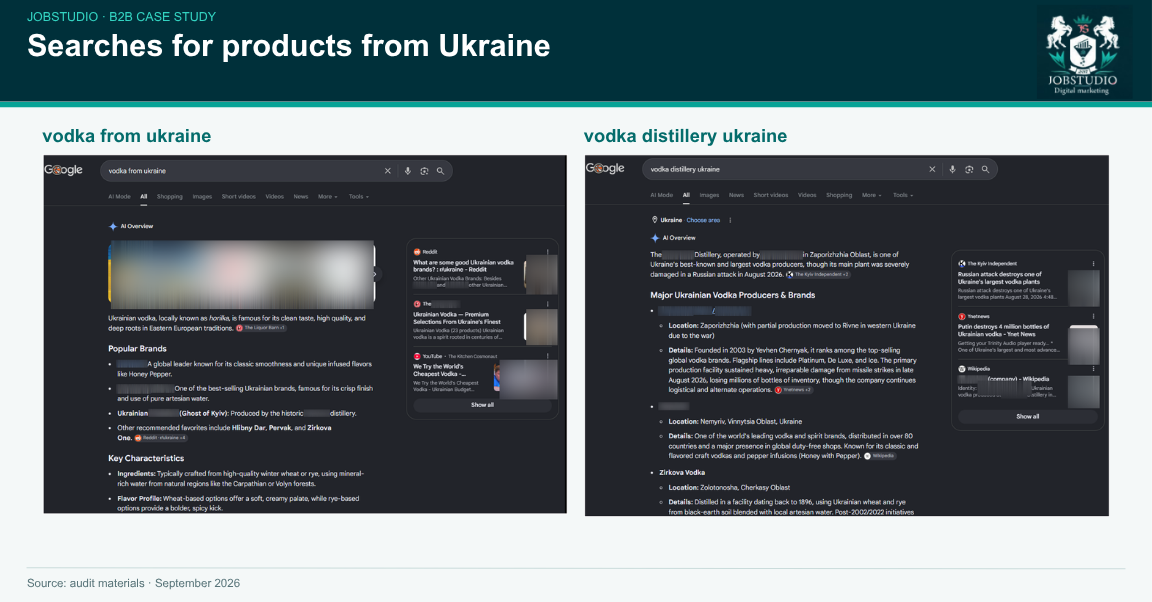
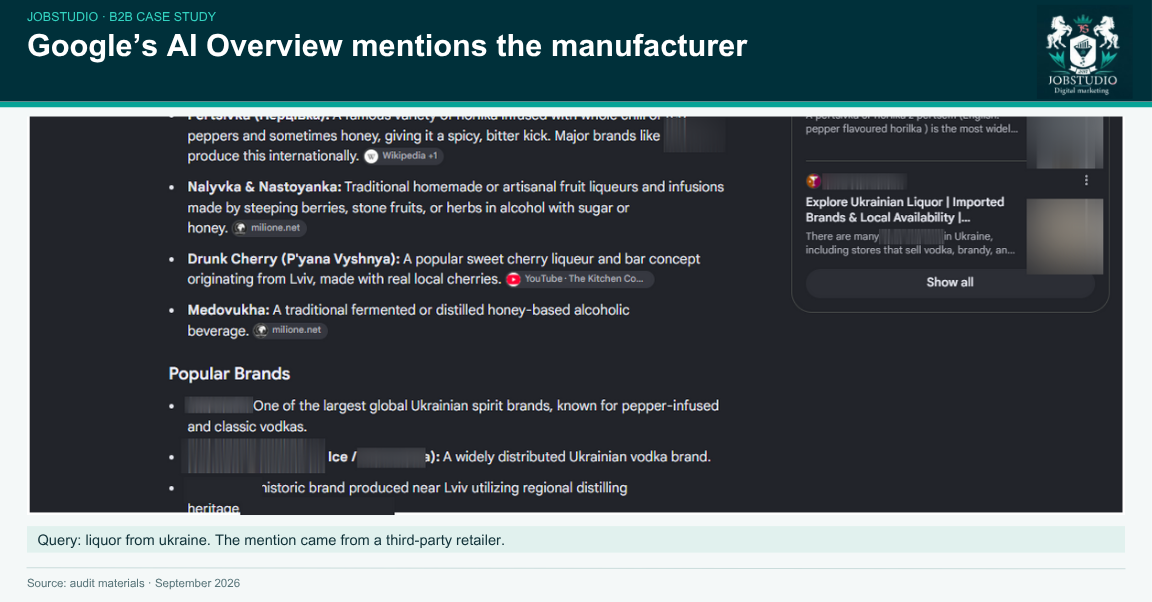
A telling example: “liquor from ukraine.” In the response, our client appeared in the list of brands, but the link next to the mention led to GotoLiquorStore.
The verified results for “alcohol exporter ukraine” included Bayadera Group, Nemiroff, Shabo, and Obolon. Our client did not appear, even though the website has pages titled “Export” and “Partners.”
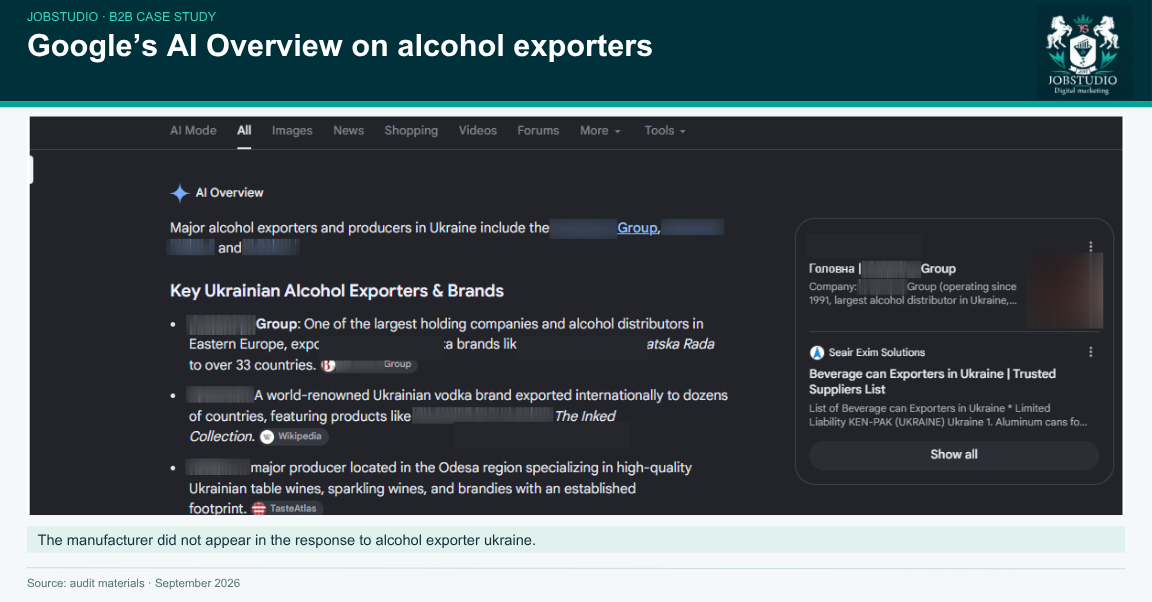
The company had “Export” and “Partners” pages on its official website, but it was not mentioned in the verified Google AI Overviews response regarding Ukrainian exporters.
Based on the audit results, we provided the client with a list of revisions and additions for both pages. We suggested explaining the company’s role as a manufacturer more clearly, describing the available forms of collaboration, and adding facts about production and exports that a potential partner could verify.
A separate phase of the project involves SEO optimization of these pages for relevant B2B search queries targeting the U.S. market. For each page, a specific set of search queries must be selected based on the information a potential partner is looking for.
We recommended compiling verifiable information on the website: who manufactures the products, what forms of cooperation are available, what documents a partner can obtain, and who to contact. A separate task: verify that these facts match the information on the partners’ websites and in other external sources.
The importance of a broader brand presence is consistent with an Ahrefs study presented by Louise Linehan on LinkedIn. In a study covering 75,000 brands, the authors found a correlation of 0.664 between online brand mentions and brand visibility in AI Overviews. This is a statistical correlation, not a guarantee of citations after a certain number of publications.
For us, the practical takeaway is this: the review should cover both the official website and how the company is described on external resources. At the same time, mentions of the brand and links to its domain should be counted separately.
Our client’s website already features information supporting international cooperation: details about production, HACCP, logistics, and export experience. During our analysis, we focused on how these facts help a partner evaluate a specific proposal.
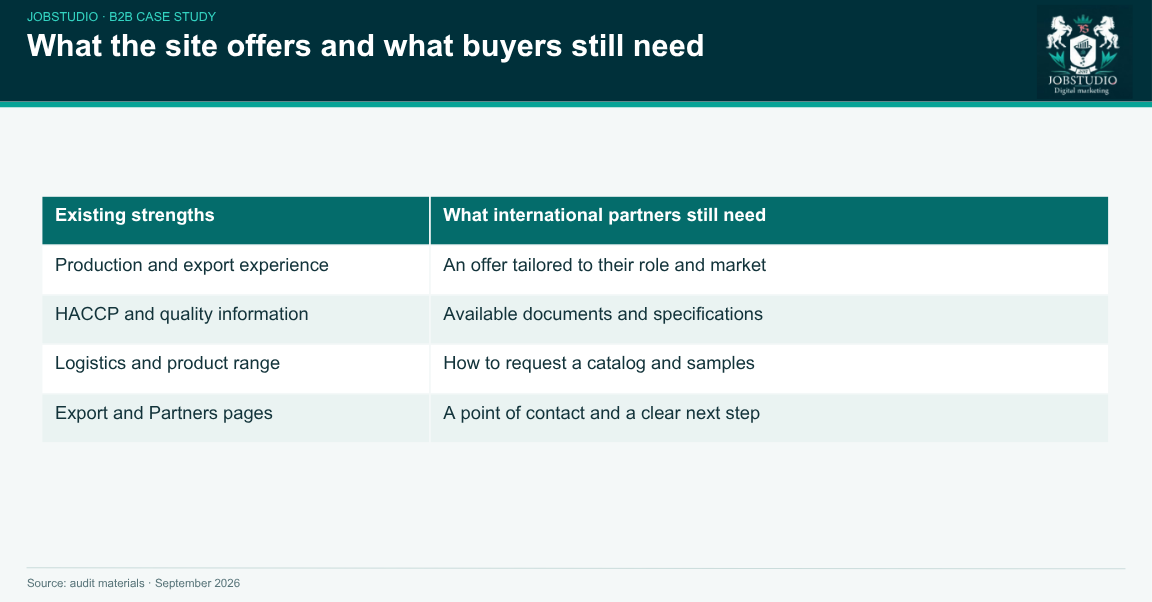
On the Export and Partners pages, we checked whether buyers could find products suited to their market, access the catalog and documentation, and contact the export team. These responses are what help us move on to evaluating the supplier.
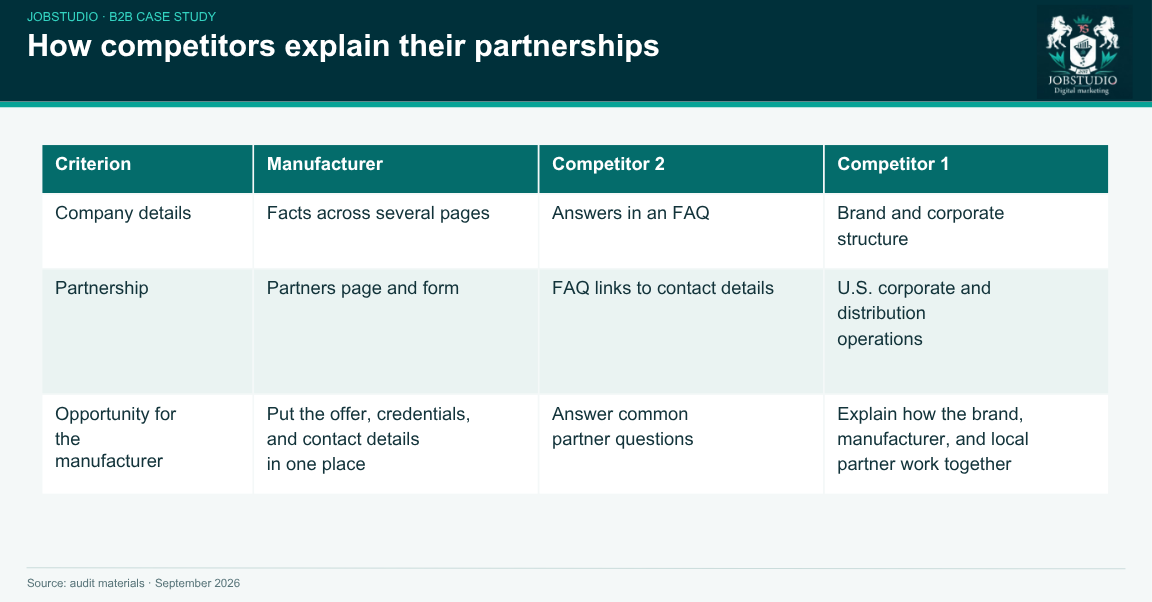
Nemiroff has a separate FAQ section that answers questions about the manufacturer and distribution partnerships and directs interested parties to contact information. On our client’s existing Export and Partners pages, there was no such section for importers and distributors. The Partners page already allowed users to submit a request, but the information needed to evaluate the manufacturer had to be searched for on various pages of the website.
We recommended supplementing these pages with brief answers to questions that arise before the first contact. An importer or distributor should immediately see what forms of cooperation are available, how to request an export catalog, samples, and documents, and who to contact to discuss delivery terms.
For visitors reviewing the distribution offering, a step-by-step page flow was proposed. The first screen should explain what the manufacturer offers to international partners. Next, display publicly available information about the product lineup, manufacturing, and quality certifications.
The next section should explain how to obtain an export catalog, specifications, and samples. Next to it, include the export team’s contact information and a specific call to action, such as “Discuss distribution” or “Request a catalog.”
After the initial contact, the partner should understand the next steps: clarifying needs, exchanging materials, and discussing commercial terms. This is a recommended scenario; the actual sequence and composition of documents must be agreed upon with the company. A private label proposal should be presented as a separate offer after its terms and priority for the manufacturer have been confirmed.
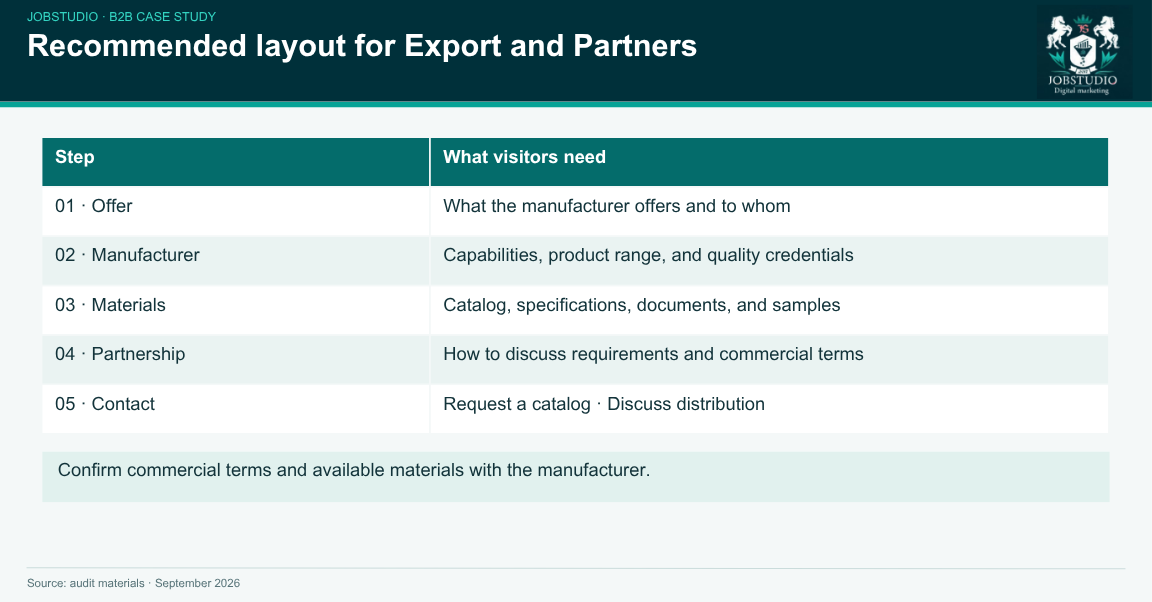
We suggested starting with English-language pages that introduce the partner to the manufacturer. Next, we’ll add sales-oriented content and set up lead tracking.
Initially, we recommended correcting the metadata and verifying that the priority English-language URLs were indexed. At the same time, we suggested updating the information about the company, brand, and manufacturer to ensure consistency across key pages.
Next, update the “Export” and “Partners” sections with the described collaboration scenario. Combine the publication of materials with the setup of action tracking: this way, future changes can be evaluated based on inquiries from potential partners.
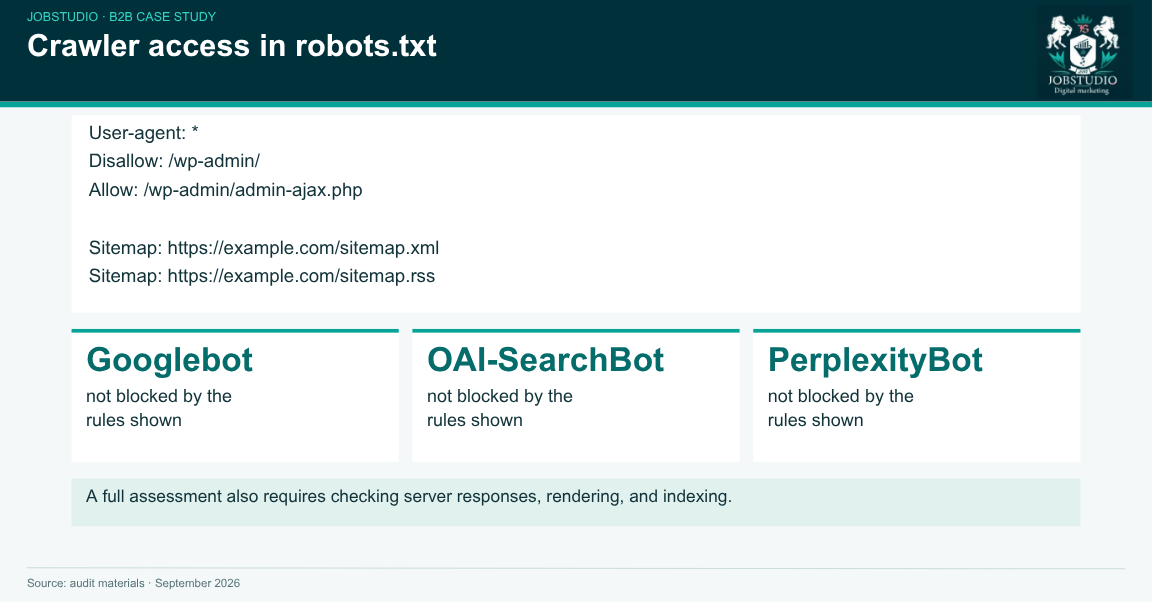
A check of the robots.txt file did not reveal any restrictions on crawling public pages by Googlebot, OAI-SearchBot, and PerplexityBot. Subsequent technical checks should cover server responses, rendering, and indexing: permission in robots.txt alone does not confirm that the site is fully accessible.
A technical audit revealed a page builder shortcode in the description of certain English-language URLs and incomplete information about the company and its products in the microdata. We have included the necessary fixes in our plan. Simply adding markup does not guarantee that the content will be cited by AI.
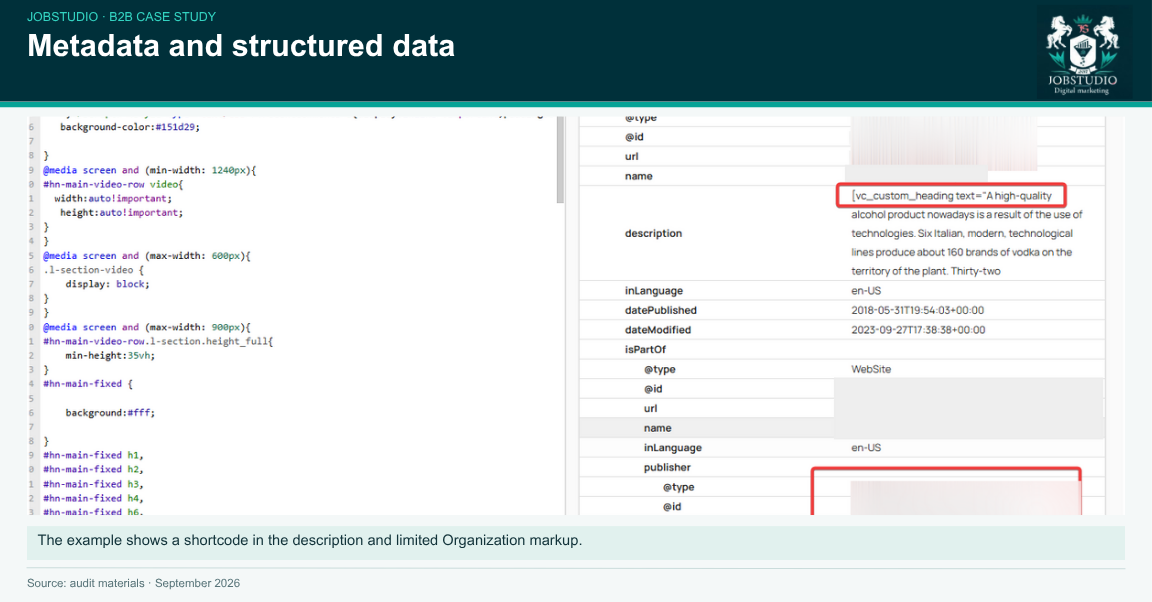
In the example shown, the main English-language “Organization” page is described only minimally, and a system shortcode is visible in the description. For the product page, the audit results show a WebPage without a separate Product/Brand section. Therefore, the recommendations include cleaning up the descriptions and linking data about the company, brand, and manufacturer.
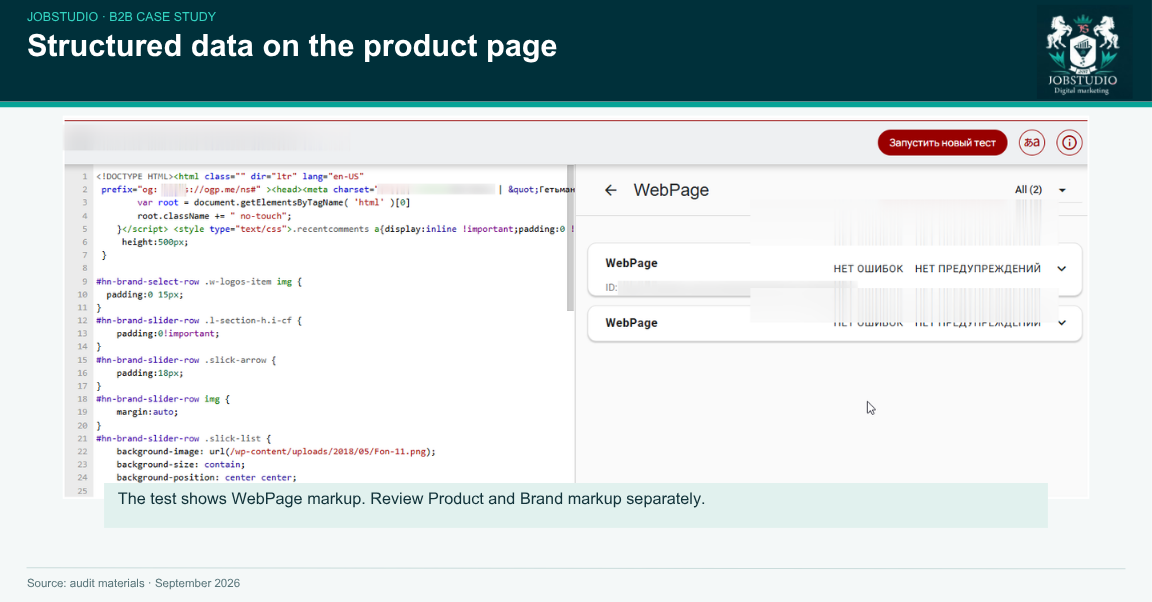
Such findings provide specific areas for improvement. They should not be interpreted as a proven cause of the lack of citations: our audit documented the status of the pages and generated working hypotheses for further verification.
To evaluate future efforts, it was recommended to track catalog inquiries, distribution requests, and sample requests. In sales, it’s important to record the country, the company’s role, the subject of the inquiry, and the follow-up status. This will help distinguish general website activity from qualified B2B interest.
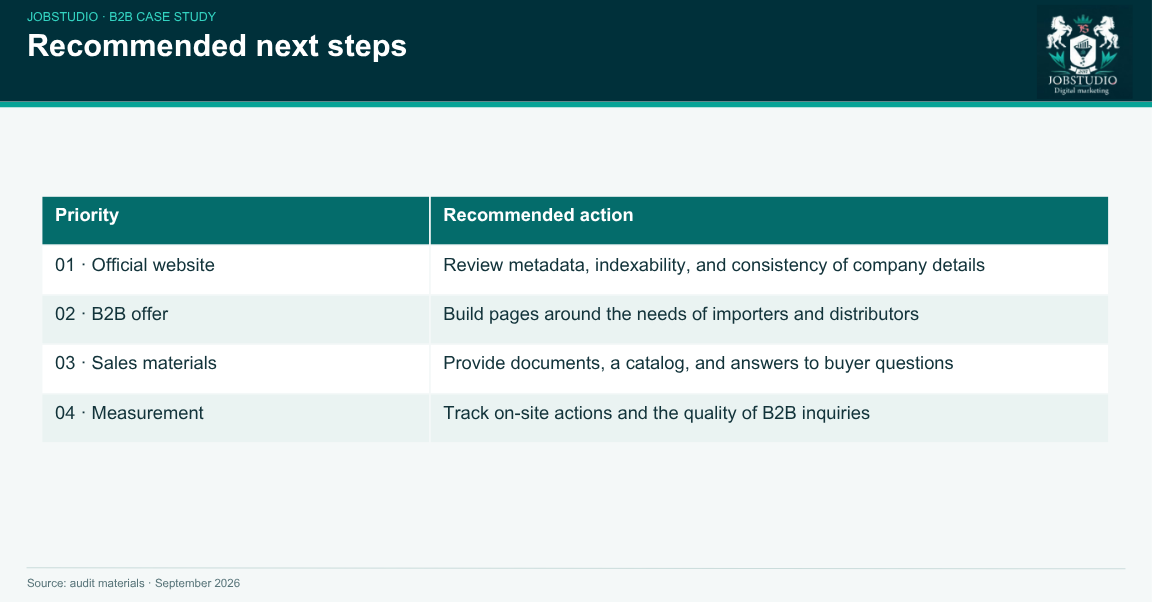
We linked each key finding to a specific solution for the website.
| What They Found | What solution was proposed? | What to Check After Implementation |
|---|---|---|
| The largest share of searches comes from broad wholesale queries | Separate local purchasing from finding manufacturers; process production and export inquiries | Visibility of the relevant pages and relevance of search queries |
| The sample includes mentions of the manufacturer, but there are no links to its corporate website | Supplement the official facts and verify their consistency with external sources | Brand mentions and domain citations in follow-up audits |
| Some of the responses for the partner are missing from the international pages | Compile a catalog, documents, a plan for the start of the collaboration, and contact information for the export team | Requests for catalogs, samples, and qualified B2B leads |
The client received a well-reasoned plan of action: which search areas to focus on, what to add to the international pages, and how to evaluate the quality of traffic. This helps determine where to allocate the budget and what to monitor after the changes are implemented.
The result described pertains to a completed audit. The impact of the implementations is assessed separately in terms of changes in visibility, citations, and the quality of inquiries.
Planning to expand into the international market? JobStudio will analyze search demand, your company’s visibility on Google and in AI-generated responses, and identify priorities for optimizing your website for potential partners.

 Contacts
 Language
 Book a call
 Order a proposal


