Get a responsible approach in promoting your project.
Contact us now!
Contact us now!



It’s no longer enough to say “SEO = Google = rankings = clicks.” Not because Google is no longer the main player, but because search behavior itself has expanded. Amanda Natividad, Vice President of Marketing at SparkToro, puts it very succinctly: “Search is a behavior.” People search not only on Google, but also on YouTube, Reddit, Amazon, AI interfaces, and communities, where they gather evidence, compare options, and verify brand trust.
Table of Contents
It’s important to note that this isn’t an “anti-Google” story. On the contrary: Rand Fishkin’s research for SparkToro shows just how massive Google still is—in terms of browser traffic, it equals the next 13 largest websites combined. But that is precisely why search often takes credit for demand that was generated earlier at other touchpoints: on social media, in the media, in emails, in communities, on podcasts, and in reviews. This leads to an unpleasant realization for old-school SEO: it’s no longer the one who simply “stood at the top” who wins, but the one who has built a stronger public brand presence.
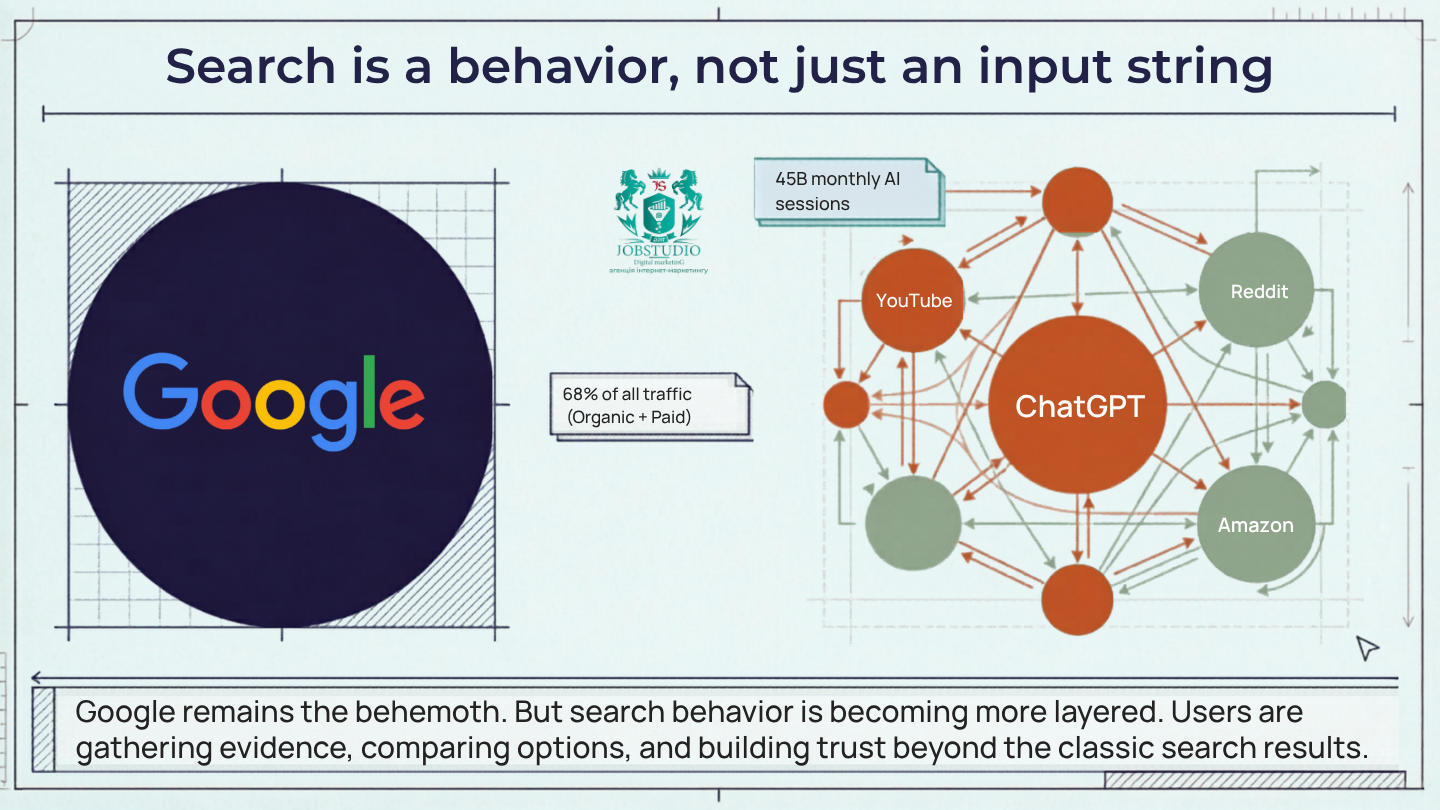
Taking a broader view, this does not diminish the power of search as a channel. Even before the AI era, BrightEdge reported that organic and paid search accounted for 68% of all tracked website traffic, with organic search alone averaging 53.3% across industries. In B2B, combined search accounted for 76% of traffic, and B2B companies generated twice as much revenue from organic search as from any other channel. In other words, search hasn’t disappeared. It has simply ceased to be a single-layer channel.

It is also worth considering the scale of AI interfaces. According to Graphite’s estimates, AI usage already accounts for 56% of global search volume, and globally, AI generates approximately 45 billion monthly sessions; 83% of AI usage occurs in mobile apps, and ChatGPT holds an 89% share of the global AI market. These are not official statistics from Google or OpenAI, but rather a market estimate by Graphite, so they should be treated as a strong indicator of scale rather than absolute truth. But the trend itself is clear: AI is no longer a “side project,” but a real part of search behavior.
At JobStudio, we see it this way: the battle is no longer just about securing a spot in the SERPs. It’s about the right to be found, correctly interpreted, cited, and selected in an environment where decisions are increasingly made not by a person scrolling through 10 links in a Google search, but by a system that aggregates answers from dozens of sources.
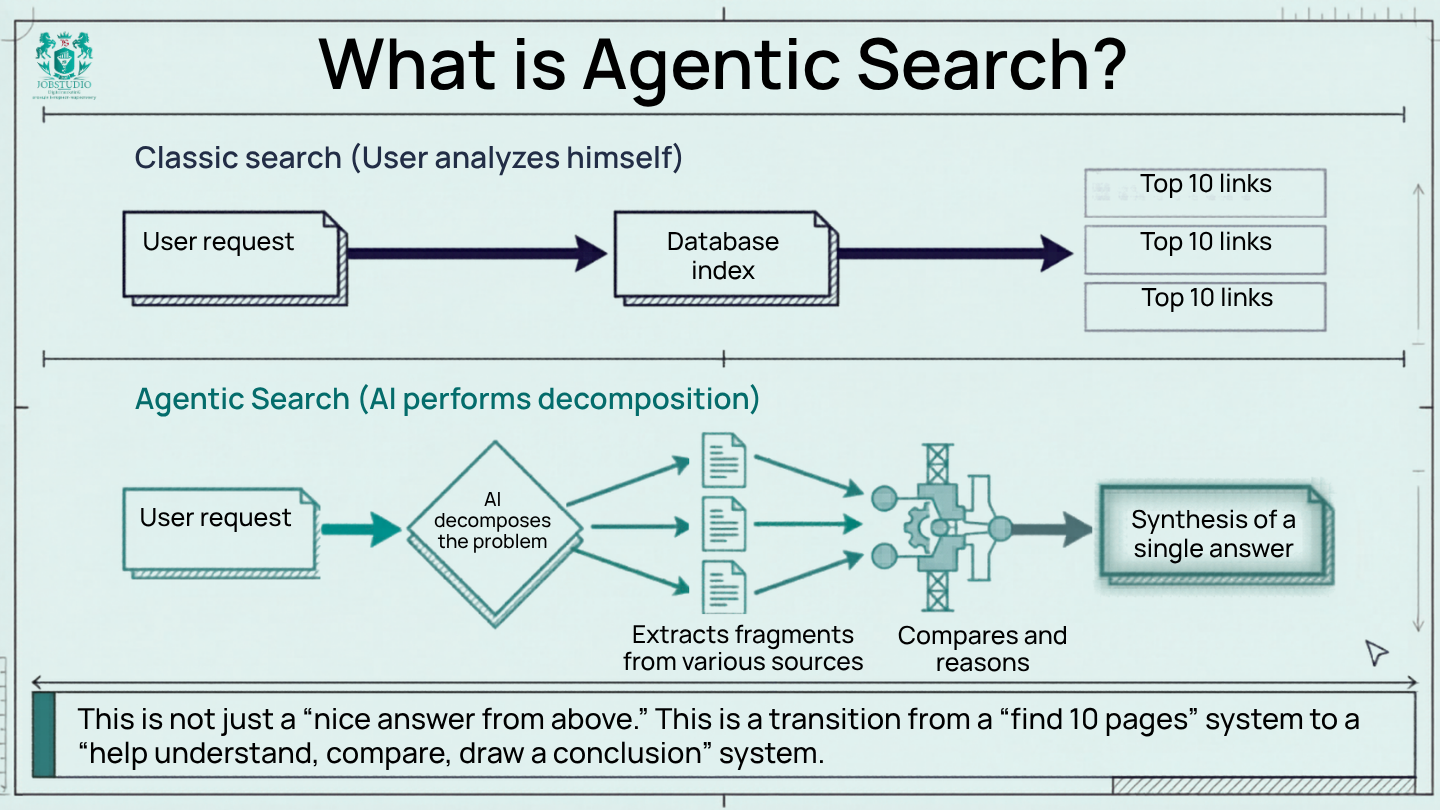
Agentic search isn’t just a search that displays a nice answer at the top. It’s a model in which the system isn’t limited to a single user query and a single list of documents. It breaks down the task, generates clarifying sub-queries, extracts relevant snippets, compares them, synthesizes a summary, and only then returns the result. That is precisely why AI Mode and AI Overviews should be viewed not as “just another SERP feature,” but as a different logic of interaction between the user, the index, and the model.
Google has already officially explained this quite clearly: AI Mode is particularly useful for queries that require further research, analysis, or complex comparisons. In other words, the system is designed not to “find 10 pages,” but to “help you understand, compare, and draw conclusions.” And that’s where query fan-out comes into play: AI Overviews and AI Mode can run multiple related searches across subtopics and data sources, as well as display a broader and more diverse set of supporting links than a classic search.
This aligns well with current market discussions. AEO Conf 2026 was co-organized by Graphite, AirOps, and Webflow specifically to explore how AI is transforming discovery, citation, and the new logic of content for LLMs. And Michael King had previously warned that we are underestimating the impact of memory, personalization, agency, and new content curation models. In our own breakdown of Google I/O 2025, we also noted the same shift: search is becoming less linear and more conversational, contextual, and fragmented.
The biggest problem with the topic of agentic search is that it has already become a market of grandiose promises. Therefore, we should start not with “ChatGPT’s secret factors,” but with setting clear boundaries.
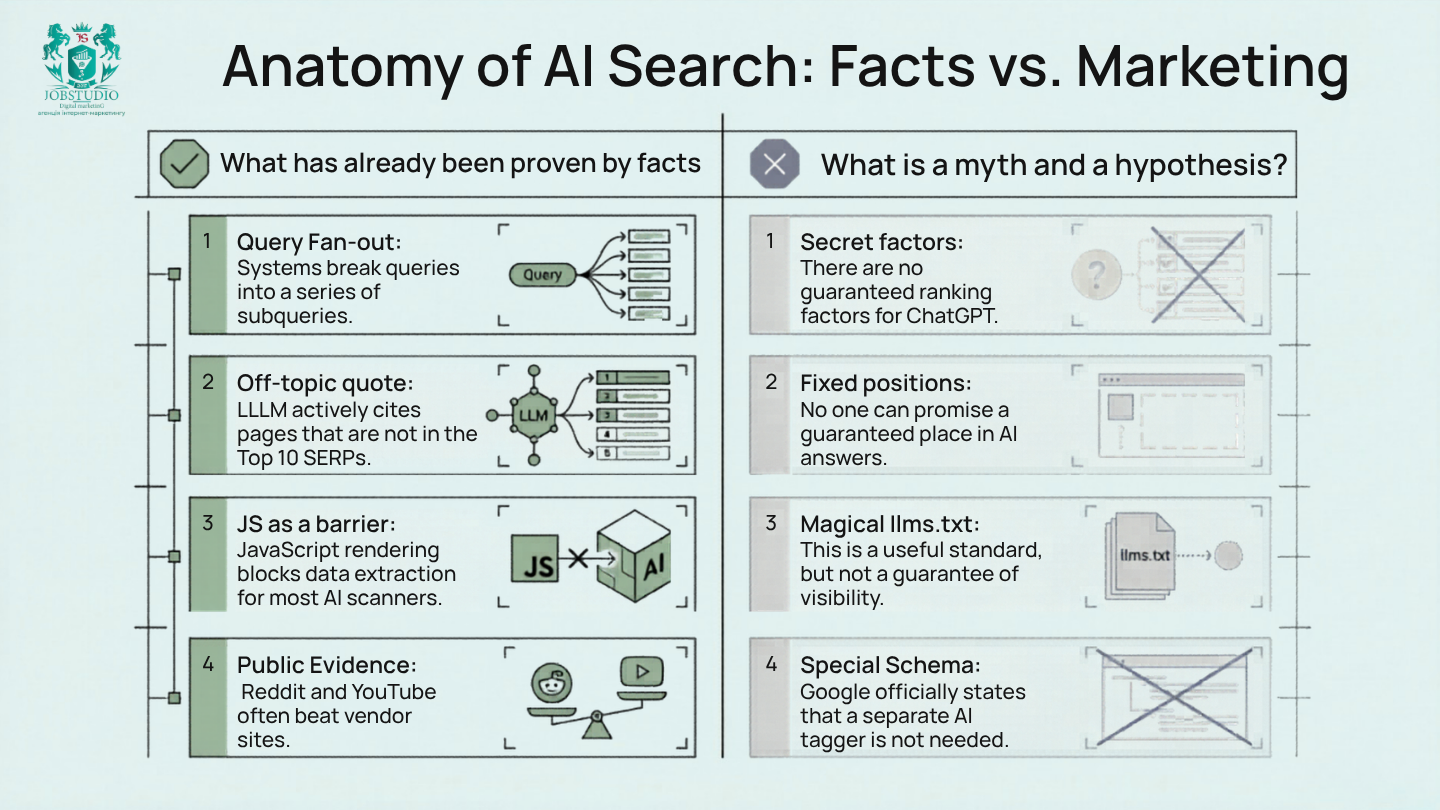
This can now be considered confirmed. First, Google officially recognizes query fan-out in its AI features. Second, AI systems can actually cite pages that do not appear in the top 10 of classic search results. Third, a page’s technical extractability matters: in Writesonic tests, 9 out of 11 metadata elements returned zero, and ChatGPT, Claude, and Gemini do not execute JavaScript on live samples at all, contrary to what many teams have come to expect. Fourth, off-site evidence really matters: Reddit often appears before vendor websites in B2B SaaS results, even for general category queries.
For now, this information should be presented with caution. There is no public list of “ChatGPT ranking factors.” There is no basis for claiming that llms.txt has already become a standard that determines visibility across all LLMs. It is not possible to honestly promise a “guaranteed appearance” in AI responses. And even strong market claims such as “95% of cited domains are within the top ten” or “60% of prompts contain more than 10 words” should be labeled as conference or market observations, not as an official industry standard.
At JobStudio, our rule is simple: we don’t sell magic. When something is a fact, we state it as such. When it’s a working hypothesis, we label it as such.
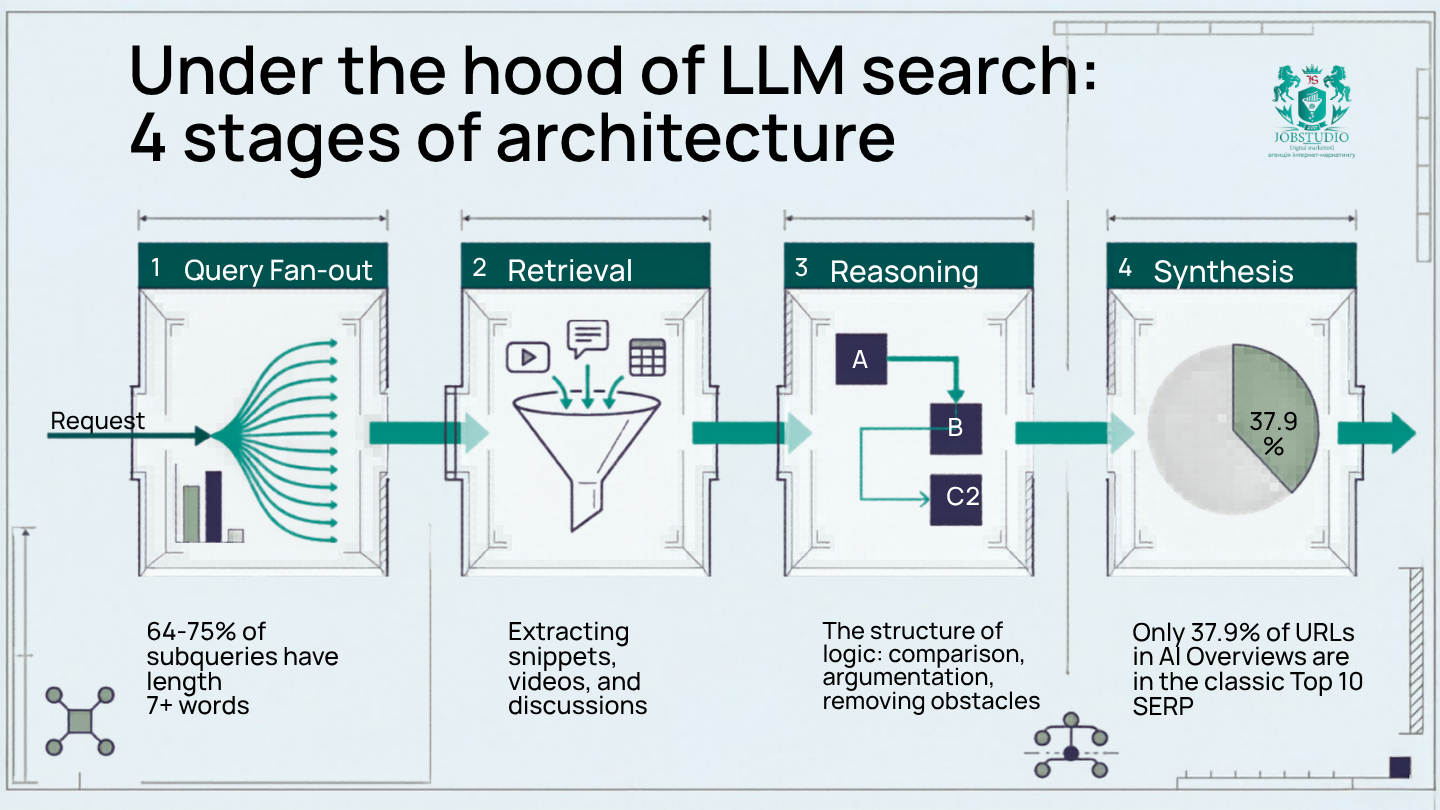
Query fan-out: what the system is actually looking for
The biggest pitfall of old-school SEO is the assumption that a user enters a single query, and therefore competition revolves around that single query. DEJAN shows that the reality is different: in their analysis of production workloads, they recorded approximately 365,920 fanout queries on Google, OpenAI, and Amazon Nova. And importantly, these queries are significantly longer than a typical classic search: on Google, 64.9% of fanout queries had 7+ words, and on OpenAI, 75.8%. This is a very strong argument against the “main keyword + a couple of supporting keywords” mindset.
After the fan-out, the system doesn’t “see your page” in the human sense. It pulls up candidates: pages, snippets, videos, tables, forums, and reviews. Google explicitly states that AI features can display a broader and more diverse set of useful links. This means that competition is no longer limited to similar landing pages at the top of the search results, but now extends to various formats of content: articles, forum discussions, YouTube videos, comparison pages, and FAQ sections.
Now comes the most interesting part. In our own breakdown of Google I/O 2025, we described this as a shift from page-based thinking to a chain of reasoning: the system doesn’t just check whether “the page matches the query,” but whether a specific snippet helps build the logic of the answer—to compare, explain, confirm, address objections, or provide a scenario. That is precisely why content with clear cause-and-effect blocks, comparisons, examples, and complete micro-conclusions wins out more often than a beautiful but vague “expert canvas.”
The final step is synthesis. The system takes several of the best snippets and generates the final response. This is where it becomes clear just how dangerous it is to reduce SEO to the mindset of “we’re in the top 10, so they’ll choose us.” According to Ahrefs, only 37.9% of the URLs cited in AI Overviews were also in the top 10 SERP blocks. Another 31.2% were in the 11–100 range, and 31.0% were outside the top 100 blocks altogether. In the test focusing solely on blue links, the distribution is very similar: 37.1% in the top 10, 26.2% in positions 11–100, and 36.7% outside the top 100. In other words, an AI response is not simply “top search results shuffled by an LLM.”
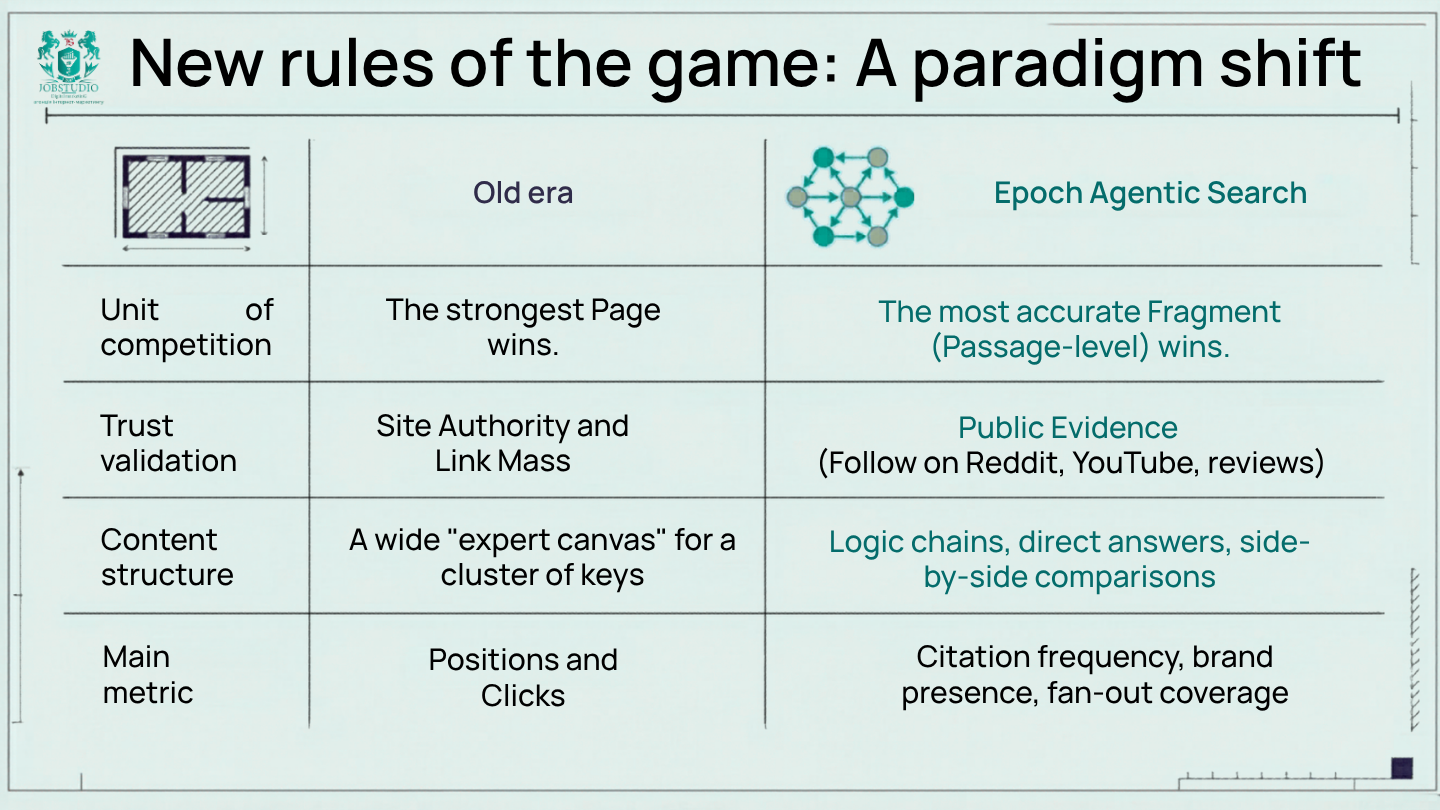
If you were to sum up this change in a single sentence, it would go like this: the new unit of competition isn’t a page, but a snippet. A single paragraph can win a direct comparison. A single list can appear in the search results. A single comparison block can explain the difference better than an entire competitor’s page. This is the practical essence of passage-level SEO, which is so often discussed in the context of AI Mode.
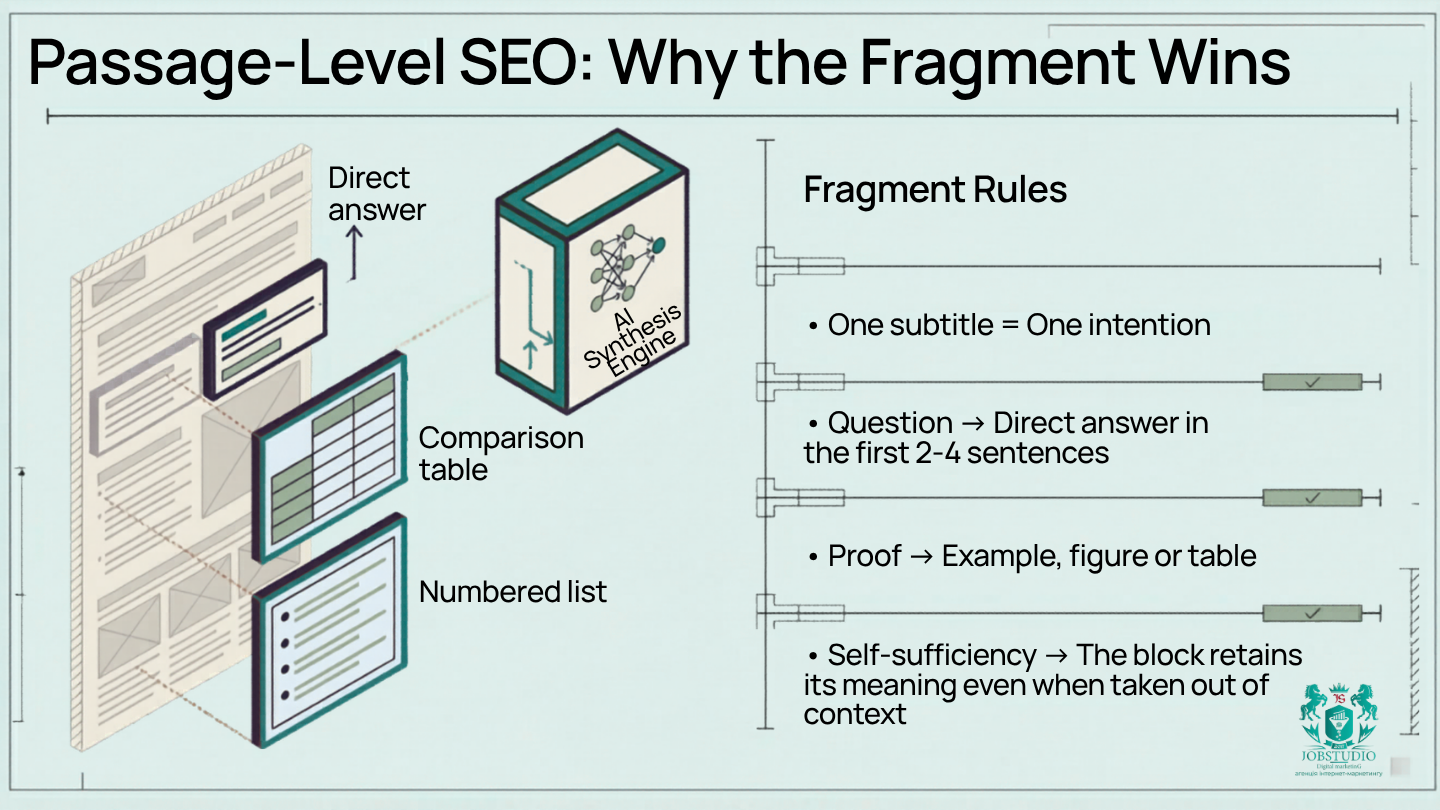
This gives rise to a new writing discipline. One paragraph—one complete thought. One subheading—one purpose. Immediately after a question—a direct answer. Next—evidence, an example, or a comparison. If a section cannot stand alone, the model tends to omit it. If, however, it is self-contained, clear, and useful, it has a chance to “shine” even without dominating the entire page.
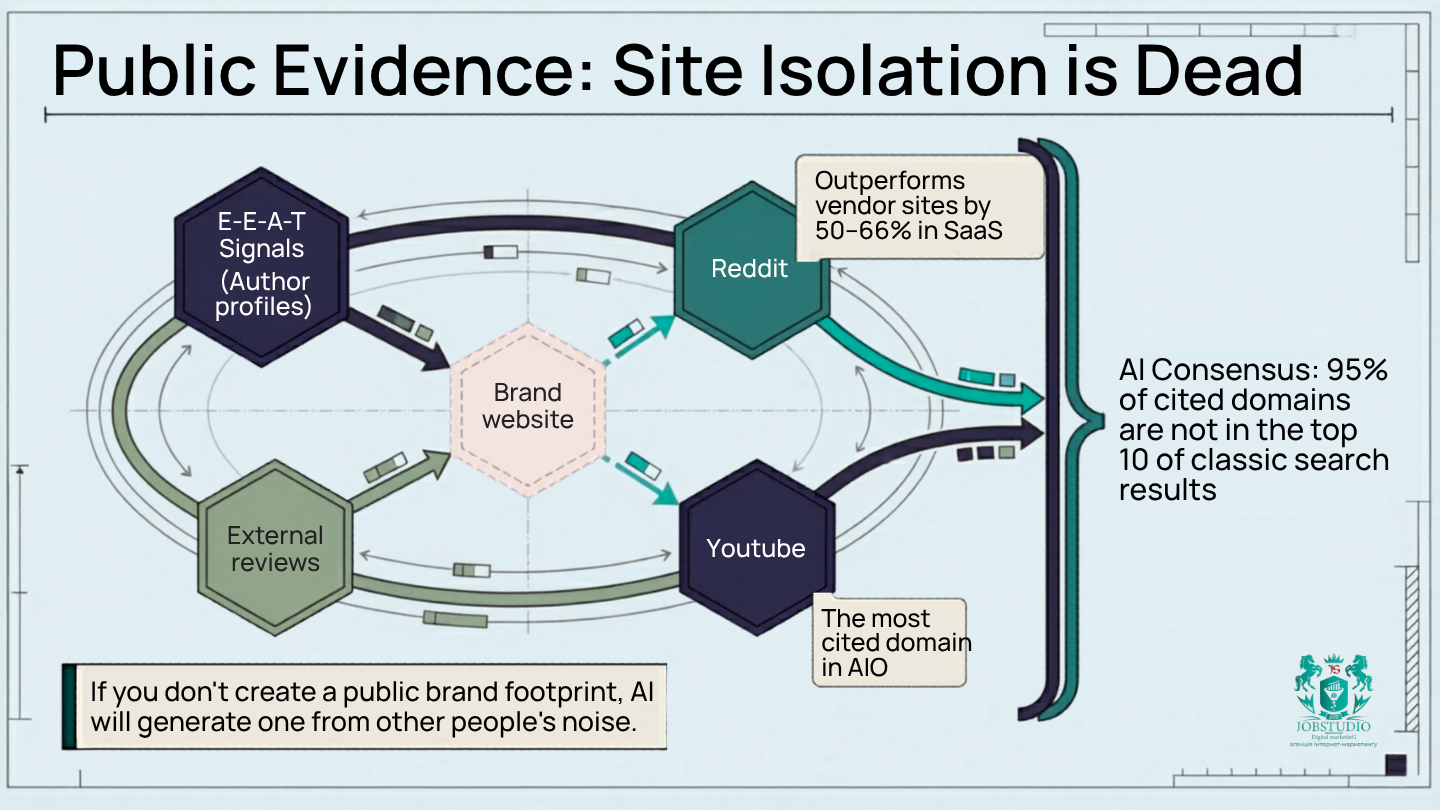
Cyrus Shepard makes a very compelling point: search visibility is no longer just about page rank, but rather an entire layer of public evidence that makes a result appear relevant, trustworthy, and click-worthy. This is one of the key tenets of the new era. AI and search engines are increasingly less likely to trust a page “in isolation”; they assess whether there is a trail surrounding the brand: mentions, discussions, reviews, profiles, authors, trust signals, and external endorsements.
Ross Simmonds backs this up with data. In a study by the Foundation, Reddit outperformed all vendors by 50–66% for general keywords across 3 out of 4 SaaS verticals, capturing 957,540 monthly searches. And most importantly: this isn’t just a “reviews story.” 77% of the search volume Reddit captures comes from general category keywords, not just “best,” “reviews,” or “alternative.” And even more telling: for queries with 6+ words, Reddit showed a 73–100% win rate across various verticals. As search queries become longer and more conversational, the community wins more often.
Amanda Natividad sums it all up perfectly: searches now take place “on Google, Amazon, YouTube, Reddit, and AI tools.” And Ethan Smith adds another useful insight in his notes following the AEO Conf: according to their findings, 95% of cited domains do not rank in the top ten, while Reddit was No. 1 with 2.36% of all citations. This should be read as a strong industry signal: AI synthesizes a consensus rather than simply taking the “strongest domain.”
In JobStudio’s experience, this boils down to one simple fact: if a brand hasn’t put its strongest selling points out there, AI and search algorithms will piece together its image from others’ mentions, reviews, and online chatter. And there’s no guarantee you’ll like that version of the brand.
After all the talk about AI SEO, it’s helpful to keep things grounded. What follows aren’t “magic buttons,” but rather indicators that most often have a real impact on whether a system can extract, understand, and utilize your content.
If important content exists only in JavaScript, tabs, dynamic interfaces, or loads too late, some AI scanners simply won’t be able to read it. Writesonic shows that ChatGPT, Claude, and Gemini can only see raw HTML during live fetching, rather than a fully rendered client-side application.
The question is in the subheading—the answer is in the first 2–4 sentences. Don’t beat around the bush; just give the answer.
Google explicitly recommends making important content available in text form, and Writesonic shows that AI-powered text-to-image converters oversimplify the page to an extreme degree. When the structure is unclear, you make not only the user experience but also the extractability more difficult.
Not “effective solutions,” but “what we do → what we measure → what results we get.” Models are more likely to pick up on complete, precise units rather than marketing buzzwords.
AI doesn’t like empty rhetoric. Data, examples, case studies, and facts increase the likelihood of being cited.
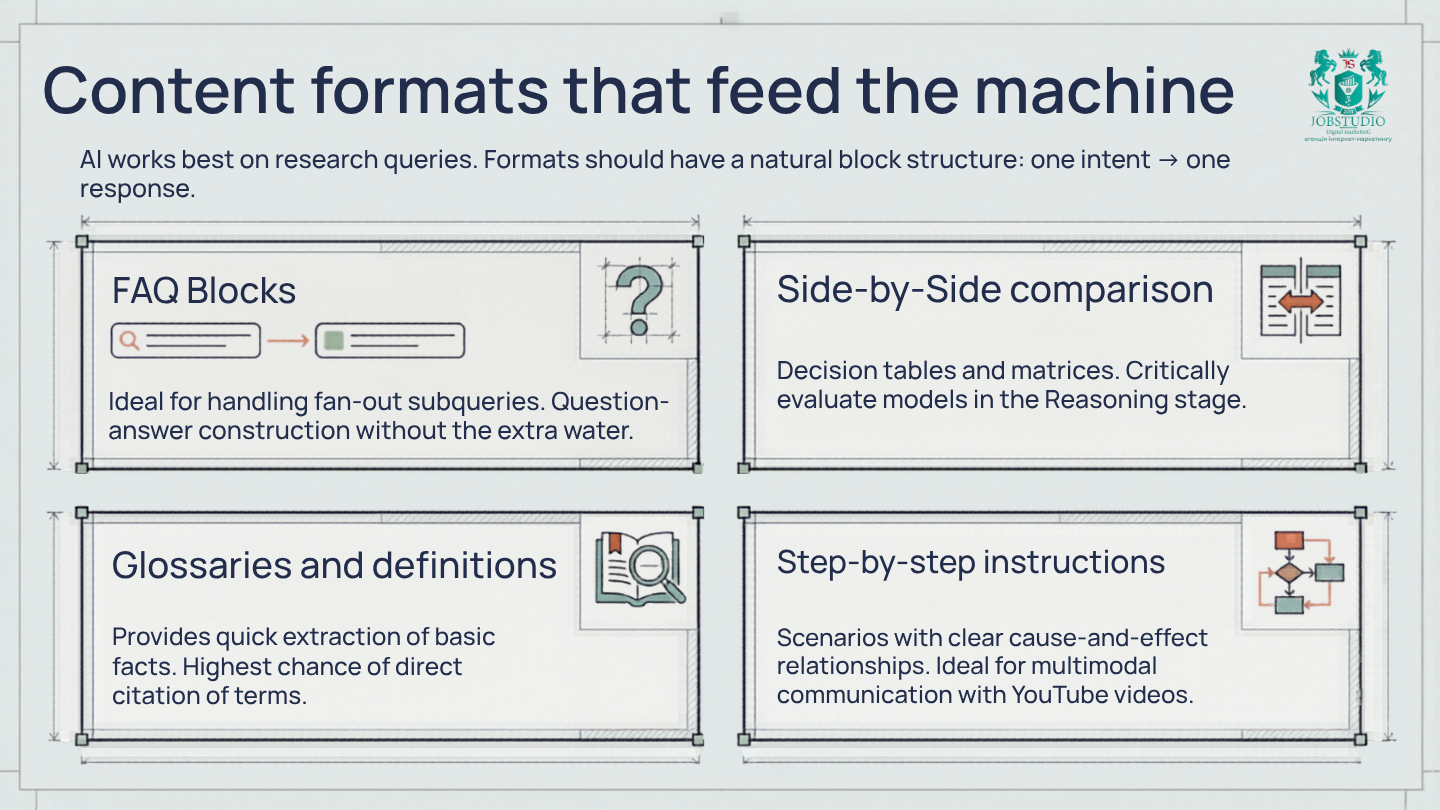
These formats are well-suited for both machine processing and human consumption.
Fresh, updated content often has a better chance of being used, especially in fast-paced niches. In his conference notes, Ethan Smith specifically pointed out that outdated content is cited significantly less often than updated pages.
Google explicitly states that no “new AI files” or special schema are required to participate in AI features. However, structured data that corresponds to the visible text remains a valuable component of overall SEO best practices. At the same time, the Writesonic test highlights an important limitation: JSON-LD alone won’t do the trick if the main content isn’t present in the body text.
The actual author, update date, profile, experience, and relevance to the topic—all of these factors help build trust in the page.
Without profiles, mentions, communities, videos, and expert citations, the website no longer functions as a self-sufficient stronghold.
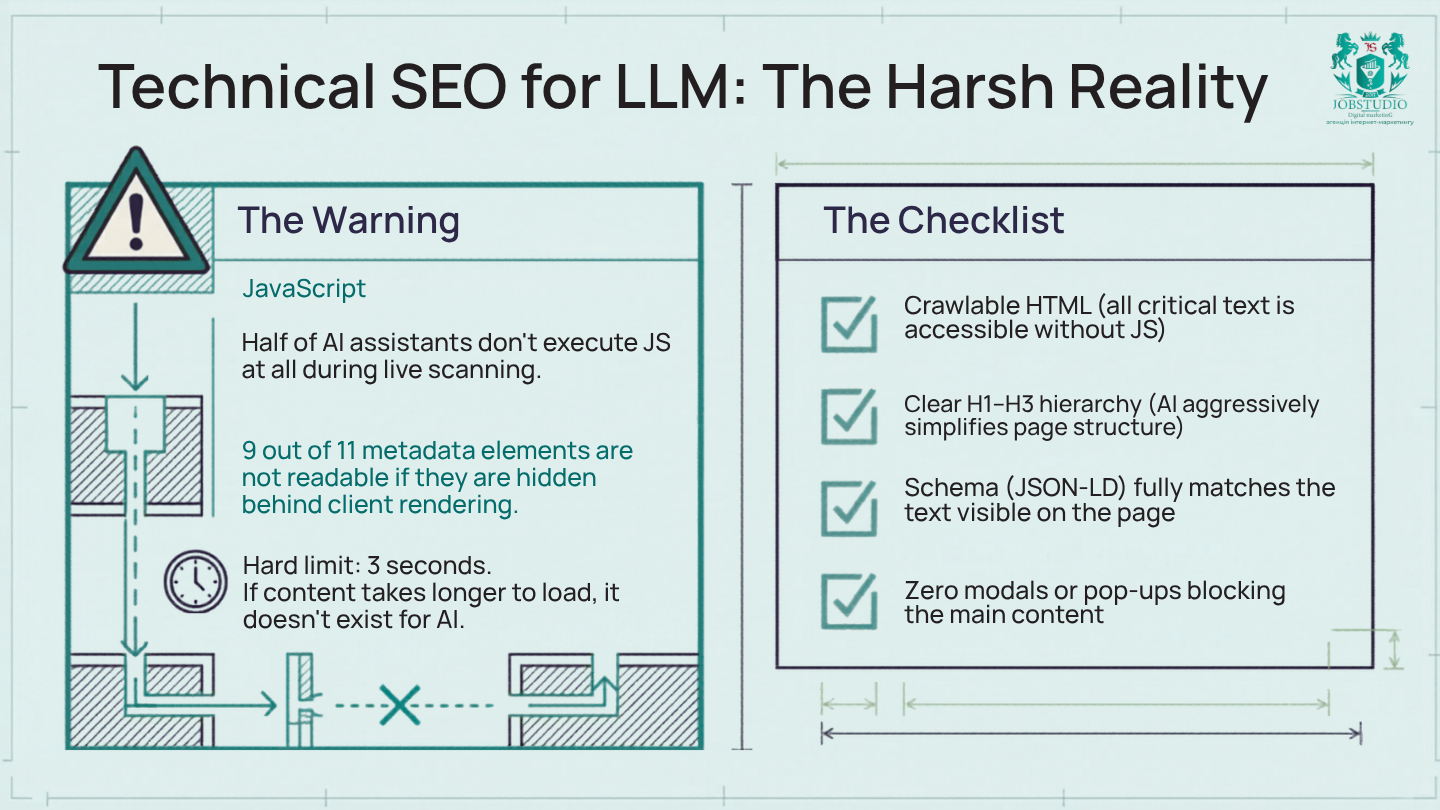
The good news from Google is that you don’t need to come up with a separate “secret technical stack for AI.” Google explicitly states that the same best fundamental SEO practices that work for search in general also work for appearing in AI features. The page must be indexed and technically eligible for display in Google Search, and there are no additional technical requirements. Google also explicitly states that there is no need to create new machine-readable files, AI-powered text files, or a special schema just for AI Overviews or AI Mode.
The bad news is that this doesn’t mean you can “relax.” Because those very same basic requirements have now become even more important. Writesonic tested 6 AI systems and 11 metadata elements in . For 9 out of 11 elements, the result was 0/6—meaning none of the six tested AIs could read them; half of the AI assistants don’t use JavaScript at all like a user’s browser, and those that do take the page 500 ms to 3 seconds to load. After 3 seconds, the crawler has already moved on. If your critical content appears later, for some AI systems, it simply doesn’t exist.
Here is a brief practical technical checklist:
In our own practice, we see this particularly clearly in projects like Obmin.Finance. There, it wasn’t possible to “just write turnkey text.” Even before launch, we had to establish the product architecture, multilingual support, page logic, intent clustering, and a system capable of consistently handling over 28,000 currency pairs and a large volume of dynamic data. It is precisely in such projects that the technical foundation determines whether content can even be part of the new user experience.
AI Mode performs particularly well with more complex queries: research-oriented, reasoning-focused, and comparison-focused. Consequently, it’s not just any content that benefits, but specifically content that helps the system navigate these steps. Google explicitly points the way: AI Mode works best when you need to explore a topic, compare options, and understand the nuances.
The most effective formats here are: FAQs, instructions, comparison pages, definition blocks, glossary pages, category explanations, use case breakdowns, decision-making frameworks, tables, and side-by-side comparisons. This is no coincidence. These formats have a natural block structure: one intent, one answer, one conclusion. They are easier to extract and work better in fan-out logic.
At JobStudio, we see the same thing with complex products. In the Obmin.Finance case, the content couldn’t just be “for show.” We needed to address informational, analytical, and transactional intents surrounding a large number of currency pairs, scenarios, and risk-related issues. That’s why the content framework had to be built not as a collection of articles, but as a system of explanations, FAQs, commercial pages, and expert materials that simultaneously drive traffic and build trust.
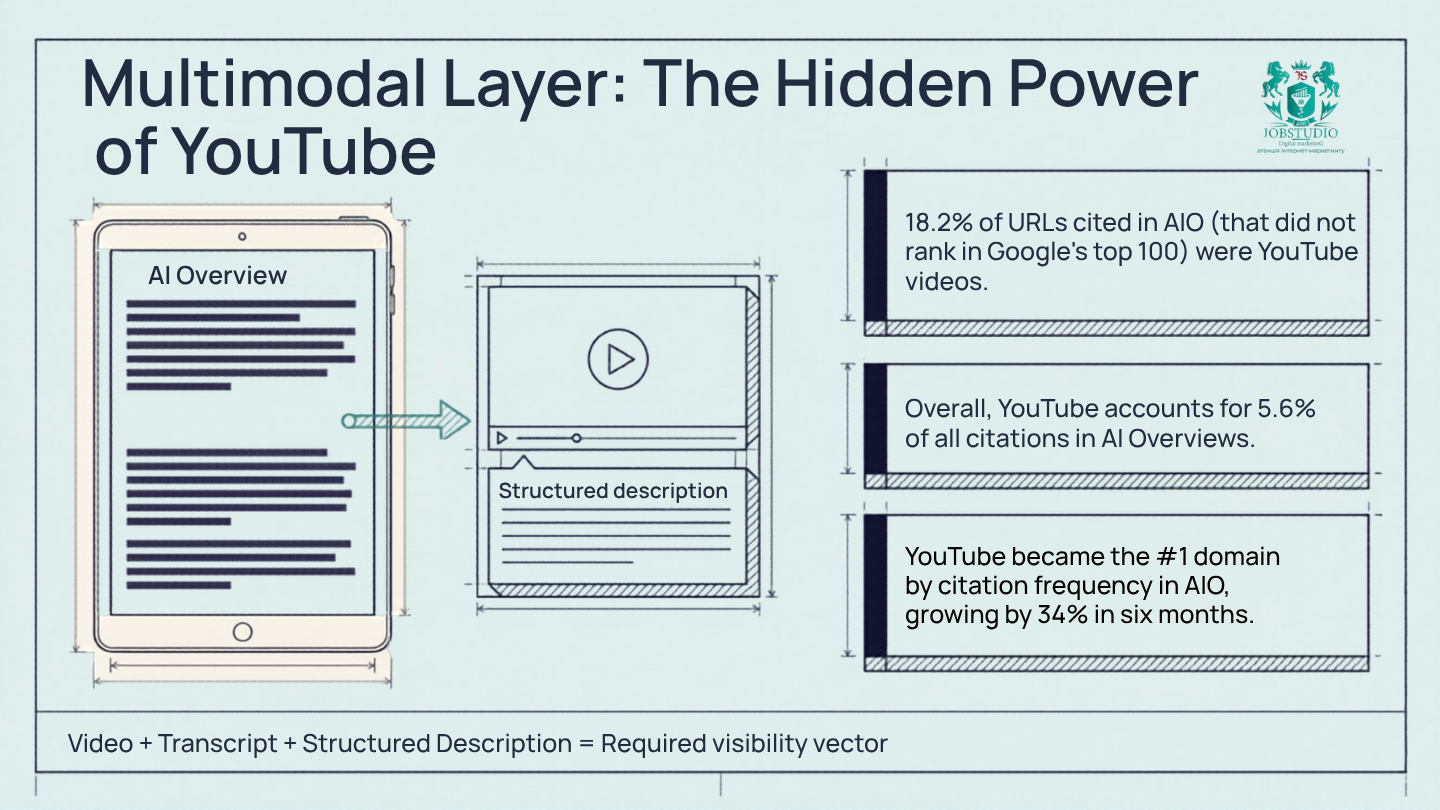
One of the most underrated topics in the GEO discussion is video. And that’s a shame. According to Ahrefs, among the pages cited in AI Overviews that didn’t rank in Google’s top 100 for the same keyword, 18.2% were YouTube URLs. Overall, YouTube accounted for 5.6% of all AIO URLs cited in the sample. Another figure is even more striking: according to Ahrefs Brand Radar, YouTube is the most cited domain in AI Overviews today and has grown by another 34% over the past six months.
The practical conclusion is stark: if you don’t provide AI with a useful video clip, someone else will. For practical and “explanatory” niches, video + transcript + structured description are no longer just a nice-to-have. This is one way to get into that part of the answer that isn’t just a paragraph of text.
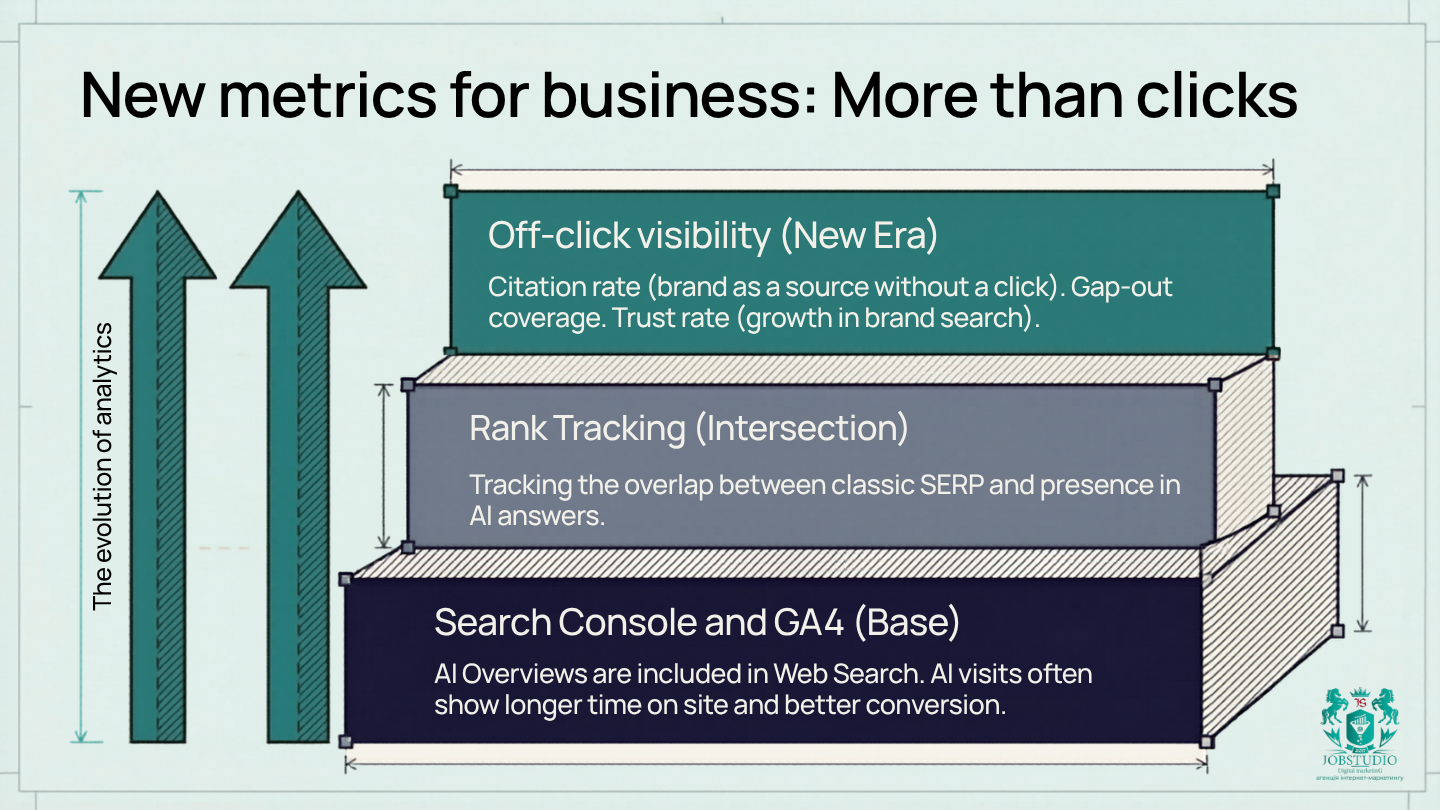
Google is pretty straightforward about this as well. Websites that appear in AI features are included in the overall search traffic reported in Search Console, under the standard “Web” search category. Google also notes separately that clicks from AI Overviews may be of higher quality: users tend to spend more time on the site. This is an important signal for businesses that still focus solely on CTR and rankings.
So, we’ll need to take a broader view. Yes, Search Console remains the foundation. GA4 is essential for tracking traffic quality, conversions, and user behavior. Rank tracking helps us see the overlap between traditional search and AI-driven visibility. On top of that, we need to add what was almost absent from the old reports: citation frequency, visibility of branded recommendations, no-click presence, lead quality from AI sources, fan-out coverage, and eventually—rough estimates of passage-level performance.
In practice, this boils down to one simple fact: not everything that matters in AI search is clickable. But what truly drives sales eventually shows up in brand search, trust-building speed, lead quality, and the brand’s ability to be the “go-to answer” more often—rather than just “another site in the search results.”
Theory only becomes useful when it is put into practice. And here is the most important lesson we’ve learned from our experience: visibility grows where there is a system in place, not where people have simply “written yet another SEO article.”
In projects like Obmin.Finance, we’ve seen that traditional on-page SEO isn’t enough. When a product has tens of thousands of entities, dynamic data, multilingual support, and complex intents, it’s not the “prettiest blog” that wins, but the architecture: how the URL logic is structured, how intents are organized, whether there is explanatory content, and whether a machine can quickly match the source, intent, and evidence. That is precisely why we came on board not just as “text optimizers,” but as co-authors of the product’s structural logic.
And this aligns well with the new logic of AI search. If you have a strong public evidence base, clear answer blocks, a solid technical foundation, and a content update system, you don’t just get “a better chance of ranking.” You get the chance to be accurately interpreted, cited, and matched within the new search architecture.
The worst thing a business can do right now is to assume that “it’s not time for that yet.” That’s what ends up costing the most.
The first mistake is to think that simply ranking is enough. Ahrefs data already shows that a significant portion of citations comes from outside the top 10, and sometimes even outside the top 100.
Second, continue to write complete pieces rather than fragments. If a single block cannot respond to a single query, it performs poorly in a reasoning environment.
Third, hiding the main offer, a figure, or evidence within an image, or within a visually appealing but technically empty block. Writesonic shows how easily this becomes invisible to some LLM crawlers.
Fourth—live solely on the website. If you don’t have videos, mentions, a community, profiles, or external evidence, someone else will take your place.
Fifth—focus only on rankings and traffic. In today’s landscape, that’s no longer the whole picture.
As we would say at JobStudio: the problem isn’t that “AI is taking away traffic.” The problem is that the brand’s online presence still isn’t structured in a way that can be interpreted by a machine.
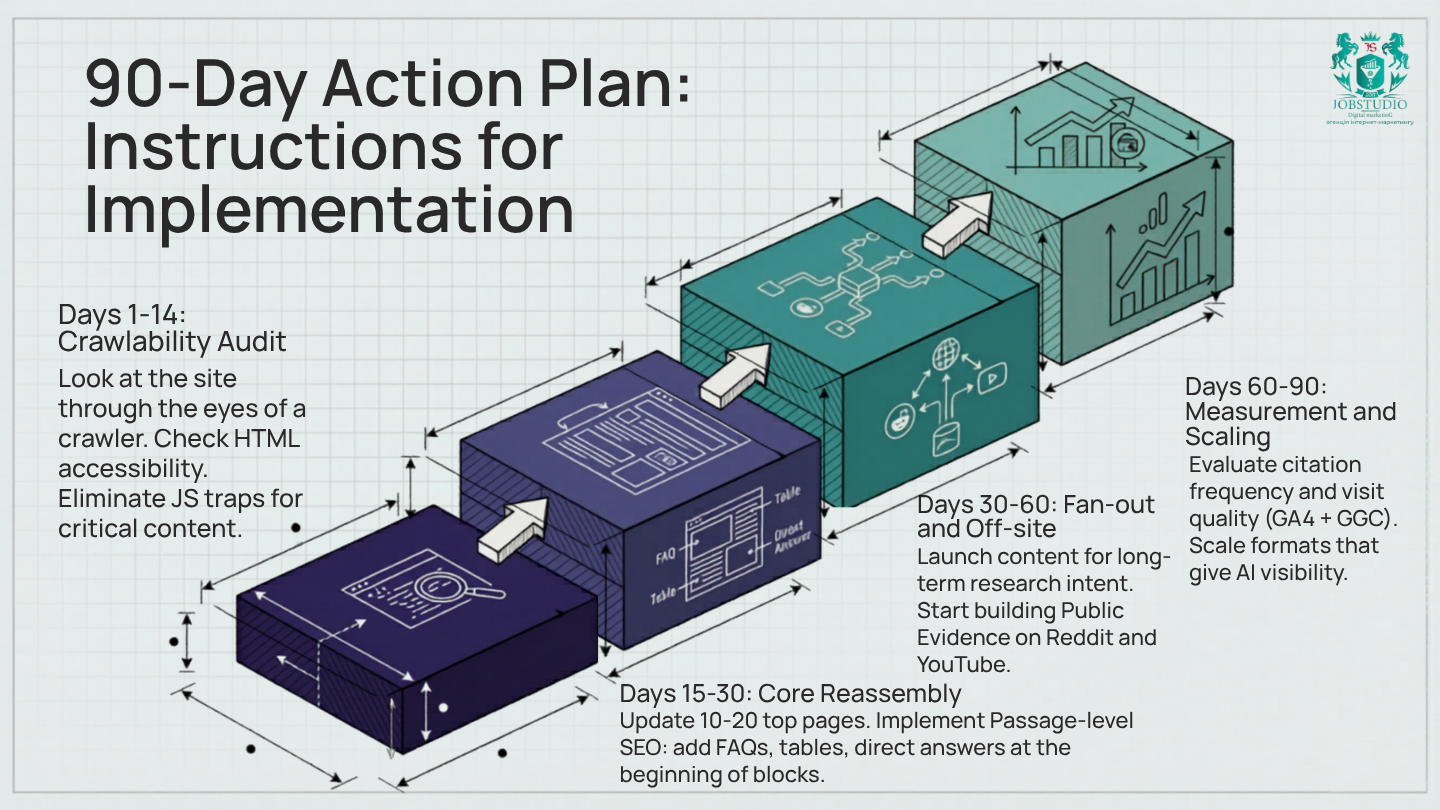
Conduct a crawlability audit. Check whether important content is available in HTML. Look at key pages through the eyes of a crawler, not a designer: are there direct answers, is there an FAQ section, is there an author listed, are there updates, and can you grasp the main point without clicking, scrolling, or switching tabs?
Review the 10–20 most important pages. Add definition sections, FAQs, comparison sections, tables, evidence, updated case studies, and clear H2–H3 headings. Highlight strong evidence in public spaces: articles, profiles, videos, and communities.
Publish content tailored to fan-out intents: longer-form questions, decision-making scenarios, comparisons, counterarguments, and niche guides. At the same time, strengthen your off-site presence—Reddit, YouTube, industry-specific platforms, and expert mentions.
Start measuring not only traffic but also your new online presence: which pages are used most often, which topics perform best in long-tail searches, which formats deliver the best visitor experience, and which pages need updating. Refine what works well, eliminate the noise, and scale up what truly drives visibility.
Search hasn’t gone away. And Google isn’t going anywhere. But the nature of competition has changed. Now, brands are fighting not only for a spot in the SERPs, but for the right to exist:
That is precisely why, in agentic search, it is not the “most optimized page” that wins, but the strongest body of public evidence that AI can quickly read, compare, and utilize. Amanda Natividad is right: search is behavior. Cyrus Shepard is right: it’s not just the rank that matters, but the entire body of public evidence. Ross Simmonds is right: the buyer’s journey has long gone beyond the brand’s website. And Google has already officially shown that its AI features work through fan-out, reasoning, and a broader set of supporting links.
Search isn’t dead.
What’s dead is the approach where it was enough to simply rank a page.
This is a search model in which the system does not simply find pages, but performs a series of actions: it breaks down the query, conducts refined searches, compares sources, synthesizes the answer, and only then displays the result to the user.
Agentic search is a broader concept. AI Overviews and AI Mode are specific Google interfaces that already incorporate this logic: fan-out, reasoning, a broader selection of supporting links, and AI-driven responses.
No. Google explicitly states that the same best SEO practices apply to AI search, and that a page must still be indexed and technically search-friendly. The change isn’t that SEO is “dead,” but rather that it’s no longer enough to focus solely on rankings and keywords.
Yes. According to Ahrefs, only 37.9% of the URLs cited in AI Overviews appeared in the first 10 SERP blocks; the rest often came from positions 11–100 or were outside the top 100 blocks altogether.
The question is framed incorrectly. Without the technical foundation, the content may not be fully read. Without strong content, the technology won’t generate citations. You need a combination of: an HTML scanner, structure, direct answers, evidence, authorship, and an external context of trust.
FAQs, instructions, comparison pages, definition sections, glossary entries, tables, case studies, decision-making frameworks, and pages with clear, straightforward answers and evidence. These are the formats that stand up best to scrutiny and fan-out.
That’s right. Ross Simmonds demonstrated this using SaaS data, while Ahrefs showed it using AIO citations, where YouTube has already become the most cited domain. The website can no longer be viewed in isolation from the rest of the brand’s public sphere.
Start with Search Console and GA4. Google officially factors AI-driven traffic into overall search traffic in Search Console, and you should assess the quality of this traffic by looking at user behavior, conversions, and time on site.
The basic strategy is the same across the board: HTML crawlers, structured content, direct answers, evidence, authorship, and an external evidence layer. However, individual systems differ in how they process metadata, video, and third-party sources.
Start with four key areas: ensuring your content is technically accessible, redesigning 10–20 key pages, publishing compelling evidence, and setting up baseline tracking for new visibility metrics via Search Console and GA4. Scale up the rest after the first monitoring cycle.
No. You can only increase the likelihood: through structure, extractability, citation frequency, evidence, authorship, and a broader body of public evidence. Everything else is either exaggeration or selling snake oil.
It’s a mistake to think that simply ranking a page is enough. In the AI landscape, snippets, evidence, authorship, videos, external mentions, and the entire logic of how a brand exists in the public sphere are already competing with one another.
.webp)