


Get a responsible approach in promoting client project.
Contact us now!
Contact us now!



 Order a call
  Get an offer
Businesses often turn to an agency to drive growth. Their expectations are clear: more high-quality leads, better visibility on Google, more effective advertising, transparent analytics, a clear work plan, and the feeling that their marketing is finally under control.
But after a few months, a completely different feeling sometimes sets in.
Work is supposedly underway. Reports are coming in. Campaigns have been launched. SEO tasks are being completed. The spreadsheets show numbers, the emails contain updates, and the plan lists completed items.
Table of Contents
But the most important thing is missing: clarity on exactly what is changing in terms of inquiries, sales, lead quality, and actual business growth.
A project may not fail outright. No one says, “We’re not doing anything.” On the contrary, everything looks fine on the surface. But gradually, the business begins to feel that it has become just one of many clients in the pipeline. Not a distinct project with its own context, goals, and accountability, but just another line in the agency’s internal spreadsheet.
This is precisely where the question of a boutique approach arises.

A boutique approach isn’t just a fancy phrase about “individuality.” Nor is it a marketing ploy to say, “We’re small, but we’re doing our best.”
In digital marketing, a boutique approach means a different way of working: deeper immersion in the business, more attention to a specific project, more direct contact with experts, flexibility in decision-making, and a focus not on completed tasks, but on how SEO, PPC, Google Ads, the website, analytics, CRM, content, and the sales funnel collectively impact leads, budget, and growth.
JobStudio isn’t just an SEO studio, nor is it a “one-stop shop” agency. We operate as a boutique performance/digital growth agency: we help businesses identify exactly where they’re losing leads, budget, and control, and then build a system that can be measured, improved, and scaled.
A boutique agency isn’t necessarily small. And it’s definitely not necessarily cheaper.
A boutique approach isn’t about the number of people on the team, but about the logic behind how a project is handled.
The flow model is often built around standardization: a standard service package, a standard list of tasks, a standard report, and standard management practices. This can work for simple tasks or large volumes of repetitive work. But when a business needs more than just a “set of activities”—namely, control over leads, lead cost, traffic quality, the technical condition of the website, analytics, and the sales funnel—a template quickly becomes a limitation.
The boutique approach works differently.
It doesn’t start with the question, “What service package should I sell you?”
It begins with the following questions:
A boutique approach is when an agency doesn’t just take on a project “by the book,” but first tries to understand exactly what the business needs at this stage.
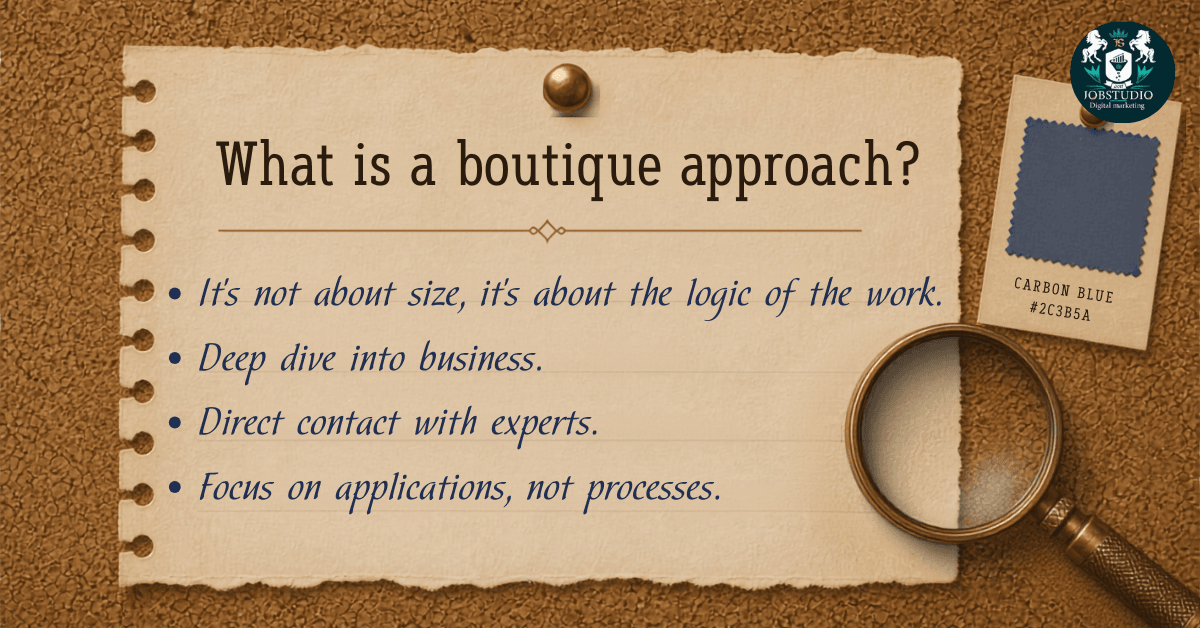
There are three key elements to the boutique approach.
The first is depth.
The team analyzes more than just the website and keywords. It examines the product, the target audience, demand, competitors, the sales funnel structure, profit margins, seasonality, the quality of leads, and the history of previous marketing efforts.
Therefore, the strategy isn’t just about “gathering semantic data,” “setting up ads,” or “writing copy.” It addresses a broader question: what exactly is preventing a business from receiving more high-quality leads, and how to fix it in the right order.
The second element is focus.
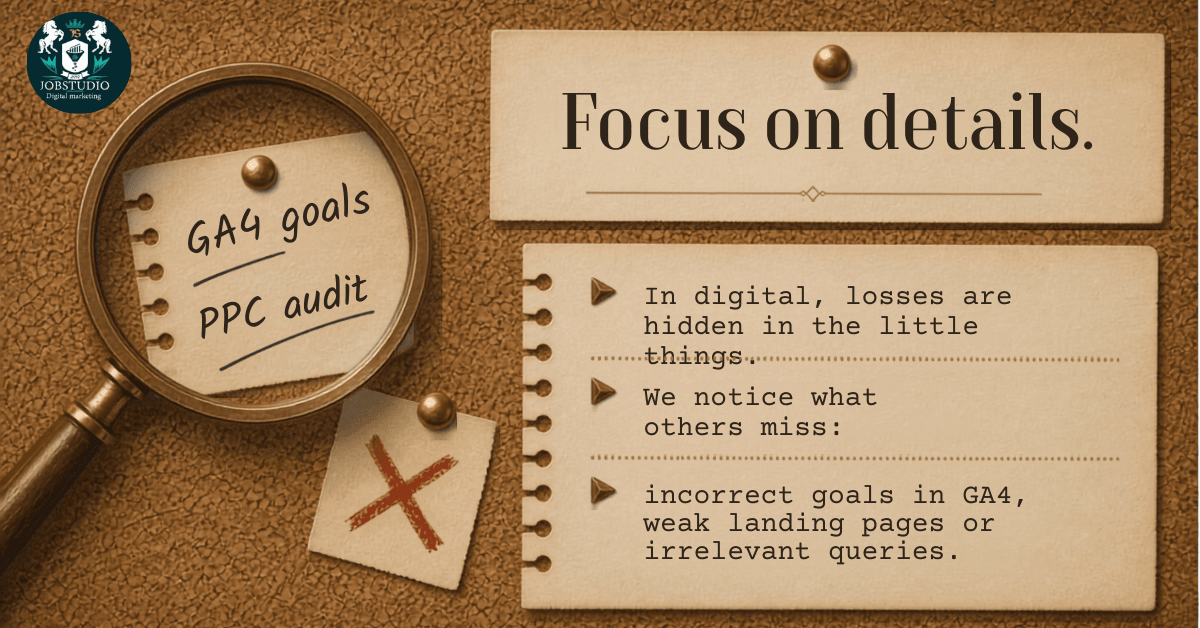
When a project doesn’t get lost among hundreds of other clients, the team has more room for analysis, spots problems faster, and pays closer attention to details. In the digital world, this is critical, because losses often aren’t caused by a single major mistake, but in a chain of minor oversights: the wrong query, the wrong ad, a weak landing page, an incorrect goal in GA4, a form without a proper workflow, or a CRM system that doesn’t evaluate lead quality.
The third element is responsibility.
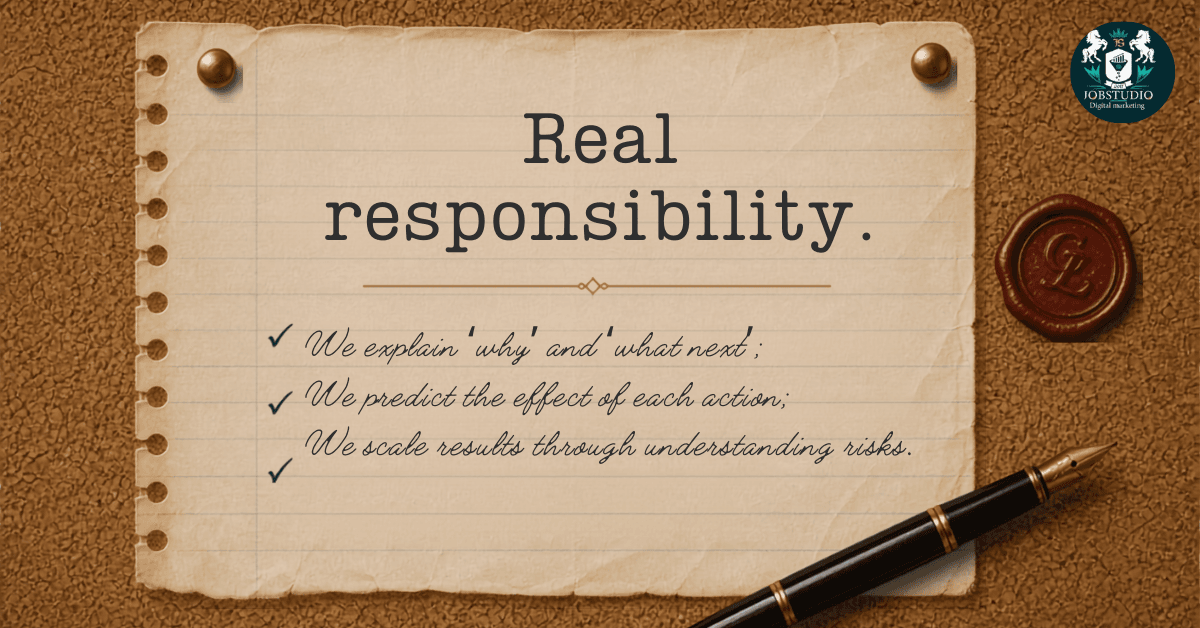
A boutique agency doesn’t just “get the job done.” It explains what has been done, why it’s necessary, what results are expected, what risks remain, and what the next step will be.
Another important element is regular communication. For example, joint conference calls to review sprint results: once every two weeks, the team presents what has been accomplished, what results are already visible, what couldn’t be completed on time, why that happened, and what the work plan is for the next period.
For businesses, this means more than just receiving a report. It means understanding what’s happening with marketing, seeing the logic behind decisions, and keeping the process under control.
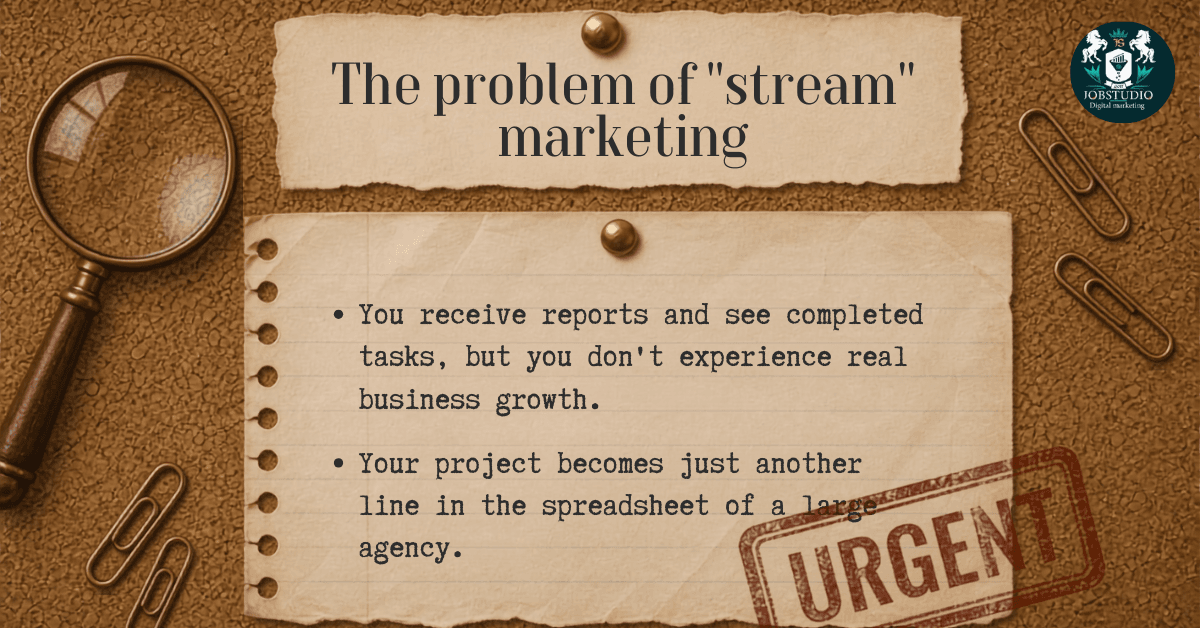
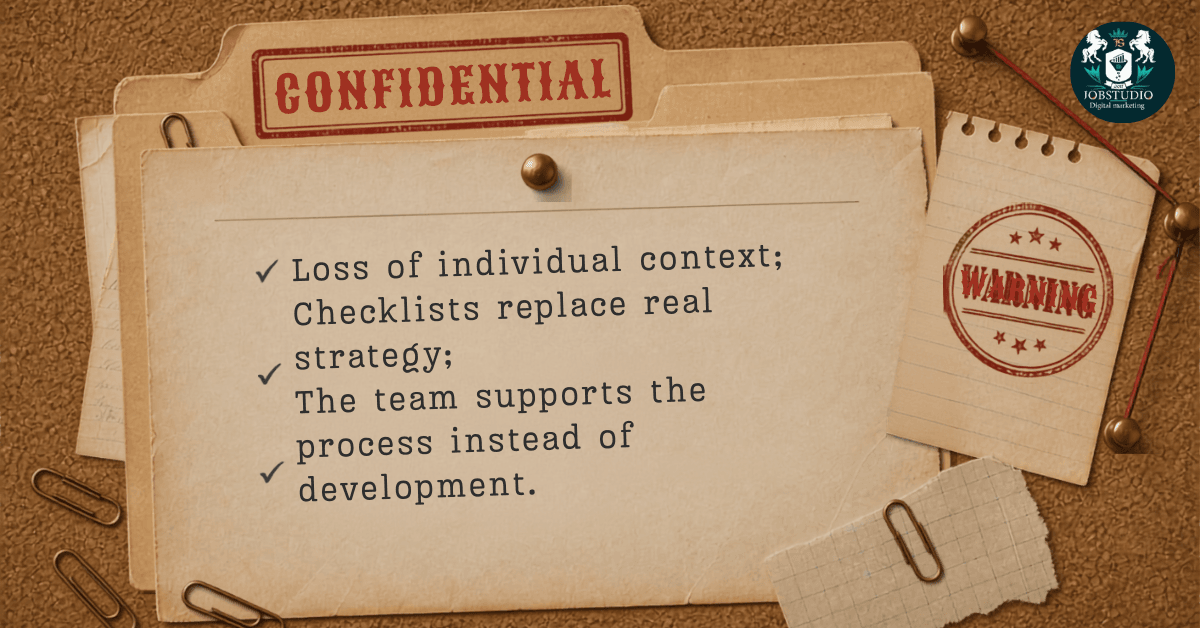
The biggest risk of the pipeline model is that the project gradually loses its individual context.
At the start, everyone discusses goals, the niche, challenges, and expectations. But then the work settles into a routine: tasks, reports, updates, monthly plans, and formal meetings. If the team is overloaded, it stops driving the project’s development and simply maintains the process.
On the surface, this may seem normal. But the business is gradually losing sight of why certain actions are being taken.
For example, an SEO specialist optimizes pages, but no one explains why these particular pages are currently a priority. A PPC specialist adjusts bids, but there’s no connection to the quality of leads in the CRM. Content is created, but it’s not always clear how it affects trust, search rankings, or conversions. A report is submitted, but it contains more numbers than conclusions.
When an agency is working at full capacity, it often doesn’t have time to figure out exactly where the business is losing money.
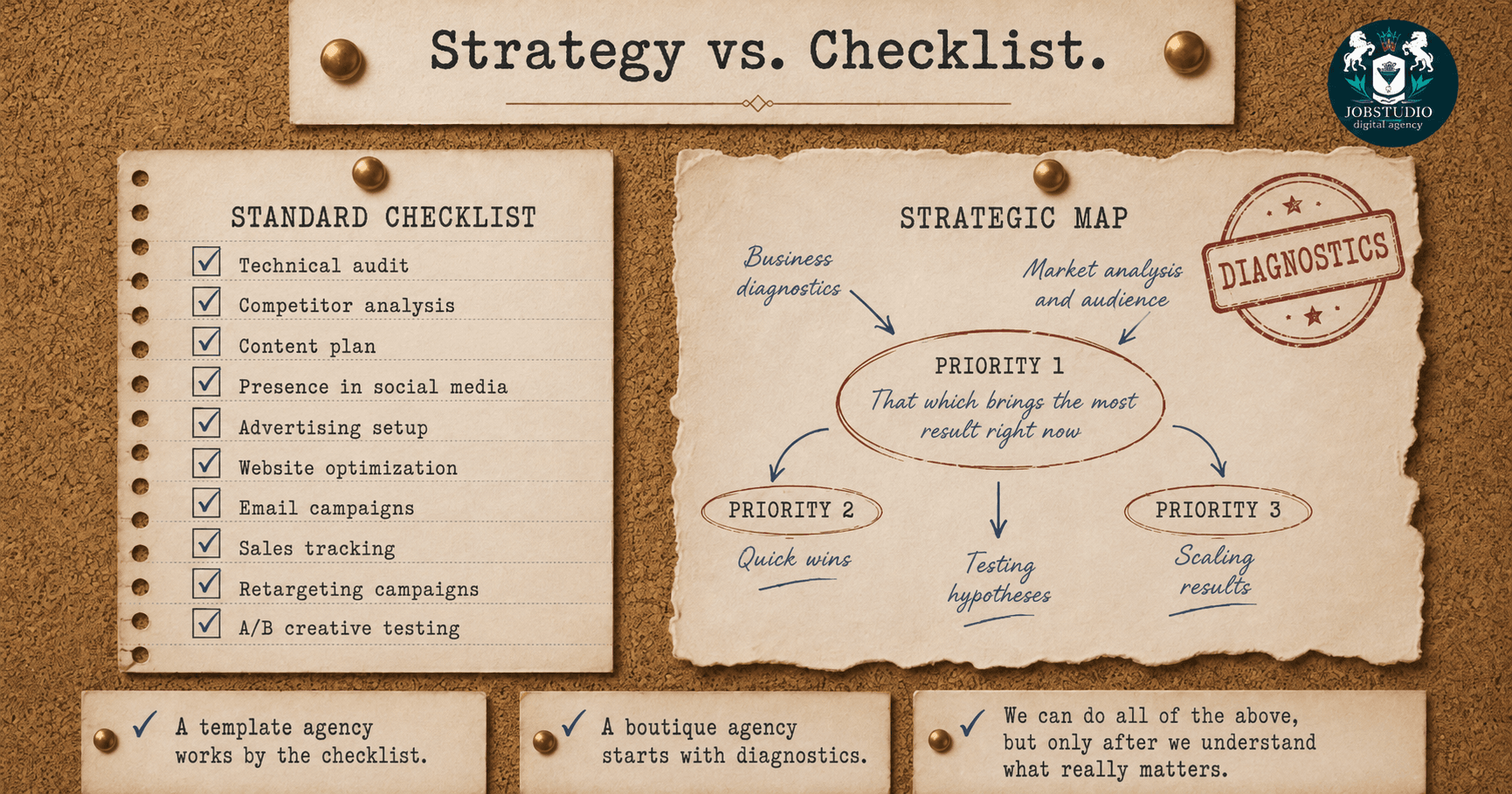
Checklists aren’t a bad thing. In SEO, PPC, analytics, and technical optimization, checklists are essential. They help ensure you don’t overlook the basics.
The problem arises when a checklist replaces a strategy.
A strategy isn’t just a list of points. It’s an understanding of what needs to be done first, why it’s important, and what the outcome should be after implementation.
A website first needs technical optimization, because without proper indexing, the content won’t be effective.
Another issue is redesigning the landing pages, because while the ads drive traffic, users don’t understand the offers.
Third, refining the semantics, because the budget is being spent on irrelevant queries.
Fourth—proper configuration of GA4, GTM, and CRM, because the business isn’t seeing the true quality of its leads.
Fifth—an independent audit of the current contractor, because work is underway, but the owner isn’t sure if any real progress is being made.
Sixth—review the offer, page structure, and sales funnel, because the problem isn’t with traffic; it’s that users aren’t getting to the sign-up page.
That is precisely why a boutique approach begins not with a cookie-cutter plan, but with an assessment.
A report is a tool. But it doesn’t provide control on its own.
A business may receive a report every month and still not understand:
Monitoring isn’t just a file full of statistics. Monitoring is understanding the cause-and-effect relationship between tasks, metrics, and results.
If a report shows traffic but doesn’t explain how that traffic affects conversions, it’s a weak report.
If a report includes CPL but lacks a lead quality assessment, it doesn’t give the full picture.
If a report includes metrics but lacks an analysis of the pages’ commercial potential, it is not yet a strategy.
In a boutique approach, the report should address not only the question “What has been done?” but also the question “How does this change things for the business?”
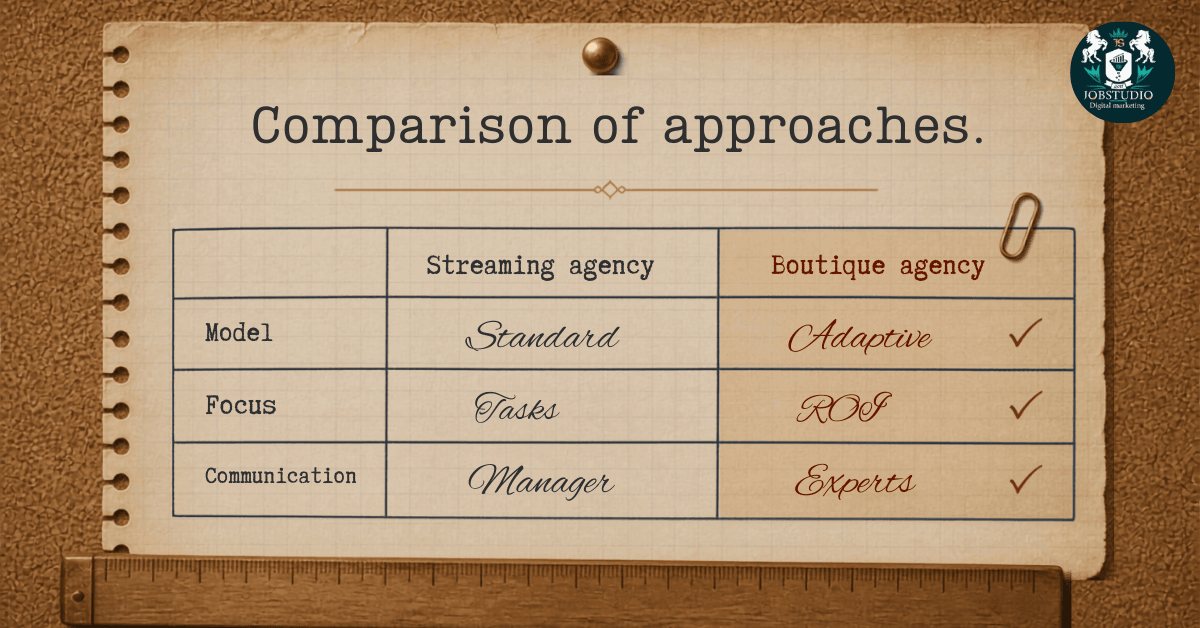
| Criterion | Streaming Agency | Boutique Agency |
|---|---|---|
| Operating Model | Many customers, typical processes, standard packages | Fewer projects, more immersion, tailored to the business |
| Focus | Carry out the work plan | Find out what really affects applications, the budget, and growth |
| Communication | Through a manager, often just for form’s sake | Closer to Experts and Solutions |
| Strategy | It is often based on a template | It is tailored to the niche, goals, website, sales funnel, and analytics |
| Reports | Numbers Without Sufficient Conclusions | Figures + Explanation of the Reasons + Next Steps |
| Reaction to Changes | Slower due to bureaucracy | Hypotheses are tested more flexibly and more quickly |
| Evaluation of the Results | Rankings, clicks, traffic, completed tasks | Inquiries, lead quality, conversions, ROI, system monitoring |
| Risk to the client | The project might get lost among the others | The project is receiving more attention and responsibility |
| The best choice is | For typical tasks and large batch processes | For businesses that need depth, control, and a growth strategy |
This doesn’t mean that large or mass-market agencies are always bad. They may have strong teams, processes, partnerships, and a solid reputation. But it’s important for your business to honestly answer the question: What does your project need right now?
If you need standard support, the streaming format may be the solution.
However, when it comes to in-depth analysis, diagnostics, working with a complex funnel, data analysis, and quality control of requests, a boutique approach often delivers greater value.
A boutique approach is suitable for companies that already understand that traffic alone is not a result.
Clicks don’t pay the bills. Google rankings don’t guarantee sales. A low CPL doesn’t always mean profit. A report without conclusions doesn’t help with decision-making.
A business needs more than just marketing activity. It needs control over how marketing affects leads, sales, and growth.
That is precisely why, with a boutique approach, it is important to look not only at the top-level metrics, but at the entire journey:
If this approach is important to a business, a boutique-style approach works very well.
Often, people don’t adopt a boutique approach right from the start, but rather after gaining some experience—when they’ve “tried something, but the results were unclear.”
Common situations:
In such cases, a business often doesn’t need yet another grand promise. It needs a second opinion, an audit, and an honest assessment.
Not “Everything’s bad for you,” but a calm response:
This is one of the most effective strategies for a boutique agency.
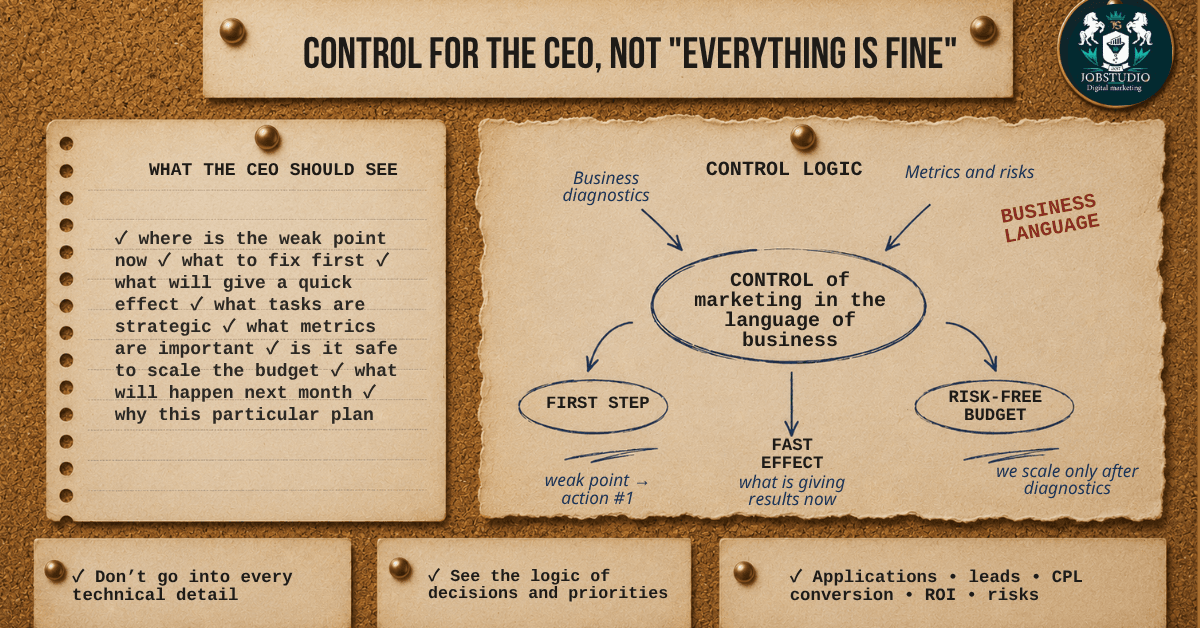
A boutique approach works best for those who don’t want to manage marketing based on the assumption that “I was told everything is fine.”
It is important for business owners, CEOs, or marketing managers to understand:
This doesn’t mean that the client has to delve into every technical detail. But they should be able to see the logic behind the decisions.
A boutique agency must be able to translate a complex digital system into business terms: applications, lead quality, acquisition cost, conversion rate, return on investment, priorities, and risks.
A boutique approach is particularly useful when the path to submitting an application is not straightforward.
For example, in B2B, a customer might spend a long time comparing contractors, reading case studies, assessing their expertise, returning via a branded search, and only then submitting a request.
In e-commerce, category structure, filters, landing pages, price, shipping, trust, remarketing, and repeat purchases are all important.
In SaaS, you need to consider not only traffic, but also onboarding, trials, activation, retention, LTV, and lead quality.
For local services, regional ties, trust, reviews, responsiveness, and the mobile user journey are important.
In international projects, languages, regions, hreflang, localization, competitors in different markets, and various search intents are added.
The more complex the sales funnel, the riskier it is to focus on marketing through a single channel. That’s why a boutique approach works not with individual activities, but with the system as a whole.

A boutique approach isn’t always suitable for a business looking for the lowest price and a minimal scope of work.
If the task is phrased like this: “We just need someone to handle SEO or advertising on a minimal budget,” a boutique approach might seem excessive.
Because it involves not only execution, but also analysis, communication, immersion, testing hypotheses, working with data, and explaining decisions.
A boutique approach isn’t about being “cheap.”
It’s about the quality of attention, diagnostics, analytics, depth, and responsibility.
A boutique performance approach is impossible without data.
To get the full picture, you need access to analytics, advertising dashboards, CRM, the website, work history, previous reports, information about leads, sales, and the business context.
If an agency only sees the advertising dashboard, it can only evaluate part of the system.
If you don’t have a CRM system or at least a manual process for evaluating lead quality, it’s hard to tell whether your ads are actually bringing in the right customers.
If no goals are set, automated strategies may learn from micro-actions that are not directly related to sales.
If a business isn’t ready to open up its data, the boutique team won’t be able to operate at full capacity.
A boutique approach also isn’t suitable for those who want to hear right away: “We’ll definitely get you to the top,” “We guarantee we’ll increase sales by X times,” or “You’ll see results in two weeks.”
In SEO, PPC, and comprehensive digital marketing, it’s not possible to honestly make such guarantees without conducting an analysis.
Results are influenced by competitors, the condition of the website, the budget, demand, seasonality, technical errors, the quality of the offer, the performance of the sales department, the brand’s reputation, the speed at which recommendations are implemented, and even changes in search algorithms.
The honest path begins not with a promise, but with a diagnosis.
First, you need to understand the actual situation. Then, set your priorities. And only after that should you discuss the forecast, the plan, and the expected outcome.
SEO can drive traffic. Google Ads can drive clicks. Social media marketing can increase reach. Content can build trust. But no single channel on its own guarantees business results.
Businesses don’t need clicks, rankings, or fancy charts.
Businesses need leads that can be measured, evaluated for quality, and scaled without breaking the budget.
That is precisely why the “SEO studio” label is too narrow for JobStudio. SEO remains an important area, but we take a broader view: we focus on the entire system of attracting, processing, and evaluating applications.
The problem might not be SEO. Or Google Ads. Or the content.
The problem may be that these elements are not integrated into a single, coordinated system.
At JobStudio, it’s important to look at the entire user journey.
A person enters a search query into Google, sees an ad or an organic result, goes to the page, reads the offer, looks for evidence, clicks a button, opens a form or chat, submits a request, is added to the CRM, communicates with a manager, and only then becomes a customer.
If even one element of this funnel breaks down, the business may pay for traffic but lose leads after the click.
For example:
That’s why the boutique approach doesn’t stop at the channel. It examines the entire system.
JobStudio doesn’t focus solely on SEO or PPC, but operates at the intersection of several areas:
Modern digital marketing no longer works on the principle of “set up a channel and wait for results.”
SEO influences trust and organic visibility. PPC generates immediate demand. A website either converts that demand or loses it. Analytics show what’s really happening. CRM lets you assess the quality of a lead. Content helps explain the value. AI visibility is gradually becoming a new layer of brand presence in search.
That is precisely why a boutique performance approach focuses not on a single button, but on the entire mechanism.
SEO cannot be the same for all types of businesses.
An online store needs a structure for categories, filters, product pages, indexing, internal linking, commercial queries, and semantic scaling.
For a B2B website, expertise, trust, case studies, service landing pages, a long decision-making cycle, and a clear path to submitting a request are important.
A local business needs geolocation queries, a Google Business Profile, service pages, reviews, local signals, and mobile usability.
For a SaaS project, the following are important: intent, comparison pages, use cases, onboarding content, integrations, trust signals, and content for the various stages of the funnel.
An international project requires multilingual support, hreflang, localization, technical accuracy, regional semantics, and adaptation to different markets.
A new website needs one strategy. A website that has been redesigned needs another. A website that has experienced a drop in traffic needs a third.
A boutique SEO approach begins with understanding the type of project, its limitations, and its potential.
Rankings are important. But they aren’t the final result.
You can rank for search queries that don’t generate leads. You can have traffic that doesn’t convert. You can increase visibility without seeing any commercial results.
Therefore, SEO should be viewed in a broader context:
A boutique approach doesn’t disregard classic SEO metrics. It simply doesn’t stop there.
The main question isn’t “whether the rankings have improved.”
The main question: “Has the business moved closer to high-quality leads and managed growth?”
In mass-market SEO, semantics often takes the form of a list of keywords. In a boutique approach, semantics is a map of user demand and intent.
It wasn’t just a matter of “gathering the keys,” but of understanding:
The same goes for content.
They didn’t just “write some copy”; they created pages that help people understand the service, trust the company, and take the next step.
We didn’t just “optimize the meta tags”; we developed a page structure that works for both Google and human readers.
That’s the difference: a boutique SEO approach doesn’t do SEO just for the sake of SEO. It integrates SEO into business results.
When Google Ads doesn’t deliver the expected results, businesses often think, “The problem is with the ad.”
Sometimes that’s really true. But not always.
Losses can stem from issues with semantics, campaign structure, negative keywords, irrelevant landing pages, a weak offer, a non-functional form, messaging apps without links, incorrect GA4 goals, a CRM system that doesn’t evaluate lead quality, or even in sales, where inquiries aren’t processed quickly enough.
That’s why simply “tweaking the campaigns” doesn’t always solve the problem.
It’s possible to lower your CPL while getting lower-quality leads.
It’s possible to increase traffic without generating more sales.
You can train an automated strategy using micro-conversions and then wonder why the ads “work” but the business isn’t growing.
The boutique approach views advertising not as a standalone feature, but as part of a system.
A true Google Ads audit shouldn’t be limited to just campaigns.
Yes, you need to check the account structure, keywords, negative keywords, ads, bids, budgets, extensions, UTM parameters, conversions, and audiences.
But that’s not enough.
You need to walk through the entire user journey:
request → ad → page → action → analytics → CRM → conclusion.
It is precisely along this path that the real problem often becomes apparent.
For example, a campaign might be set up fairly well, but it directs users to a generic page instead of a relevant landing page.
Or a form may exist in the code but not be implemented correctly.
Or a messaging app button might look like a communication channel, but not lead where it’s supposed to.
Or the goals can be set, but instead of counting leads, they count micro-actions that don’t produce real results for the business.
A boutique audit is valuable precisely because it reveals not only “what’s wrong in the office,” but also where efficiency is being lost throughout the entire system.
Scaling without diagnostics is one of the most dangerous scenarios in advertising.
If the system is already running a deficit, increasing the budget will only accelerate the losses.
If an ad generates irrelevant leads, scaling it up will result in even more irrelevant leads.
If GA4 counts micro-actions as conversions, the automated strategies will be optimized based on noise.
If the CRM doesn’t show the quality of leads, the business won’t be able to figure out which campaigns are really worth focusing on.
Therefore, the key logic is simple:
Don’t scale up the chaos—first find out where the system is losing requests.
A boutique approach isn’t at odds with scaling. On the contrary, it helps make scaling safer, because before increasing the budget, it verifies whether the system is ready to receive, count, and process requests.
Digital marketing has become too complex for a single person to cover all areas with equal depth.
It is physically impossible for a single professional to excel simultaneously as a technical SEO specialist, PPC specialist, analyst, content strategist, UX expert, CRO specialist, link builder, designer, developer, and strategist.
Each direction has its own depth.
Technical SEO requires an understanding of indexing, site structure, duplicate content, canonical tags, sitemaps, robots.txt, page speed, status codes, and page templates.
PPC requires working with semantics, campaigns, bids, audiences, ads, negative keywords, and conversions.
Analytics requires GA4, GTM, UTM, CRM, events, attribution, and data logic.
Content requires an understanding of intent, page structure, expertise, trust, and commercial value.
CRO requires an analysis of user behavior, forms, CTAs, pages, mobile usability, and interaction scenarios.
That’s why a boutique approach isn’t about having “one jack-of-all-trades.” It’s a team-based model in which different specialists approach the project from their own perspective.
Many companies already have an in-house marketer, SEO specialist, or marketing manager. That’s not a problem. On the contrary, it can be an advantage.
An insider has a better understanding of the product, the customers, the sales team, seasonality, practical constraints, and the business context.
And a boutique team can provide support where specialized expertise, extra manpower, or an outside perspective is needed.
For example:
JobStudio isn’t necessarily meant to replace your in-house team. Often, our value lies precisely in providing that team with expert support, technical expertise, and a clear plan of action.
When a team is working on a project, errors and hypotheses are examined from various angles.
SEO identifies a structural issue.
PPC sees a problem with demand.
The analyst sees a data problem.
The content creator sees a problem with the offer.
The designer sees a problem with perception.
The project manager understands the priorities and the business logic.
This reduces the risk of arbitrary or narrow decisions.
For example, a PPC specialist might say, “We need a bigger budget.” But an analyst will see that the goals are set up incorrectly. An SEO specialist will notice that the landing page doesn’t match the search query. A content specialist will see that the offer is weak. And the project manager will ask: Does it make sense to scale up before we fix the conversion path?
It is precisely this team-oriented approach that helps us identify the cause rather than just treat the symptom.
In marketing, it’s easy to sell promises. It’s harder to honestly explain reality.
A reputable agency should not promise guaranteed top rankings or instant results when those results are influenced by Google’s algorithms, competitors, the technical condition of the website, content, budget, demand, the speed at which recommendations are implemented, and the client’s team’s efforts.
This is especially true for SEO.
No one controls Google. No one can honestly guarantee a specific ranking on a specific day. No one can fully predict competitors’ actions, algorithm updates, or changes in demand.
But one thing is certain:
A boutique approach doesn’t sell an illusion. It sells control.
A boutique approach doesn’t mean “we’re just trying really hard.”
Here’s how it works:
There’s no magic to it. It’s all about attention to detail, experience, structure, teamwork, and regular monitoring.
It is discipline that sets a strong boutique approach apart from mere rhetoric about “individuality.”
If an agency says, “We take a personalized approach,” but can’t explain exactly what will be personalized in terms of strategy, analytics, priorities, communication, and performance evaluation—it’s just a catchphrase.
The boutique feel should be evident throughout the process.
It’s not always necessary to immediately switch contractors, increase the budget, or completely overhaul your marketing strategy.
Often, the smartest first step is an audit.
An audit helps you understand:
A good audit isn’t about “grilling” the previous contractor. Nor is it an attempt to intimidate the business.
This is the second point that helps you make decisions based on facts.
For JobStudio, an audit is the logical starting point for a boutique approach. First, a diagnosis. Then, a plan. Then, implementation. Then, measuring the results.
Digital has become more complex
In the past, businesses used to think in terms of:
It doesn’t work that way right now.
SEO affects trust and organic visibility.
Advertising generates demand, but it doesn’t guarantee sales.
A website either converts a user or loses them.
GA4 and CRM provide insights into the quality of data and leads.
Content builds expertise.
Social media is building up momentum ahead of the address.
AI is changing the way people search for information and evaluate brands.
If all these elements aren’t interconnected, the business ends up with chaos instead of a system.
That is precisely why a boutique approach is becoming more important: it allows you to see not just a single channel, but the entire growth strategy.
It’s no longer enough for businesses to be visible only on the classic Google.
The role of AI-generated responses, AI Overviews, ChatGPT, Perplexity, Gemini, and other systems is gradually growing, and these can influence how users perceive a company’s brand, services, and expertise.
Now it’s important to understand:
GEO and AEO aren’t “magic marketing tricks in ChatGPT.” They’re a new layer of control over brand visibility.
And here, once again, what’s needed isn’t a template, but a systematic approach: technical infrastructure, content structure, expertise, data, brand mentions, and clear positioning.
The more complex digital marketing becomes, the riskier a reactive approach is.
If an agency focuses solely on SEO, it may overlook a problem with its CRM.
If you focus solely on Google Ads, you might overlook a problem with the landing page.
If you focus only on traffic, you might overlook a problem with the quality of the leads.
If you look only at the report, you might not see the actual business impact.
In chaos, it’s not the one who does the most that wins.
The winner is whoever has better control over the system.
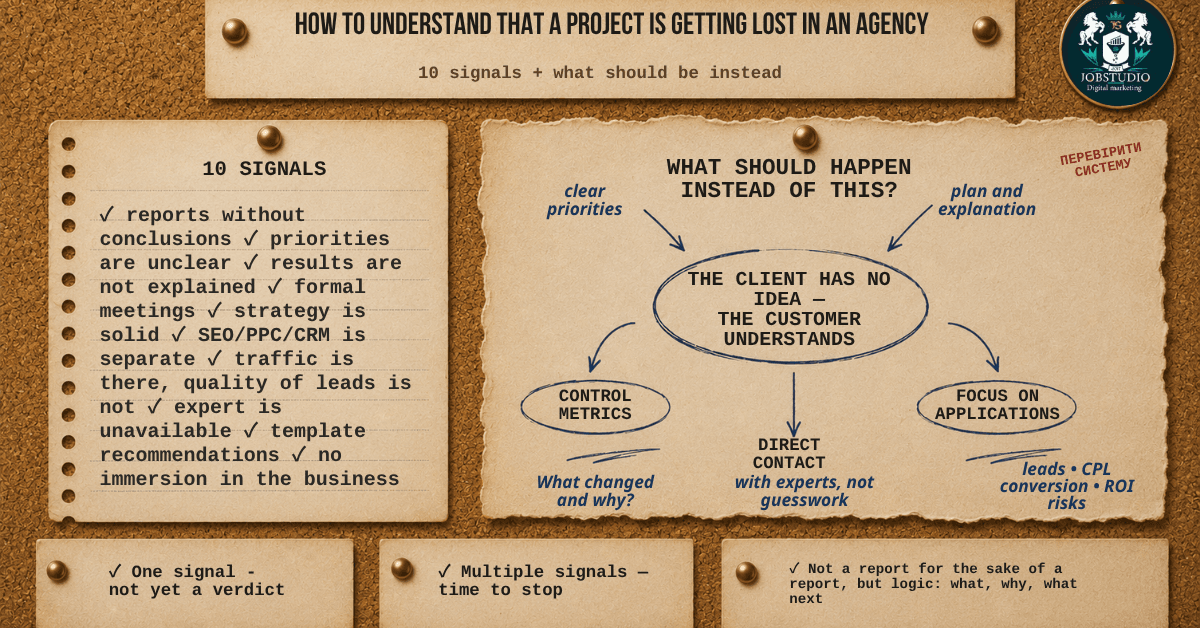
There are several signs that indicate a project may gradually fall by the wayside at the agency.
One warning sign doesn’t necessarily mean everything is wrong. But if you’ve recognized several of these points, it’s worth taking a moment to check the system.
Instead of a formal approach, businesses should be provided with a clear system for how they operate.
It includes:
The client shouldn’t have to guess what’s going on with their marketing.
He needs to understand:
That is what control is all about.
We don’t start by saying, “Here’s our standard package—let’s get started.”
First, you need to understand the situation.
What we’re checking:
This allows us to avoid wasting time and resources on secondary tasks while critical issues remain unresolved.
For example, there’s no point in scaling up your ads if the sign-up form isn’t working properly.
There’s no point in writing dozens of articles if the website has indexing issues.
There’s no point in celebrating a low CPL if the CRM shows that the leads are of poor quality.
Diagnostics are needed to distinguish a real problem from noise.
After an audit, it’s important not just to produce a long list of problems.
A list of problems alone doesn’t help a business. It can even create more chaos.
We need a plan of priorities:
It is prioritization that distinguishes a strategy from a checklist.
In the boutique approach, not all tasks are equally important. The team must explain why this particular action is currently the top priority, while another is second or third.
Business needs more than just activity. It needs consistency that leads to results.
JobStudio’s boutique approach is when the client understands:
We don’t sell “marketing magic.” We show where the system is losing leads, budget, or control, and what needs to be done to fix it.
That is exactly why it’s not just SEO, PPC, or advertising on their own that are important to us.
The entire chain is important: channel → website → action → analytics → CRM → lead quality → business decisions.
To help the client see this system in action, we use the Agile methodology: we break the work down into clear stages, regularly track progress, review priorities, and adapt the plan based on actual data rather than a formal list of tasks.
A key component of this approach is transparent reporting.
For SEO, we prepare detailed reports twice a month: what has been done, what changes have occurred, how rankings and traffic are performing, the technical condition of the website, indexing, landing pages, and next priorities.
For advertising, reporting is even more frequent—weekly. In our reports, we present all key metrics for evaluating effectiveness: costs, clicks, conversions, CPL/CPA, lead quality, campaign trends, problem areas, hypotheses, and an optimization plan for the next period.
If necessary, we can provide examples of such reports so that the client can immediately see what monitoring looks like in practice, rather than just in theory.
Your project shouldn’t be just another line in the agency’s spreadsheet.
If a business invests in SEO, PPC, advertising, audits, or comprehensive marketing, it should get more than just the completion of tasks.
He needs a team that digs deep, identifies weaknesses, analyzes data, explains decisions, and helps build a managed growth system.
A boutique approach isn’t about being a “smaller agency.”
It’s about paying more attention to specific businesses, taking more responsibility for decisions, and having more control over where applications are approved or rejected.
In digital marketing today, it’s not enough to simply “do SEO” or “set up ads.” You need to understand how all the elements work together.
Where the user saw the brand.
What did he press?
Look where I ended up.
Did Ofer understand?
Was he able to submit a request?
Has the application been entered into the CRM?
Was it of good quality?
Is it possible to scale this without breaking the budget?
It is precisely this level of control that a boutique performance/digital growth approach provides.
If you feel that marketing has become a mere formality, start not with a new budget, but with an assessment.
Type “AUDIT”—and we’ll show you where your website, advertising, SEO, or analytics might currently be losing leads, budget, and growth opportunities.
A boutique digital agency is a team that doesn’t just churn out projects one after another, but delves deeper into the client’s business, its goals, niche, sales funnel, analytics, and growth opportunities.
It isn’t necessarily a small agency. It’s an agency that focuses on depth, quality of attention, more direct communication, and accountability for decisions.
A typical SEO agency often focuses on search rankings, traffic, technical optimization, and content.
A boutique performance/digital growth agency takes a broader view: how SEO, PPC, the website, analytics, CRM, and the sales funnel work together to drive leads and business results.
In other words, the focus is shifting from “website promotion” to a managed customer acquisition system.
Yes, especially if it’s important for a business not just to “do something in marketing,” but to understand where leads are being lost, why ads aren’t scaling, why SEO isn’t delivering the expected results, and what needs to be fixed first.
For small and medium-sized businesses, this may be even more important than for large companies, because every irrelevant click, weak landing page, or error in analytics has a more immediate impact on the budget.
A boutique approach may not be suitable for a business that is looking for the cheapest solution without in-depth analytics, is not willing to grant access to data, or expects instant guarantees without a diagnostic assessment.
This format is also not suitable for those who simply want to “check off a marketing item” but aren’t ready to get to the root of the problems and implement changes.
Not always.
But a boutique approach isn’t usually about the lowest price. It’s about the quality of attention, the depth of analysis, direct contact with experts, better prioritization, and less risk of wasting your budget on chaos.
The question isn’t just how much the work costs. The question is what the business gets for that money: a standard set of tasks, or a team that understands the big picture and helps make decisions.
Yes.
In this format, JobStudio doesn’t replace the in-house team, but rather complements it. For example, it can handle technical, analytical, SEO, PPC, or audit tasks for which the company may lack the time or specialized expertise.
This could be a powerful model: your in-house team knows the business well, and JobStudio brings external expertise, analytics, structure, and additional resources.
Because without diagnostics, you can scale errors rather than results.
If the form isn’t working, the goals are set up incorrectly, there are irrelevant queries, or the CRM shows low-quality leads, increasing the budget will only accelerate losses.
Before scaling, you need to verify that the system is ready to receive, process, and handle requests.
An audit helps you understand exactly where the system is losing effectiveness: in SEO, advertising, analytics, the website, landing pages, CRM, or the quality of leads.
This provides not a haphazard list of changes, but a roadmap of priorities.
A good audit highlights not only the problems but also the next steps: what to fix first, what can yield quick results, what requires more in-depth work, and what needs to be verified before scaling up.
A reputable agency cannot guarantee specific rankings or an immediate top position, as these are influenced by Google’s algorithms, competitors, the technical condition of the website, content, and the market.
But we can guarantee a transparent process, consistent operations, secure methods, analytics, reporting, a plan, and accountability for implementation.
This is precisely the realistic foundation for long-term SEO results.
The best first step is an audit.
It will show where the business is currently losing orders, budget, or control, and will help develop a realistic action plan without unnecessary assumptions.
After that, you can make decisions: what to fix quickly, which tasks to prioritize, whether it makes sense to scale up your advertising, how to improve your SEO, and how to build a system in which marketing is driven not by inertia but by managed growth.
.webp)
 Contacts
 Language
 Book a call
 Order a proposal


