


Get a responsible approach in promoting client project.
Contact us now!
Contact us now!


 Order a call
  Get an offer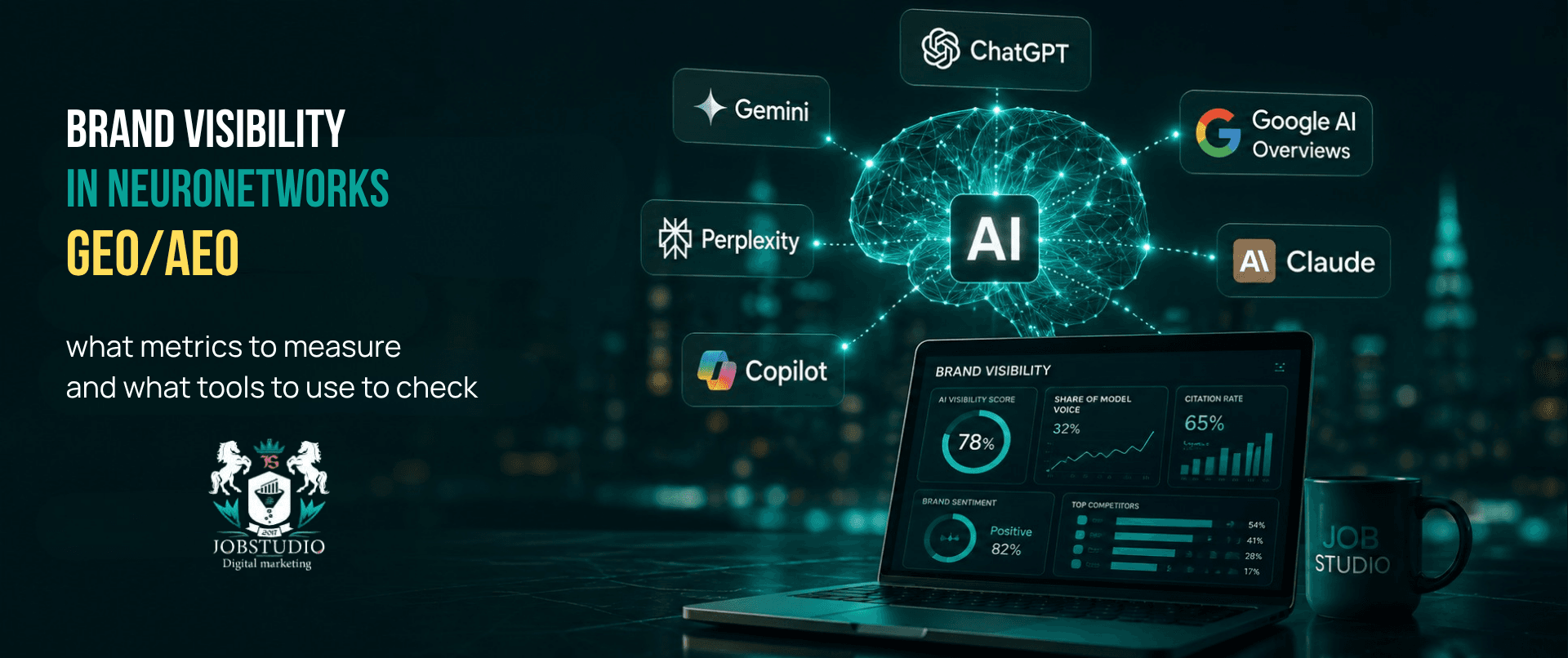
Your website may be at the top of Google’s search results, but the neural network will still recommend a competitor.
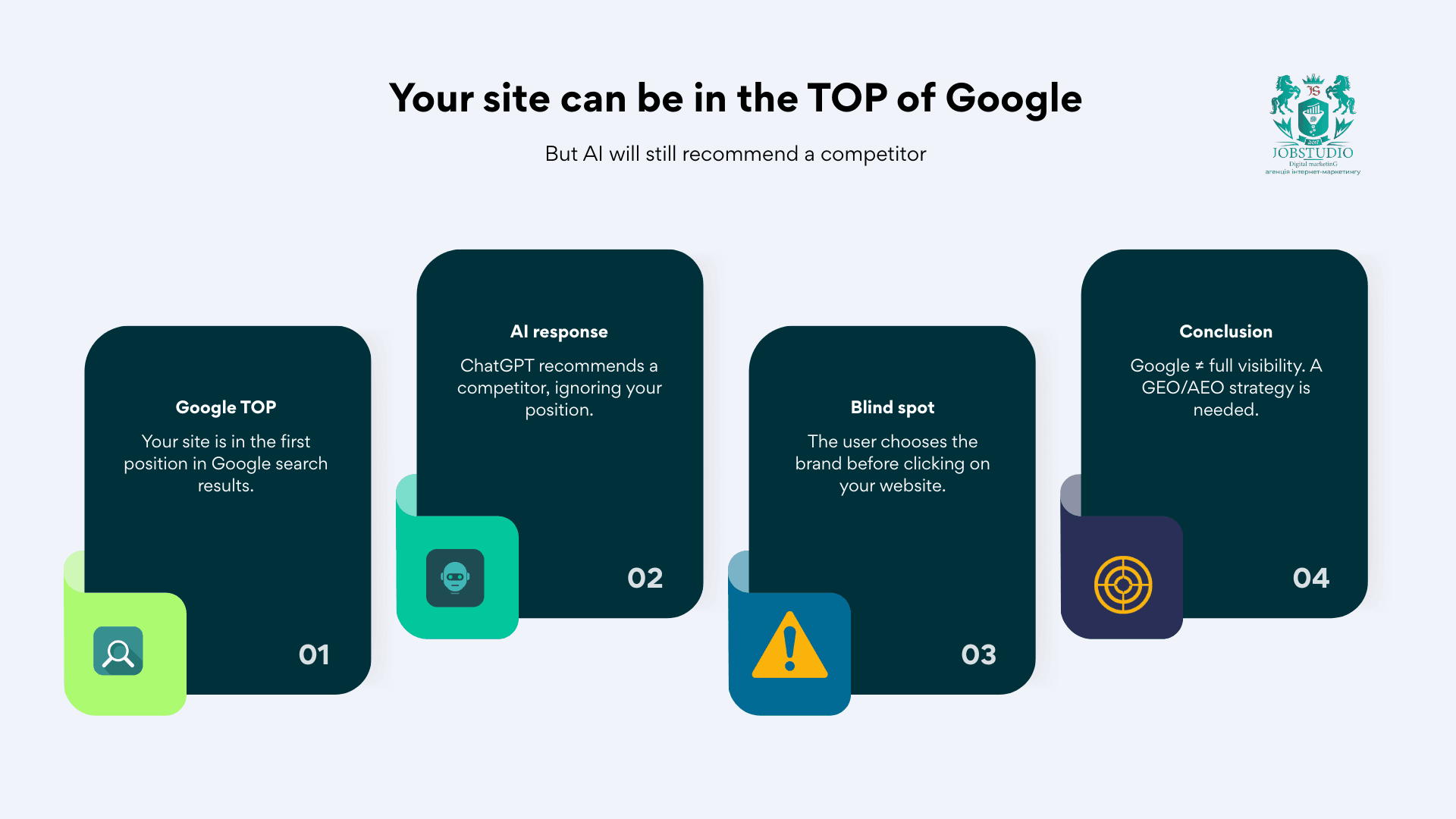
Or even worse: The AI might mention your brand, but describe it in an outdated, vague, or inappropriate way.
In GA4, this might not seem like a problem. The reports will look fine: traffic is coming in, there are some leads, and branded search is alive and well. But in reality, the customer’s decision might have been made earlier—on ChatGPT, Gemini, Perplexity, Copilot, or Google AI Overviews.
Table of Contents
A user doesn’t always open ten websites. They might ask the AI a simple question:
“Which SEO agency should I choose for B2B?”
“Who does a good Google Ads audit?”
“What services measure brand visibility in AI?”
“Which companies should you compare before choosing a contractor?”
And if your competitors are mentioned in the answer but you aren’t—that’s no small matter. It’s a new blind spot in marketing.

At JobStudio, we don’t view GEO/AEO as simply “promotion in ChatGPT,” but as a new layer of control: does the AI recognize the brand, understand it correctly, mention it, recommend it, who does it pair it with, and does this affect demand, branded search, direct traffic, inquiries, and sales.
In classic SEO, everything was clearer: there’s a search query, there’s a search result, there’s a ranking position, there’s a CTR, and there’s a click-through to the website.
In AI search, this chain is broken.
AI can:
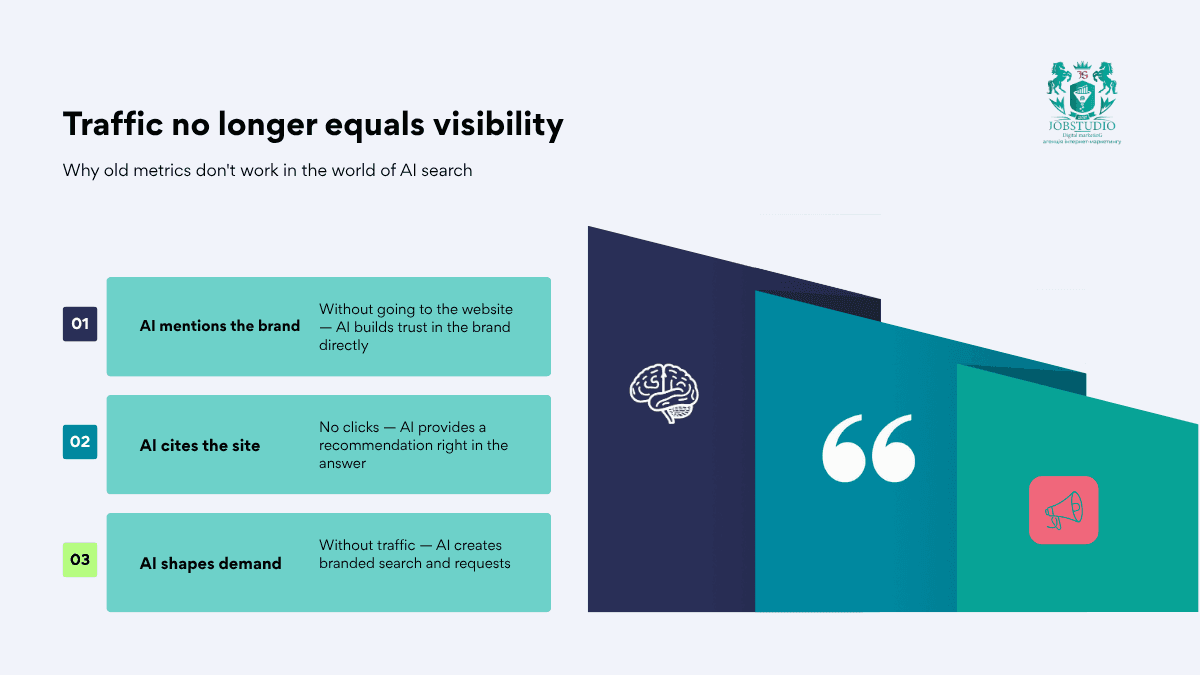
Therefore, traffic is no longer the same as visibility.
If a business focuses solely on clicks from ChatGPT or Perplexity, it’s only seeing the final part of the journey. Most of the impact may occur without a click.
That is why modern GEO/AEO tools measure not only traffic but also the AI Visibility Score, brand share of voice, mentions, source visibility, sentiment, and competitive presence.
Peec AI, for example, defines the Visibility Score as the percentage of AI responses that mention the brand.
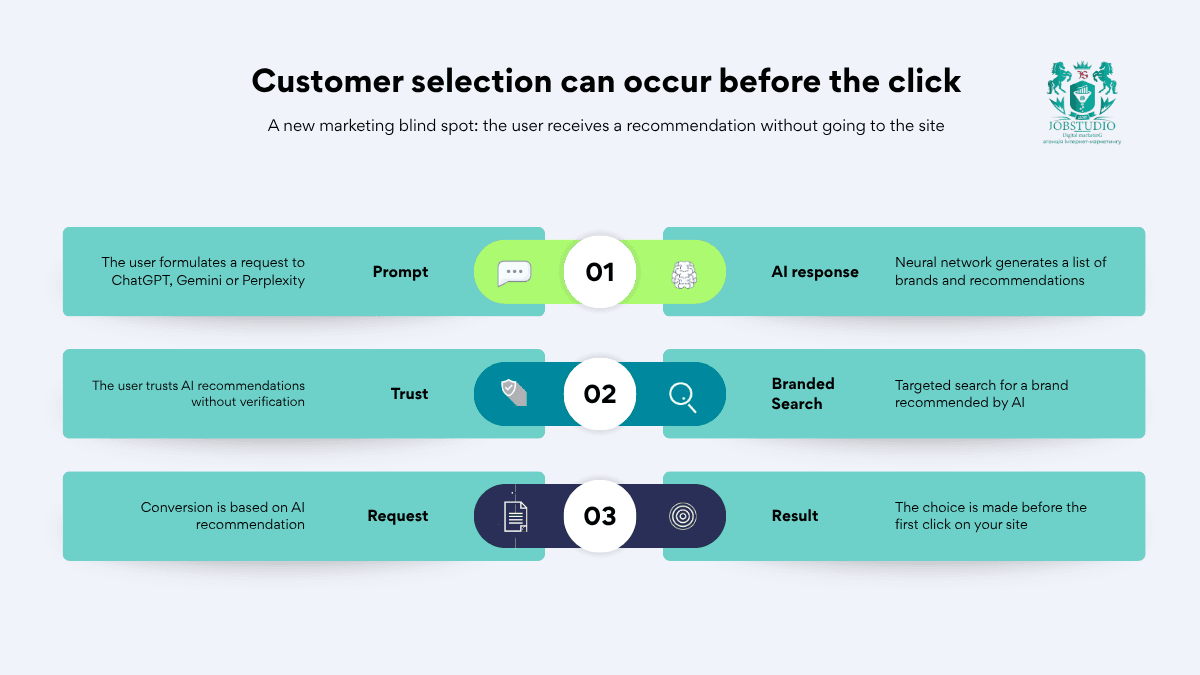
Let’s imagine a situation.
A business owner asks the AI:
“How can you tell if an SEO contractor is actually doing the work, rather than just sending reports?”
AI replies:
Next, the AI can mention brands, case studies, rankings, expert articles, or reviews.
The user won’t necessarily click right away. But if the brand appears in the search results, it has already earned the user’s trust. If the AI also describes it as an agency that systematically handles SEO/PPC audits, analytics, and the lead funnel, this influences the choice.
In your analytics, this may appear much later: as a branded search, direct traffic, a return visit, or a lead after several touchpoints.
So the question is no longer just about how many clicks you’ve received from AI.
The question is whether AI considers your brand when a customer is still just narrowing down their options.
At JobStudio, we don’t believe in haphazard “promotion on ChatGPT.”
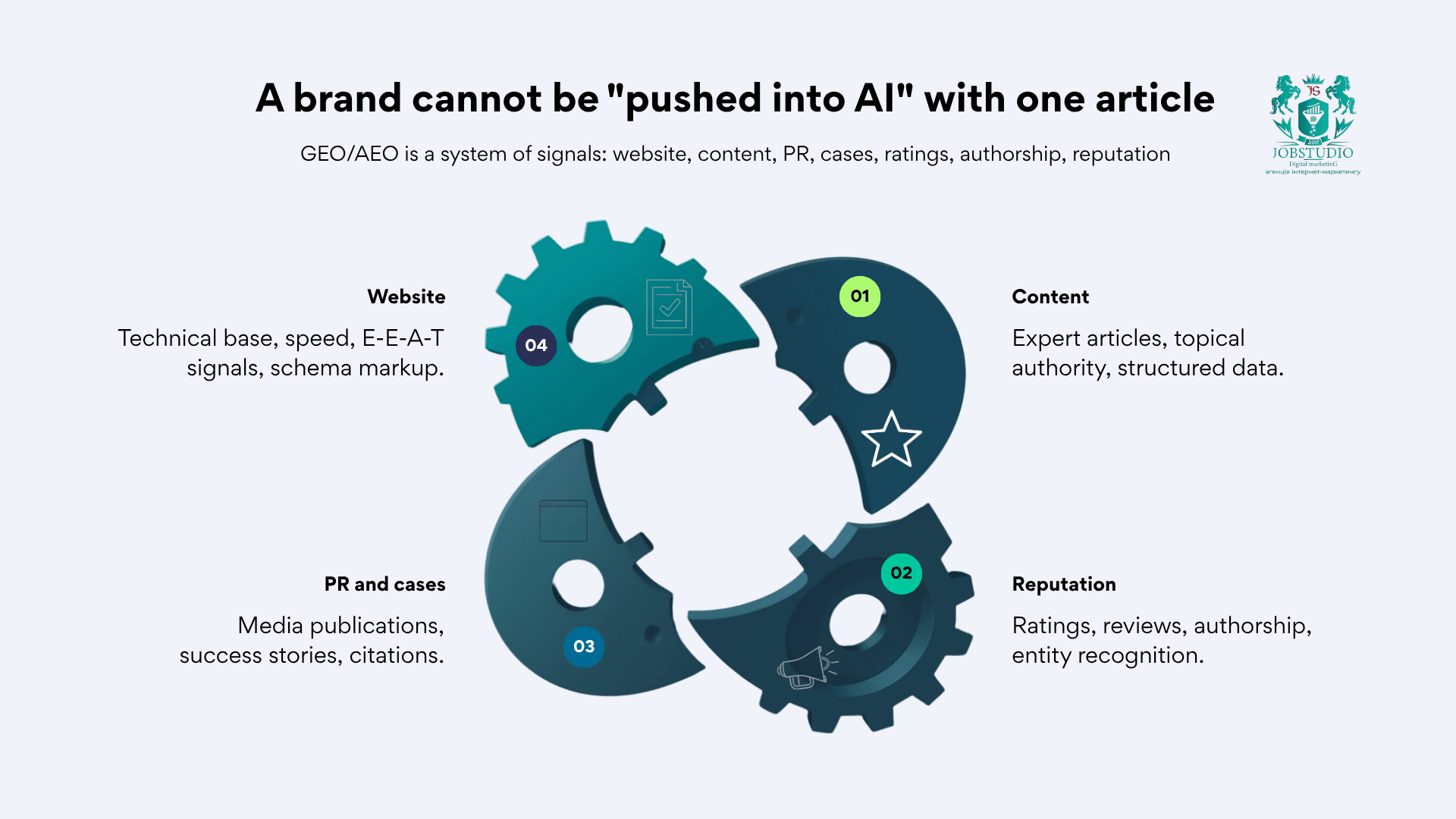
You can’t “feed a brand into AI” with just one article, one prompt, or one service.
GEO/AEO is a system of signals:
In our practice, we’ve been working this way for a long time: we don’t look at a single metric in isolation.
In the Google Ads audit for a project in the transportation and shuttle service industry, the goal was not simply to “review the ads,” but to identify where efficiency was being lost: in the campaign structure, ads, keywords, budget, conversion tracking, or post-click—at the website level.
This logic applies directly to GEO/AEO.
You can’t just look at whether ChatGPT mentioned you. You need to check the entire sequence:
prompt → AI response → brand mention → source → context → competitor → emotion → website → branded search → lead.
If even one element is weak, AI visibility will either fail to materialize or fail to translate into business results.
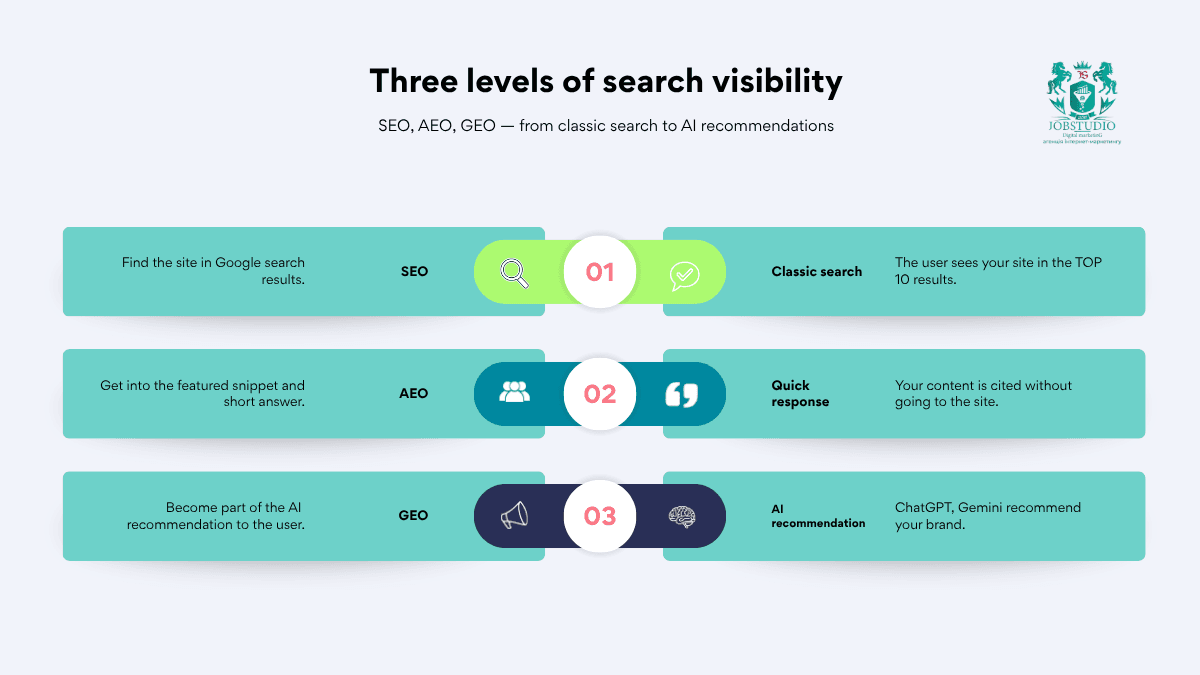
SEO is the process of optimizing a website for traditional search engine results. The goal is for pages to rank on Google, drive traffic, and bring users to the site.
AEO is about optimizing for answers: Featured Snippets, People Also Ask, AI Overviews, voice assistants, and short answer blocks. The goal is to enable the system to quickly extract a clear answer from your content.
GEO is the optimization of a brand and its content for generative systems: ChatGPT, Gemini, Perplexity, Copilot, Claude, and Google AI Mode. The goal is for AI to recognize the brand, describe it accurately, mention it in relevant responses, cite sources, and recommend it in the appropriate context.
To put it simply:
SEO helps people find a website
AEO helps you get a response
GEO helps you become part of a recommendation
GEO doesn’t replace SEO. It makes SEO even more important.
AI systems don’t operate in a vacuum. They rely on training data, live search, indexed pages, authoritative sources, external mentions, ratings, reviews, social media profiles, videos, Reddit, LinkedIn, YouTube, and other open sources.
Ahrefs Brand Radar, for example, analyzes brand visibility in Google AI Mode, AI Overviews, ChatGPT, Perplexity, Copilot, web pages, and search demand. In other words, AI visibility is viewed not as an isolated channel, but as part of a broader information landscape surrounding the brand.
If the website is technically weak, its pages aren’t indexed, its structure is chaotic, its services are described vaguely, and it lacks authorship, case studies, external mentions, and structured data, AI won’t have enough reasons to consistently use your brand in its responses.
Therefore, GEO/AEO is not a substitute for SEO.
It’s SEO + content + PR + reputation + analytics + brand consistency.
The phrase “promotion in ChatGPT” sounds good as a sales pitch, but it doesn’t accurately describe reality.
First of all, ChatGPT is just one of many systems. There are also Gemini, Perplexity, Copilot, Claude, Google AI Overviews, Google AI Mode, DeepSeek, Grok, and Meta AI.
Second, AI may source information not from your website, but from rankings, directories, reviews, listicles, forums, Reddit, YouTube, media outlets, or LinkedIn.
Third, AI visibility isn’t simply a matter of “whether or not it’s mentioned.”
It’s important to understand:
Therefore, it is more accurate to speak not of “promotion on ChatGPT,” but of a brand’s systematic AI visibility.
In traditional SEO, traffic was direct proof of visibility. If a page’s traffic goes up, so does its traffic. If the CTR drops, we check the snippet. If rankings drop, we analyze competitors, technical issues, content, and backlinks.
In AI Search, visibility can occur without a redirect.
AI can mention the brand, provide a brief summary, compare it to competitors, and build trust, but the user won’t visit the website right away.
This does not mean that there is no effect. It means that the effect is not always visible in the standard report.
Therefore, GEO/AEOs need to track:
On Google, a position is a clear unit of measurement.
Yes, SERPs are personalized. But we can track average position, CTR, trends, landing pages, clusters, and seasonality.
At GEO, things are different.
The same prompt can yield different responses. A slight change in wording can alter the list of brands. A different model might choose different sources. The response may depend on the time, context, region, interface, or search integration.
Therefore, GEO cannot be measured as a “position in ChatGPT.”
It should be measured in terms of the likelihood and consistency of the brand’s presence in the appropriate context.
One of the most common mistakes:
Open ChatGPT, enter a single query, and draw a conclusion:
“We’re not in AI”
or
“AI is already recommending us”
This isn’t an audit. It’s a screenshot.
One prompt does not show:
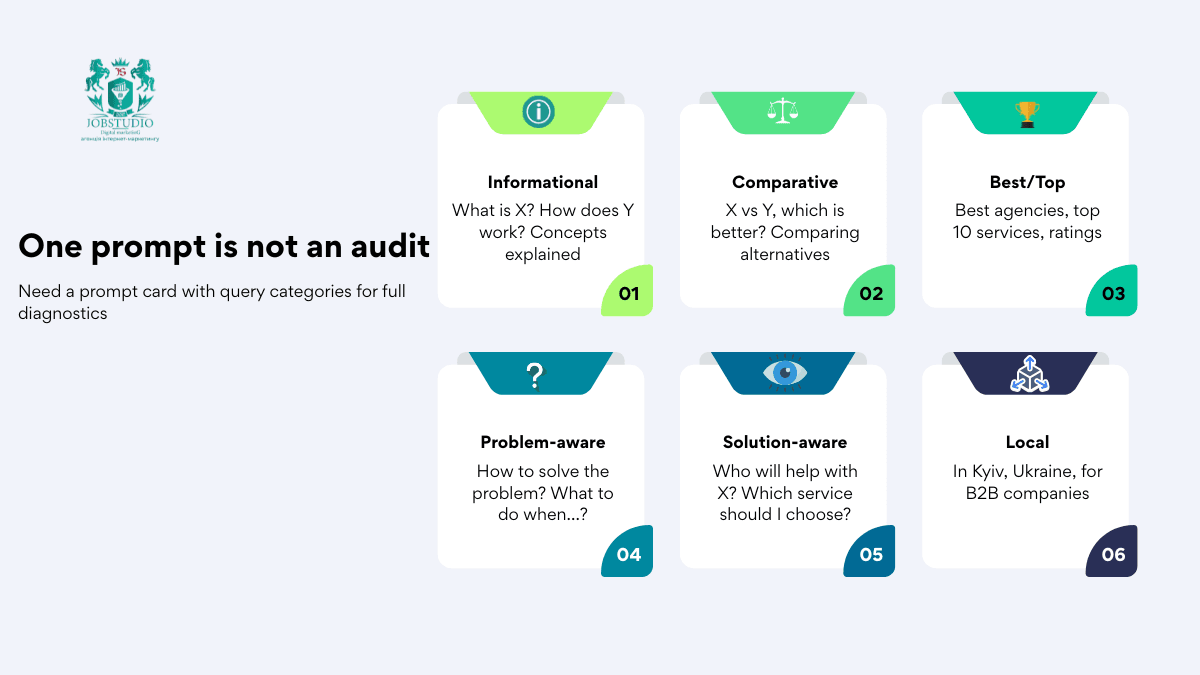
At JobStudio, we suggest working not with a single prompt, but with a prompt map.
This is a set of search queries that reflect real-world customer decision-making scenarios: informational, comparative, local, industry-specific, problem awareness, solution awareness, “best/top,” and queries made on behalf of a CEO, marketing director, or business owner.
Instead of asking:
“Where do we stand with ChatGPT?”
We need to ask different questions:
This is the transition from “positions” to an AI-based visibility system.
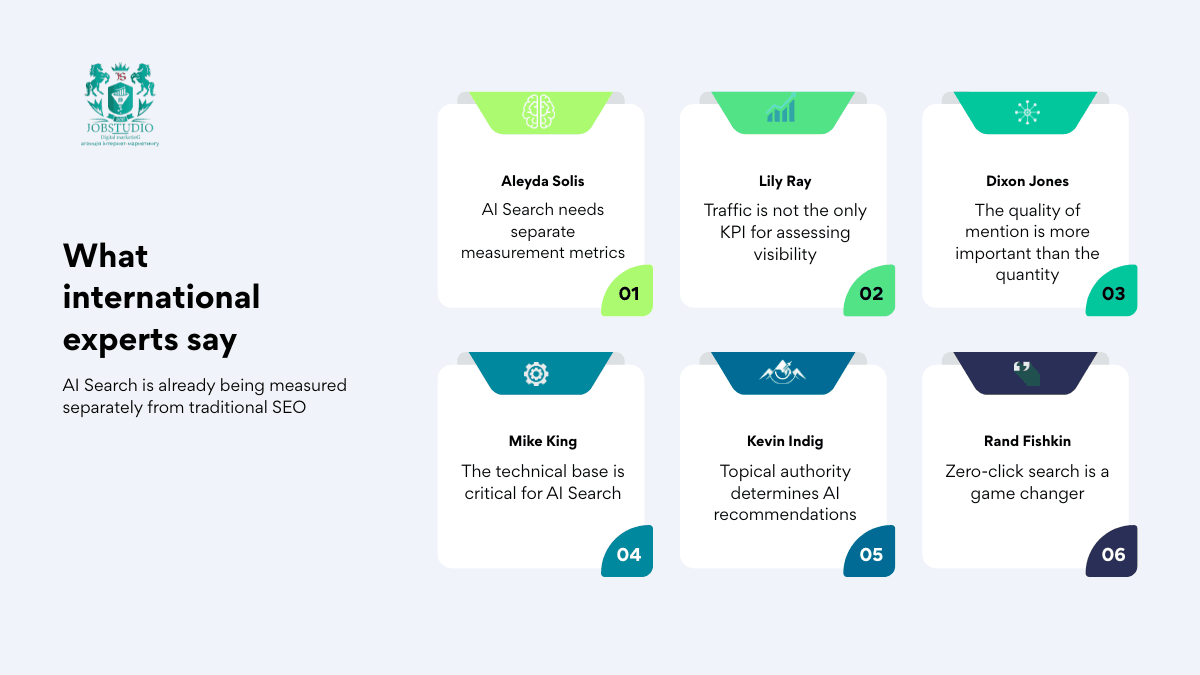
During the Profound Zero Click London event, Aleyda Solis and Mike King—world-class experts—discussed how answer engines work, which signals influence AI responses, and how content is selected for generative search results.
Takeaway for businesses:
AI Search can no longer be measured using traditional rank tracking alone. You need to look at:
This is completely in line with our approach: first, we need to assess where the brand is present in AI responses and where it falls short compared to competitors. Only then can we plan content, PR, technical adjustments, and external mentions.
Lily Ray, Amsive’s vice president of SEO strategy and research, emphasizes that marketers are already moving beyond traditional SEO metrics such as clicks, CTR, and traffic. New AI-focused KPIs are designed to show how often and how prominently brands are cited or mentioned in LLM responses on ChatGPT, Google AI Mode, Microsoft Copilot, Perplexity, and other answer engines.
Takeaway for businesses:
You can’t evaluate AI Search based solely on website traffic. You need to measure the brand’s presence within the responses themselves.
This means that GEO isn’t just about on-page SEO.
It’s also:
Michael King is important in this context because he views AI Search not only as a content issue, but as a technical system: automated responses, search, structure, signals, and source selection.
At Profound’s professional events, he and Aleyda Solis discussed how content is selected for AI-generated answers and which signals matter to brands that want to be cited in those answers.
Takeaway for businesses:
GEO/AEO isn’t just a task for a copywriter. It involves a combination of:
AI is more likely to trust a brand that consistently engages with the topic than a random website.
One article about GEO won’t make the brand an authority on GEO.
System requirements:
At JobStudio, this is clearly evident in complex SEO projects. In the Elife Travel case study, the SEO team got involved even before the website launched, working on architecture, multilingual support, URL structure, hreflang, redirects, content, GA4/GTM, and technical tasks. For GEO/AEO, the logic is the same: AI needs to see not just a fragment, but a system of expertise.
Just being mentioned isn’t a victory.
AI can mention the brand, but present it as:
In that case, visibility becomes a risk rather than an advantage.
Therefore, GEO/AEO overlaps with PR and brand reputation. It is important to monitor not only the number of mentions but also the brand image that is being shaped in AI responses.
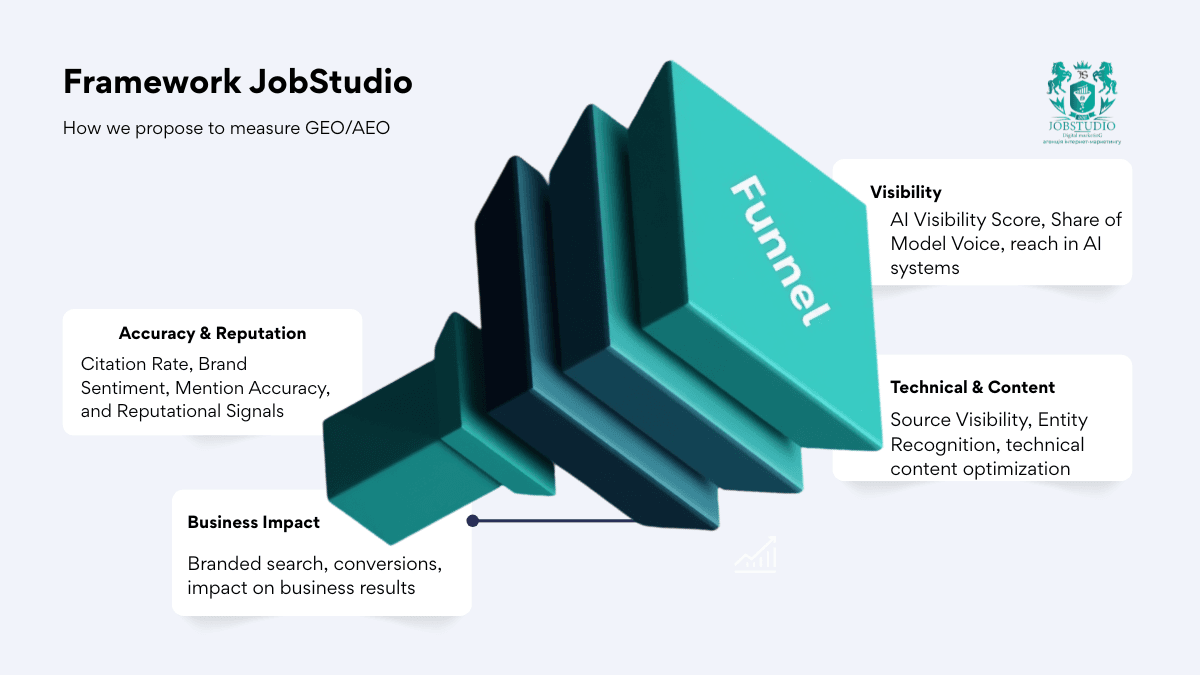
Level 1 — Basic Visibility.
We check:
This addresses the first audit question:
Does AI even recognize the brand or not?
The second level is accuracy and reputation.
Here we analyze:
It is at this level that GEO intersects with PR. If AI describes a brand inaccurately, the problem may not lie with the AI, but rather with the inconsistency of sources: the website says one thing, the catalogs say another, and old publications say yet another.
The third level is technical and content readiness.
We check:
A real-world example from JobStudio: During a Google Ads audit, we discovered that the problem wasn’t limited to the campaigns. The project had conversions set up for clicks via phone, email, Telegram, Viber, WhatsApp, and a form, but the form itself wasn’t actually implemented, and some of the messaging app buttons didn’t have links.
For GEO, the logic is the same: a report may indicate that “content exists,” but in a real-world scenario, the AI cannot use it correctly or does not trust it as a source.
The fourth level is business impact.
We don’t stop at “they mentioned us.”
We’re watching:
In the Google Ads audit, JobStudio reviewed not only the ads but also the website: the relevance of the final URLs, page speed, mobile usability, cross-browser compatibility, the presence of a form, the functionality of contact buttons, and UX scenarios. It’s the same principle: evaluate not the settings for the sake of settings, but the actual path to a lead.
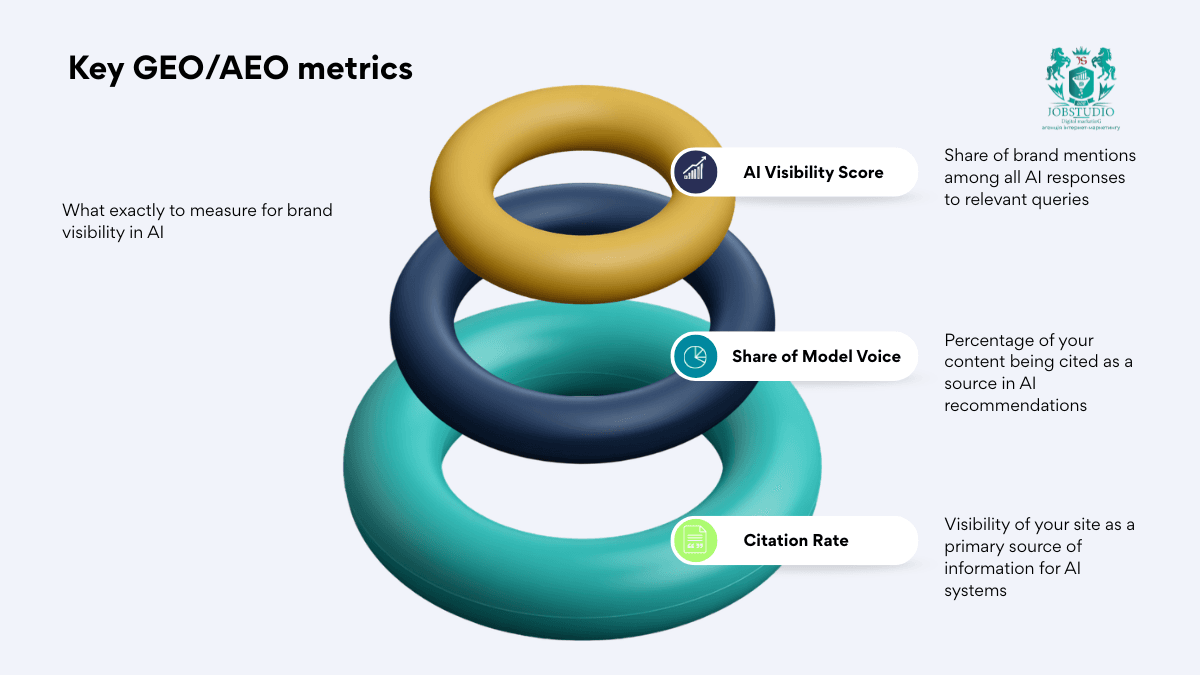
The AI Visibility Score shows how often a brand appears in AI responses based on a selected set of prompts.
Formula:
AI Visibility Score = number of AI responses mentioning the brand / total number of responses analyzed × 100%.
Peec AI uses exactly this logic: The Visibility Score measures the percentage of AI responses that mention the brand.
Example:
We reviewed 100 prompts on the topic of SEO/PPC audits. JobStudio was mentioned in 18 responses. AI Visibility Score = 18%.
But the number itself doesn’t tell the whole story without context. If a competitor is mentioned in 45 responses, the problem isn’t just about visibility. The problem lies in the market share within the AI responses.
Share of Model Voice shows what percentage of AI responses the brand accounts for compared to its competitors.
For example:
It’s no longer a question of “whether people can see us or not.”
This is a competitive presence map.
In traditional SEO, users saw 10 results. In an AI-powered response, they might see 3–5 brands. That’s why relative visibility becomes critical.
The Citation Rate shows how often AI references a website or uses it as a source.
The brand may be mentioned without citing the website.
For example:
“Some agencies to consider include JobStudio, Netpeak, Promodo…”
However, the source may not be the JobStudio website, but rather a third-party ranking.
In that case, the brand is visible, but the website does not indicate the source.
Source Visibility shows whether a brand’s domain or content is used as a source, even if the brand is not mentioned in the response text.
Peec AI clearly distinguishes between brand visibility and source visibility: a brand may be mentioned in a response, but the website may not be cited as a source; or the website may be cited as a source, but the brand may not be named.
This is very important for diagnosis.
If you’re often quoted but not credited, the problem may be a lack of brand recognition.
If you’re frequently mentioned but not cited—the AI recognizes the brand but doesn’t consider your content a strong enough source.
Prompt Coverage shows the number of relevant scenarios in which a brand appears in AI responses.
This isn’t just a list of keywords.
This is a list of situations in which a customer might ask the AI a question.
For JobStudio, these could be prompts:
Prompt Coverage helps you understand at which stages of the decision-making process a brand is already present, and where AI doesn’t even consider it.
Brand Sentiment shows exactly how AI describes a brand.
Options:
Example:
If an AI describes JobStudio simply as an “SEO agency” but fails to recognize its boutique format, performance-driven approach, audits, analytics, Google Ads, and funnel management, that’s a sign: we need to reinforce our positioning more strongly in open sources.
Entity Recognition shows whether the AI correctly identifies the brand as an entity.
It is important to JobStudio that AI associates the brand with the following areas:
If the AI doesn’t understand the essence of the brand, it won’t consistently recommend it in the right responses.
The Content Retrieval Success Rate indicates whether AI can find, read, understand, and use a brand’s content.
The following factors influence this:
This is an area where classic technical SEO directly impacts GEO/AEO.
This is one of the most complex and important metrics
AI can influence the user, but the conversion will take place through a different channel
So you need to look at:
This isn’t always attributed perfectly. But if these signals aren’t measured, businesses can’t see the actual impact of AI on customer choice.
How JobStudio Conducts a GEO/AEO Audit in Practice
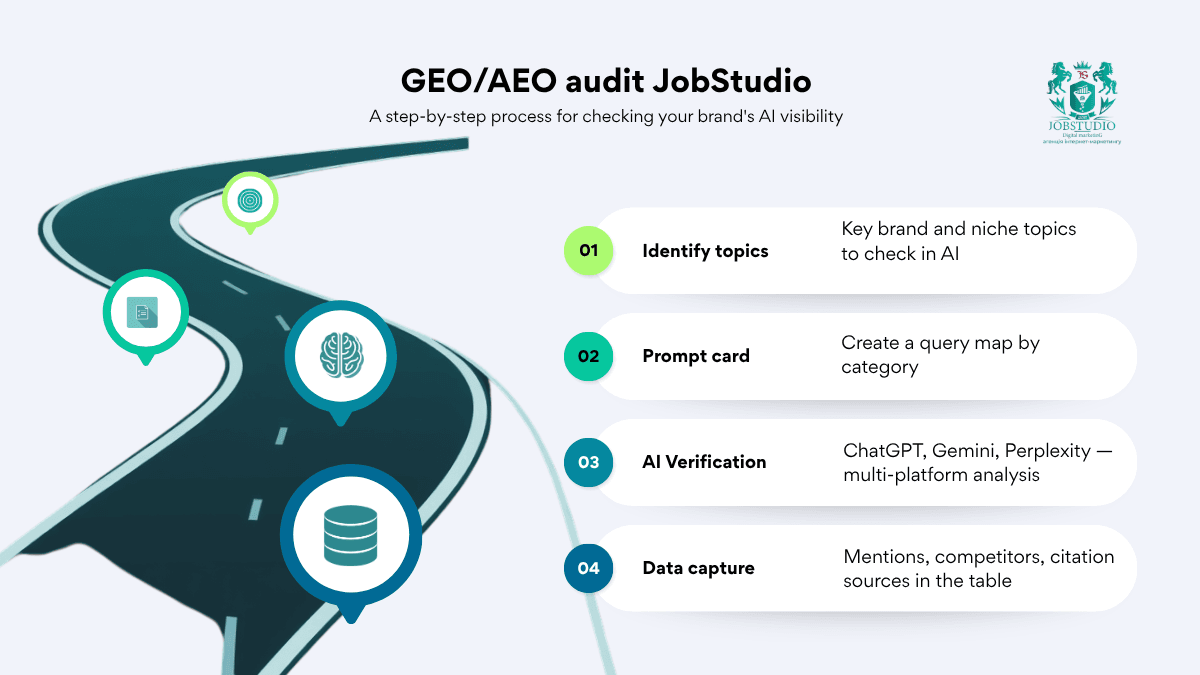
It’s not a tool at first.
First, the topics.
For JobStudio, these could include:
If you don’t define the topics, you won’t know exactly what to measure.
A prompt map should cover more than just the obvious queries.
Required:
For example:
“How can you tell if Google Ads isn’t paying off?”
“What are the signs of a poor SEO contractor?”
“Which agencies in Ukraine conduct Google Ads audits?”
“Compare an SEO audit and an SEO contractor evaluation”
“What tools measure AI visibility?”
Minimum set:
A single system does not provide the full picture. Different AI systems may perceive a brand differently, use different sources, and generate different responses.
Recommended table:
| Field | What we record |
|---|---|
| Prompt | Which query was checked |
| AI system | ChatGPT, Gemini, Perplexity, etc. |
| Brand Mention | Was the brand mentioned? |
| Competitors | Which competitors have emerged |
| Sources | Which sources are cited |
| Sentiment | Positive, neutral, or negative |
| Accuracy | Is the brand described accurately? |
| Errors | Errors, hallucinations, or outdated data |
| Source Visibility | Was the brand’s website used as a source? |
| Next Action | What to do next |
Without such a table, a GEO audit becomes nothing more than a subjective impression.
With a table, it’s already a system of solutions.
The audit should not result in a finding of “low visibility.”
There needs to be a plan.
For example:
That’s exactly how JobStudio approaches performance audits: not “take a look and forget about it,” but “identify the problem → map it out within the system → provide an action plan.”
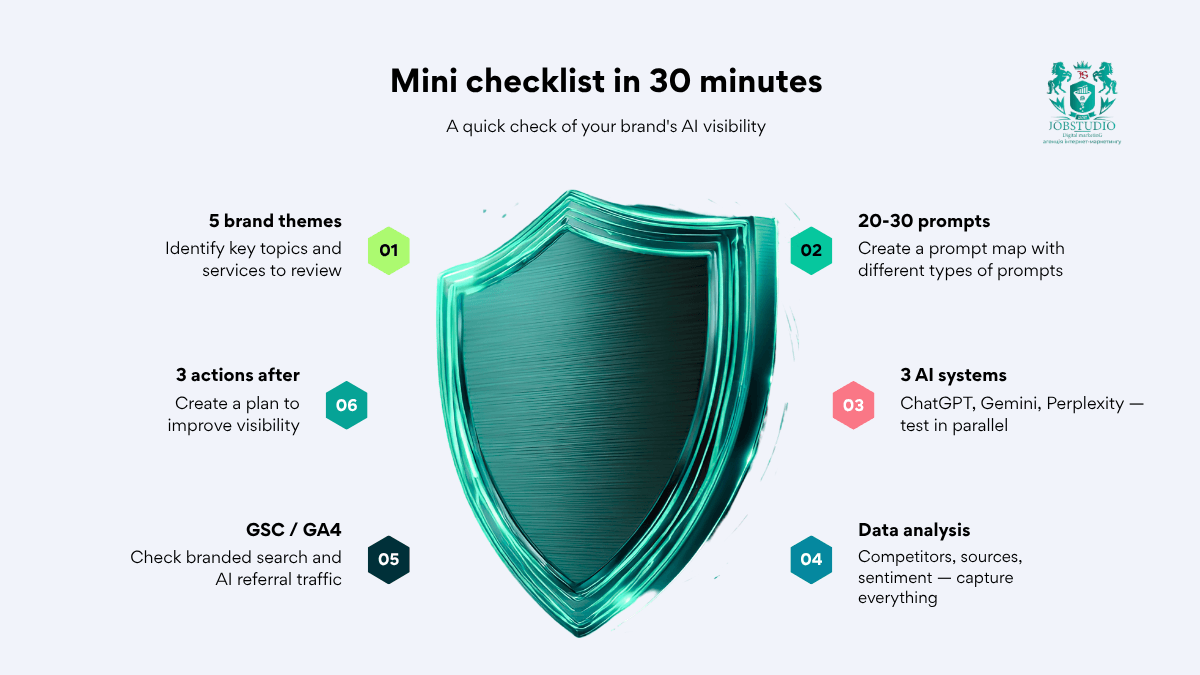
This checklist is not a substitute for a full audit, but it quickly shows whether there is a problem
| Step | What to Do | What You Should Understand |
|---|---|---|
| 1 | Select 5 key brand themes | What AI should associate you with |
| 2 | Create 20–30 prompts | In what scenarios might a customer turn to AI? |
| 3 | Test ChatGPT, Gemini, and Perplexity | Does the brand appear in the responses? |
| 4 | Identify competitors | Who does the AI recommend instead of you? |
| 5 | Review sources | Where does AI get its information? |
| 6 | Assess sentiment | How exactly does AI describe the brand? |
| 7 | Check accuracy | Check for outdated or incorrect statements |
| 8 | Check Google Search Console | Is the number of brand-related queries increasing? |
| 9 | Check GA4 | Are there any referrals from AI systems or spikes in direct traffic? |
| 10 | Identify 3 priority actions | What to fix in SEO, content, PR, or analytics |
The main purpose of this checklist is not to get a “good grade,” but to identify the first steps to take.
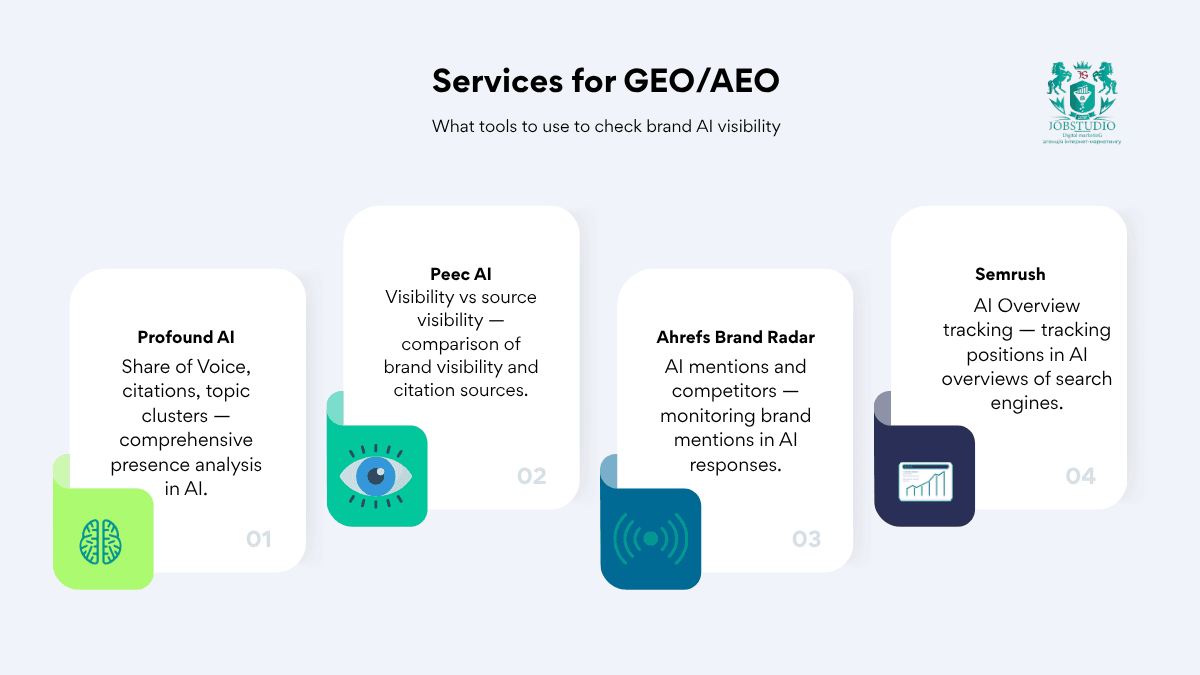
No tool today provides the full picture when it comes to AI visibility.
Reasons:
Therefore, these services should be used not as a “definitive ranking,” but as a way to track trends.
They help us understand:
| Service | Why It’s Useful | Who It’s For | What to Check First | Connection to the field of expertise |
|---|---|---|---|---|
| Profound AI | AI visibility, Share of Voice, citations, sentiment, prompt volumes, Conversation Explorer, topic clusters | Enterprise, major brands, agencies, B2B teams | Share of Voice, citations, topic clusters, co-mentions | Strong signal: Aleyda Solis and Mike King participated in Profound AI Search events; Profound is actively shaping the AI Search analytics field |
| Peec AI | Visibility Score, brand mentions, source visibility, competitor tracking, prompt tracking | In-house marketing, medium-sized businesses, agencies | Brand visibility vs. source visibility | Clearly explains the difference between brand visibility and source visibility |
| Ahrefs Brand Radar | AI visibility, AI citations, competitors, web visibility, YouTube, Reddit, TikTok, search demand | SEO teams already working with Ahrefs | Competitors, top-cited pages, AI mentions | Useful for connecting traditional SEO, brand visibility, and AI visibility |
| Semrush AI Toolkit / Prompt Tracking | Prompt Tracking, ChatGPT Search, Google AI Mode, Gemini, competitor comparison | Teams already using Semrush | Prompt visibility, average position, competitor comparison | A convenient bridge between SEO audits, prompt tracking, and AI visibility |
| Rankscale AI | Citation mapping, sentiment analysis, AI readiness audits, competitor benchmarking | Agencies, PR/brand teams | Citation sources, sentiment, competitors | Useful for reputation management and identifying external sources of influence |
| SE Visible / SE Ranking AI Visibility | Visibility Score, sentiment, topic insights, competitor benchmarking | SEO agencies, CMOs, businesses | Visibility by topics, sentiment, competitors | Suitable for teams that need AI visibility within the familiar SEO framework |
| Writesonic AI Search Visibility | Prompt monitoring, citation gaps, AI crawler analytics, action center | Content and SEO teams | Citation gaps, prompt monitoring | Interesting for transitioning from monitoring to content recommendations |
| AthenaHQ | Prompt volume, GEO score, source intelligence, e-commerce/Shopify integrations | Enterprise, e-commerce, and data-driven teams | GEO score, source intelligence, e-commerce prompts | Useful for e-commerce and performance marketing |
| Goodie AI | Topic Explorer, AEO writer, semantic optimization, AI attribution | Growth teams, PR, SEO | Topic gaps, AI attribution, semantic recommendations | Better suited for content actions following monitoring |
| DataForSEO LLM Mentions API | API for custom dashboards, automated collection of LLM mentions | Technical SEO teams, agencies, product teams | Custom prompts, mentions, model comparison | Suitable for custom monitoring and integration with Looker Studio or CRM |
Ahrefs Brand Radar lets you find AI citations and analyze how your brand is represented in AI responses and other marketing touchpoints.
Semrush Prompt Tracking lets you track your brand’s daily visibility based on a custom set of prompts in ChatGPT Search, Google AI Mode, and Gemini; compare AI search visibility with traditional Google rankings; and analyze competitors.
Profound is one of the most talked-about tools in the field of AI search visibility.
Its value does not lie in the fact that it “reveals a secret trick in ChatGPT.”
Its value lies in the fact that it helps us see:
In other words, Profound isn’t useful for “playing around with AI,” but rather for assessing AI visibility at the brand, category, and competitive landscape levels.
Aleyda Solis and Mike King participated in the Profound event “Inside AI Search London,” where they discussed the technical fundamentals of response mechanisms and the signals that influence AI responses.
This doesn’t make Profound the only right service. But it shows that a strong professional community is forming around it.
When Profound Can Be Useful for Businesses
Profound makes sense if:
When Profound Might Be Overkill
Profound might be overkill if a business is just getting started.
To start with, the following may be enough:
The most important thing is not to buy an expensive tool before you understand what decisions you will make based on the data it provides.
The following are suitable:
Objective: To gain a basic understanding of whether the brand is mentioned, where exactly it is mentioned, alongside whom, and in what tone.
The following are suitable:
Objective: To see who is submitting AI-generated answers on your behalf.
The following are suitable:
Objective: To understand which rankings, directories, articles, reviews, or pages influence AI responses.
The following are suitable:
Objective: To see how the AI describes the brand and check for any negative content, errors, outdated information, or weak comparisons.
The following are suitable:
Objective: Link AI visibility to indexing, content, competitors, branded search, and technical SEO.
The following are suitable:
Objective: Build a custom system for an agency or an in-house marketing analytics team.
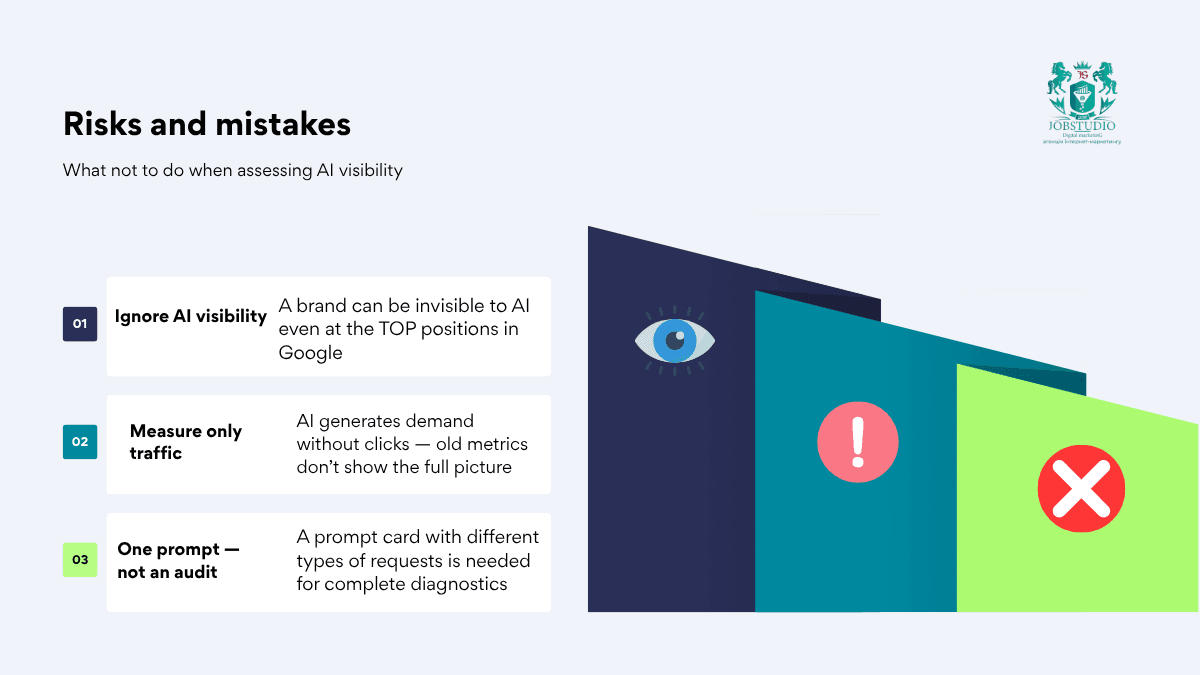
This means that the AI doesn’t see enough cues to associate the brand with the topic.
What to do:
JobStudio builds trust through concrete case studies, screenshots, before-and-after comparisons, statistics, and practical insights—not through abstract claims like “we’re the best.”
This means that while the brand may be well-known, the website is not perceived as a strong source.
What to do:
This is the most valuable part of the audit.
You need to understand why your competitors are mentioned in the answer, but you aren’t.
Let’s check:
Next, we create content and PR initiatives based on those same prompt clusters, but with higher quality.
In the “Jewelry” case study, we’ve already seen how critically important it is to filter out the wrong kind of demand. For a B2B jewelry company, the challenge wasn’t about generating any traffic, but about avoiding selling to wholesalers as if they were retail customers. In GEO, the logic is the same: it’s not enough to simply “be mentioned”; you need to be mentioned in the right commercial context.
It’s not the AI that needs to be fixed, but the sources from which it draws its information.
Check:
AI often makes mistakes not because it is “bad.” Open sources are often chaotic: inconsistent descriptions, outdated services, inconsistent geographic data, vague location information, and outdated profiles.
This means that GEO needs to be linked to the funnel.
Check:
In JobStudio’s Google Ads audit, I saw a similar pattern: even a strong commercial query won’t help if, after clicking, the user lands on the wrong page or can’t submit a request properly. The case study featured irrelevant URLs, inactive messenger buttons, a non-functional form, and poor mobile UX—and these factors could have been causing leads to be lost even after a paid click.
GEO/AEO faces the same problem: AI can generate interest, but the website, offer, or CRM may not convert that interest into a lead.
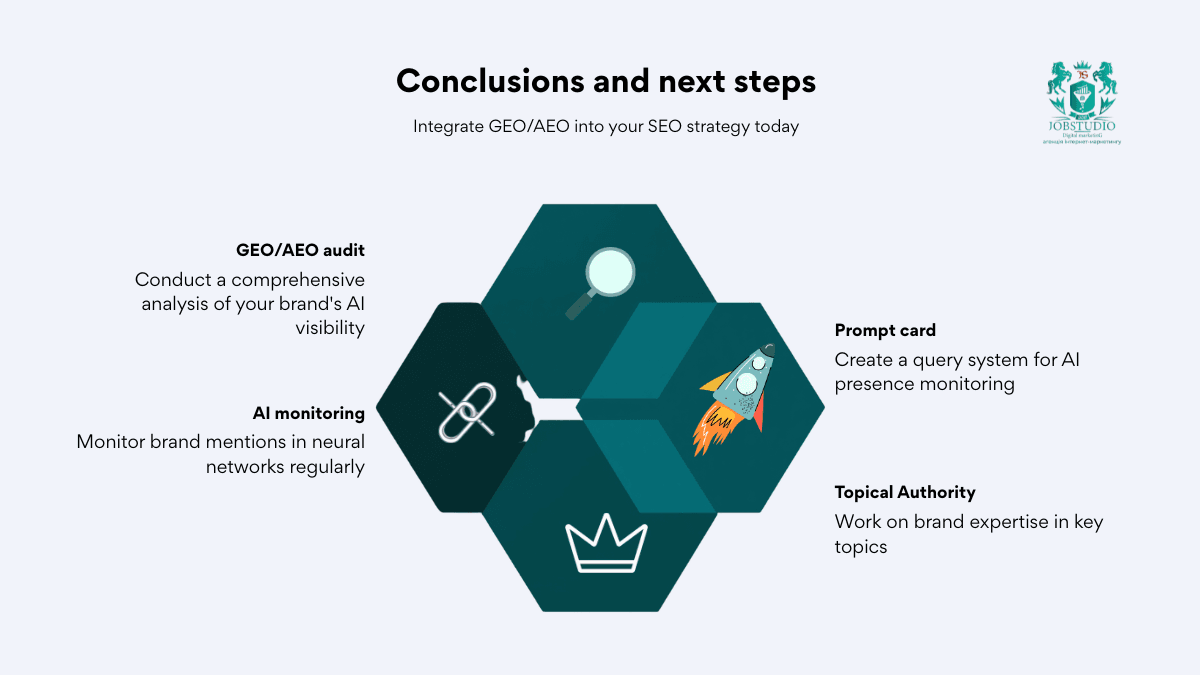
Business doesn’t need yet another fancy acronym.
Business needs oversight.
GEO/AEO isn’t about asking ChatGPT about your company just once.
The point is to understand:
In traditional SEO, businesses competed for rankings.
In the GEO/AEO sector, businesses are competing for the right to be properly understood, cited, and recommended when decisions are made.
Start with a simple GEO/AEO audit:
We don’t recommend starting with a haphazard “push into ChatGPT.”
Start with an audit.
It’s important to understand:
Only then does it make sense to develop a GEO/AEO strategy.
Do not scale content that AI cannot understand.
Don’t invest in PR if you don’t know which sources are being cited.
Don’t get excited about a mention if it’s inaccurate or negative.
GEO/AEO isn’t magic. It’s a new way to influence customer choice.
GEO is the process of optimizing a brand and its content so that generative systems such as ChatGPT, Gemini, Perplexity, or Copilot mention, quote, and recommend the company in their responses.
AEO is the optimization of content for short answers in search engines, AI Overviews, Featured Snippets, “People Also Ask,” and voice assistants.
SEO focuses on rankings in traditional search results. GEO focuses on a brand’s presence in AI-generated answers: mentions, citations, tone, accuracy of description, and share of voice.
No. GEO does not replace SEO; it complements it. Without technical SEO, high-quality content, external signals, and a clear website structure, AI will have no basis for consistently referencing the brand.
This is because AI often fulfills the user’s need without them having to visit the website. A brand can influence the decision even if the click occurs later through branded search, direct traffic, or another channel.
Key metrics: AI Visibility Score, Share of Model Voice, Citation Rate, Source Visibility, Prompt Coverage, Brand Sentiment, Entity Recognition, Content Retrieval Success Rate, and Business Impact.
No. A single prompt doesn’t provide an objective picture. You need a prompt map, regular testing, multiple AI systems, and comparisons with competitors.
Some useful services include: Profound AI, Peec AI, Ahrefs Brand Radar, Semrush AI Toolkit, Rankscale AI, SE Visible, Writesonic AI Search Visibility, AthenaHQ, Goodie AI, and DataForSEO LLM Mentions API.
This is because Profound actively works with AI visibility, share of voice, citations, sentiment, prompt volumes, and topic clusters. Its data is used, shared, or discussed by world-class experts, including Aleyda Solis and Mike King, who participated in the Profound event Inside AI Search London.
That’s right. AI can describe or recommend a brand without directly linking to its website. That’s why, in GEO, it’s important to measure not only referral traffic but also mentions, tone, and share of voice.
We need to update and standardize the information across all sources: the website, service pages, company profiles, catalogs, LinkedIn, Google Business Profile, reviews, media, FAQs, and structured data.
Yes, but not always with expensive instruments
Small and medium-sized businesses should start with a basic GEO/AEO audit: check 30–50 prompts, see who the AI recommends instead of you, what sources it cites, how it describes the brand, and whether branded search is growing. If you already see potential or competitors are actively appearing in AI responses, then you can start using specialized services.
Start manually:
This is enough to identify the initial issues and determine whether a more in-depth audit is needed.
At least once a month. In competitive niches—every week, because AI responses change, and what matters isn’t a one-time check but the dynamics of visibility, citations, sentiment, and the competitive landscape.
.webp)
 Contacts
 Language
 Book a call
 Order a proposal


