


Get a responsible approach in promoting client project.
Contact us now!
Contact us now!


 Order a call
 Get an offer
When choosing an SEO contractor, you want to understand a few simple things: who will be working on the website, how much time they’ll devote to the project, and how you’ll be able to verify the work that’s been done. This is especially true if a previous collaboration left you with more questions than results.
At JobStudio, we’ve built a boutique model around these needs: we’ve limited the number of projects per specialist, specified working hours in the contract, and given clients access to the process. Here’s what that means for your business.
Why are we starting with the terms of the project? Because it’s often a bad experience with a previous partner that leads to the phrase: “We’re looking for an SEO contractor—but not an agency.”
Have you seen this in job postings for SEO contractors or partnership proposals? Or maybe you’ve written something like this yourself.
Table of Contents
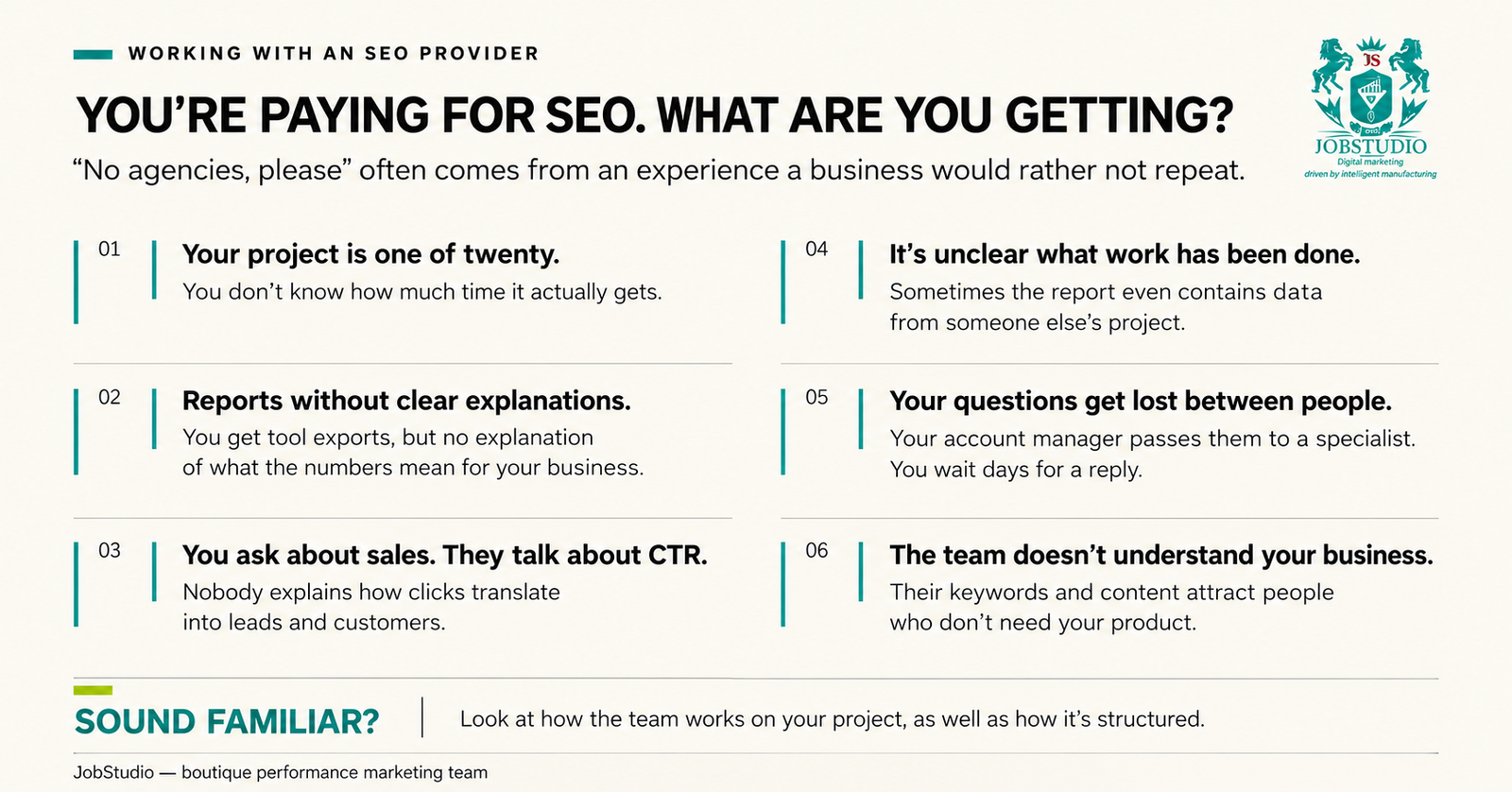
And we understand where you’re coming from. Often, this phrase stems from a bad experience with a partner: you pay for SEO, but you don’t know how much time is being devoted to your project, what exactly they’re doing, or how it’s helping your business. Reports come in, but there’s a lack of clear answers and attention to your specific goals.
But let me ask one question: Do all people work the same way just because they have the same profession?
Probably not. One specialist might manage five projects superficially, just ticking off the basic checklist. Another might handle two, but know the client’s business almost as well as their own: margins by category, seasonality, and the pain points of the sales department.
It’s the same with agencies.
So we suggest not lumping everyone together just because of the word “agency.” Instead, take a few minutes to figure out exactly how people work—and what’s really behind your “anything but an agency” filter.
It’s the same with agencies. After a bad experience at a restaurant, we look for another place. After buying from an unreliable online store, we check the seller more carefully. One poor-performing specialist isn’t a reason to stop hiring altogether. Why, then, should an experience with a single SEO contractor determine our attitude toward the entire market?

The phrase “we’ve already worked with an agency and don’t want to do so again” sometimes reveals the criteria behind the initial selection. Perhaps the deciding factors were price, a compelling presentation, a recommendation from acquaintances, or the promise of quick results. But who will actually work on the project, how well the team understands the business, and how accountable they are for the work—these factors were overlooked. This doesn’t absolve the contractor of responsibility, but it does provide a specific point of reference for next time.
Here at JobStudio, we recommend starting with these questions. Get to know the specialists, ask them to explain the logic behind the upcoming work, and ask to see a sample report. Find out how much time they’ll allocate to your project, who will be responsible for implementation, and how you’ll be able to verify the work completed. Even the term “boutique,” which we use to describe our team, must be reflected in how the work is organized.
After an unsuccessful SEO campaign, it’s worth changing your approach to selecting a partner. Instead of “no more agencies,” think, “now we know what to look for before starting a partnership.”
We are JobStudio, a boutique performance team. And we have deliberately built a model that is much closer to the work of a top freelancer than to that of a traditional large agency
Below, we’ll explain what this means in practice—point by point, without beating around the bush.
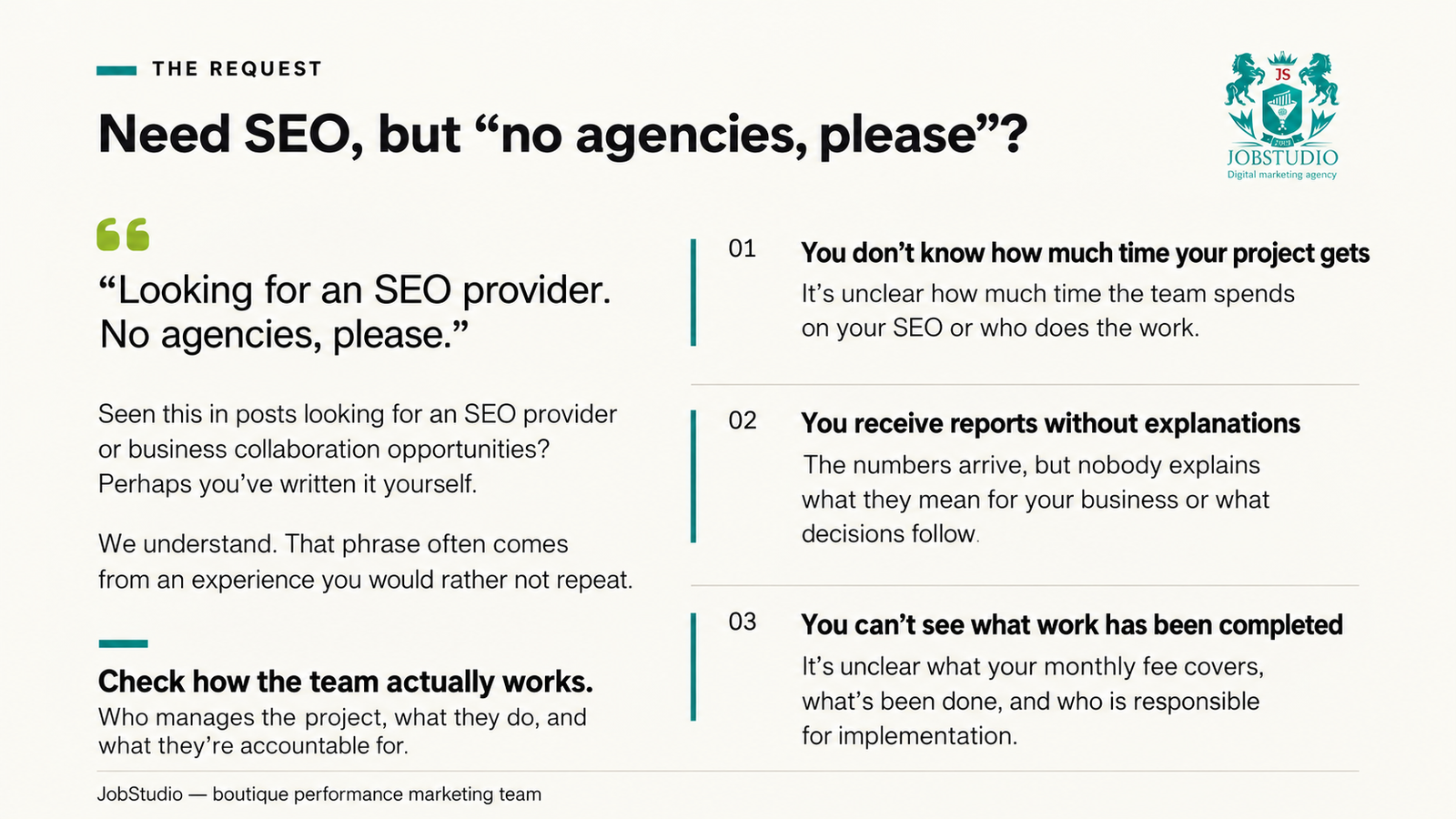
Let’s stick to the facts. Negative experiences with marketing agencies usually stem from three systemic issues.
In a traditional agency, the business model is based on volume. A single specialist may be responsible for 10 to 20 projects. Under these conditions, the specialist simply doesn’t have the time to fully understand your unit economics. They don’t know which product category generates a 70% margin. They don’t know that your sales department doesn’t answer the phone after 6:00 p.m. They don’t know that half of last month’s leads are duplicates.
The work boils down to a basic checklist: launch campaigns, check bids, and prepare a report.
“You have 12,400 clicks, a 3.2% CTR, and a 2.1% conversion rate.” So what? How many sales did this channel actually generate?
Agencies often report using platform metrics: impressions, clicks, and conversions in the Google Ads dashboard. But these numbers don’t match your CRM. They don’t account for profit margins. They don’t show how many leads turned out to be junk.
The owner sees a nice report and an empty cash register. And he concludes: “The agency is just spending the budget.”
The cost of services provided by a traditional agency includes the rent for a prestigious office, salaries for HR managers, account managers, and department heads, as well as expenses for the agency’s own marketing and conferences. The client pays for the contractor’s organizational structure, not for the hours spent working on their project.
What exactly am I paying the agency for every month? If you can’t answer that question in 30 seconds—the problem isn’t with you. The problem is with the format.
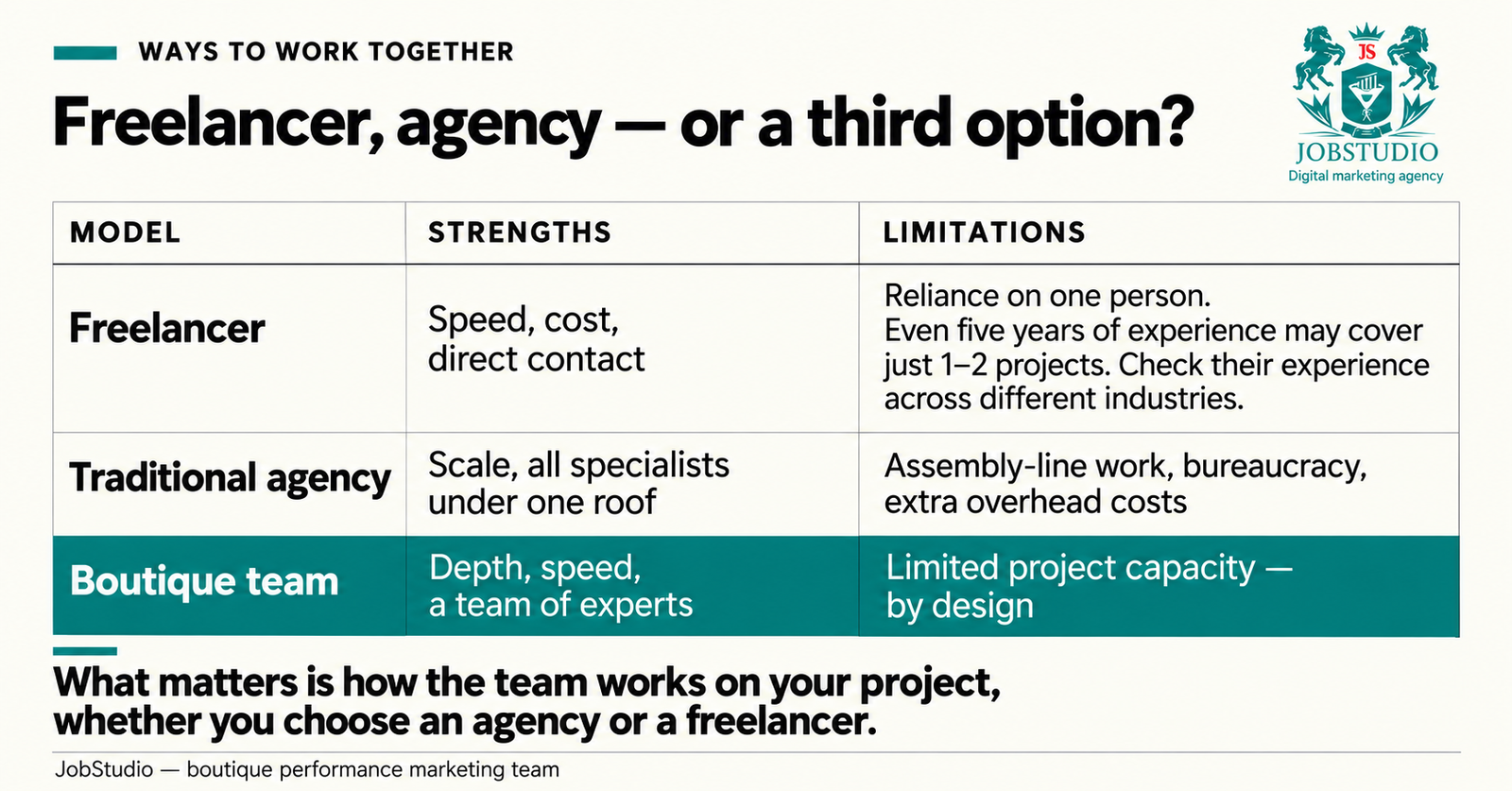
There are three main forms of collaboration on the market. Each serves a different purpose. And each has its own “bottleneck.”
A skilled freelancer. Fast. Affordable. Direct contact. But there’s only one of them. They can’t be a top-tier SEO specialist, a qualified web analyst, a PPC expert, a developer, and a designer all at once. A freelancer is the bottleneck of your business. If they get sick, burn out, or disappear for a month—your project comes to a standstill.
A traditional agency. Scale, with all the specialists in one place. But there’s a lot of red tape: to change a single line item in the budget, you have to wait three days for approval. There’s a wall between you and the specialist—the account manager. It’s like a game of Chinese whispers. And half the price has nothing to do with your business.
The third option is a boutique team. At JobStudio, you work with specialized professionals, and the number of hours allocated to your project is specified in the contract. We work in short cycles: we evaluate the work completed and adjust priorities based on business needs and the data we receive.
In our reports, we explain what we’ve done, what has changed, and what next steps we propose. You have online access to working files and tasks so you can track progress and monitor the implementation of our agreements.
| Format | Strengths | Restrictions |
| Freelancer | Direct contact with the contractor, flexibility in decision-making, and easy coordination of tasks. | The scope of work and the set of required skills depend on a single person. Additional specialists may be needed for related tasks. |
| A Traditional Agency | A team of various specialists, the ability to manage large-scale projects, and the flexibility to replace team members. | It’s worth checking the team’s workload, access to specialists, and the speed of approvals. |
| The JobStudio Boutique Team | Working hours are specified in the contract. Agile approach: short development cycles and flexible priority adjustments. Clear reports 2–4 times a week, including explanations and next steps. Online access to tasks and working files to track progress. Involvement of subject-matter experts. | There are a limited number of spots available for new projects. Whether a project can get started depends on the team’s workload. |
Perhaps it’s not about whether it’s an agency or a freelancer. It’s about how people actually work on your project.
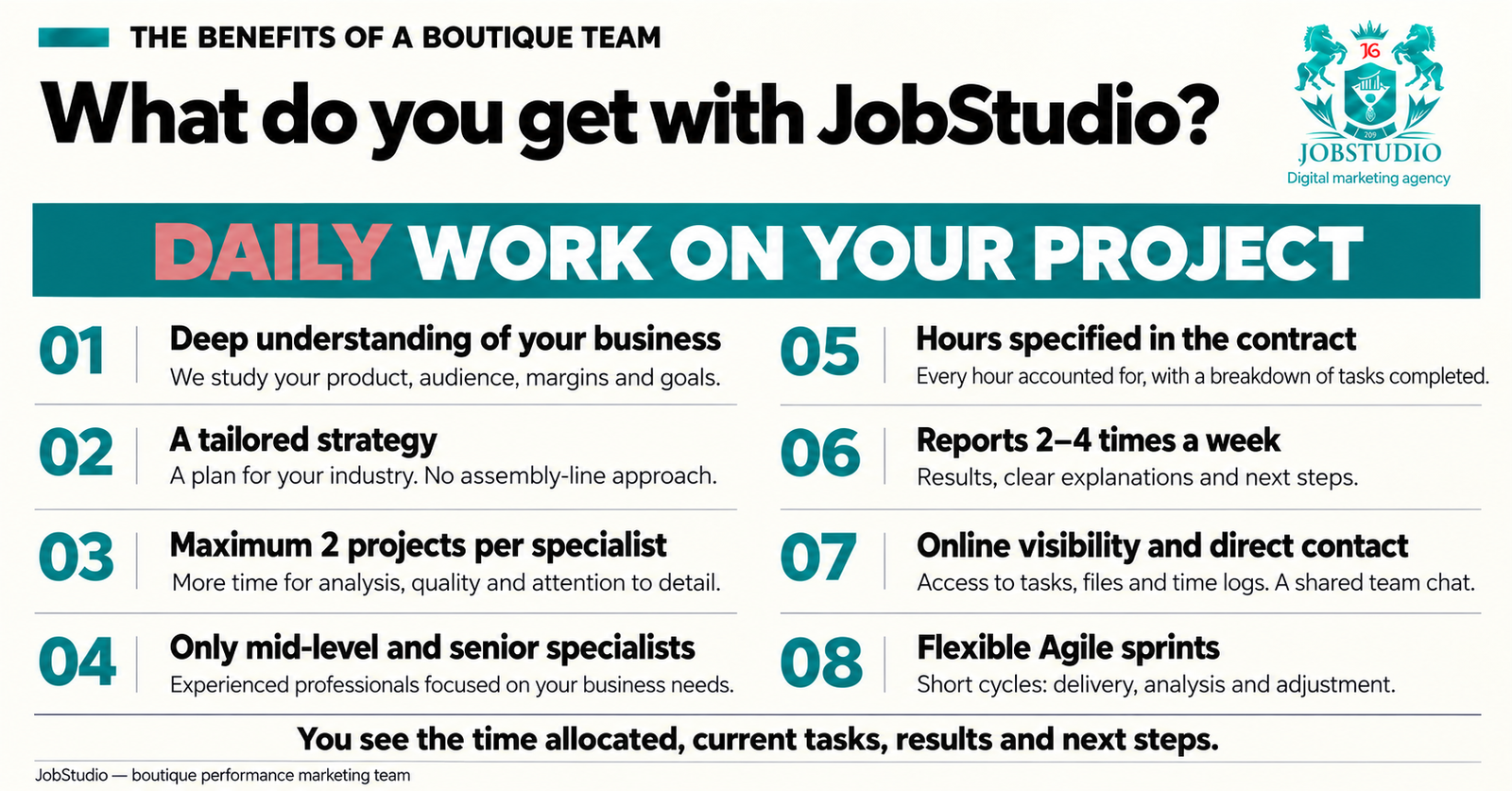
For the client, the boutique approach should be reflected in the specific terms of our collaboration. At JobStudio, we’ve organized our work as follows:
Quality of execution, experience, and attention to detail are the cornerstones of our work. For our clients, this means well-reasoned decisions, oversight of execution, and a clear connection between the team’s work and business goals.
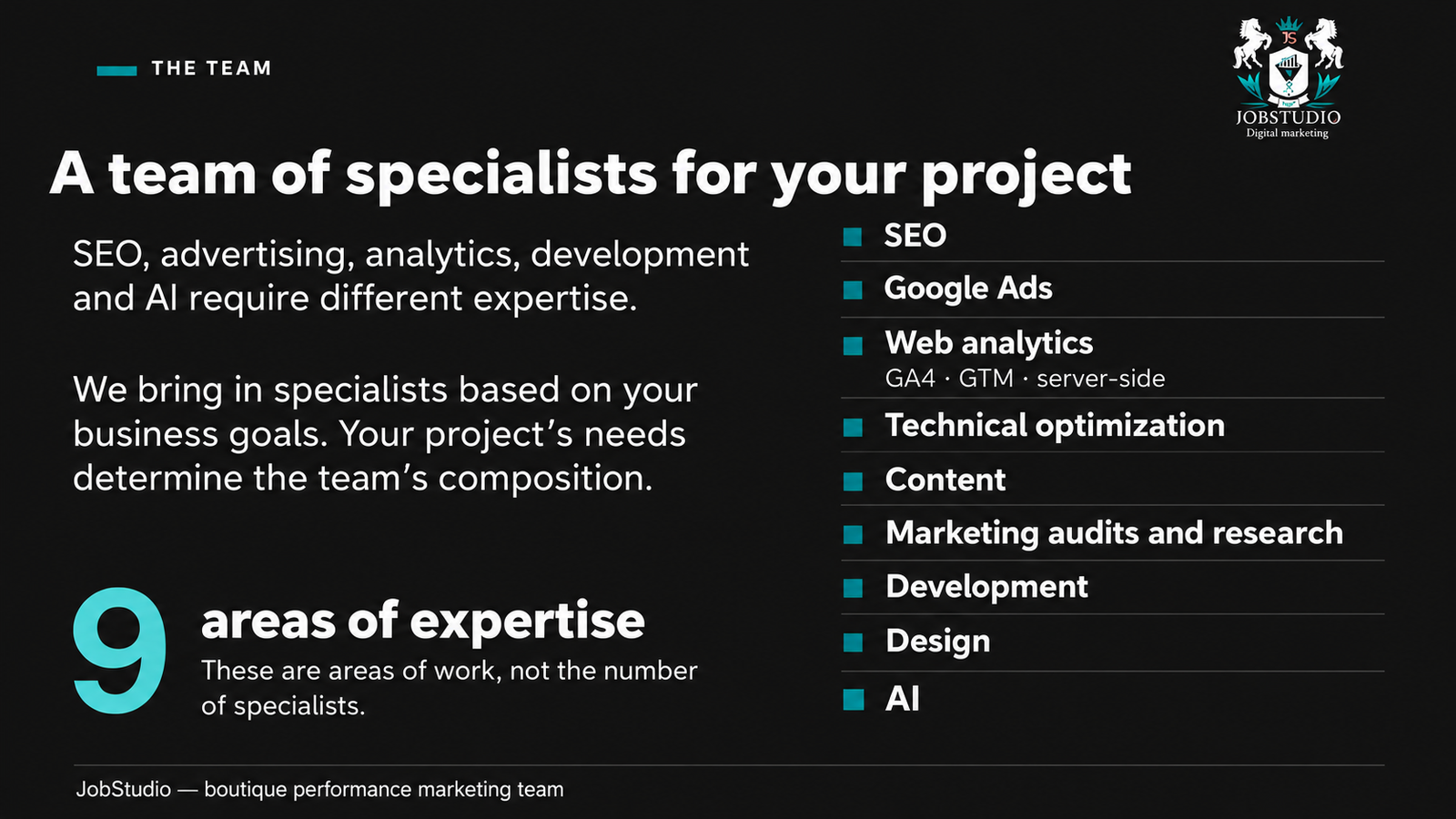
And instead of a single generalist, you gain access to specialists in specific fields.
Below are four real-life examples of how this approach works. No hype. Just the numbers.
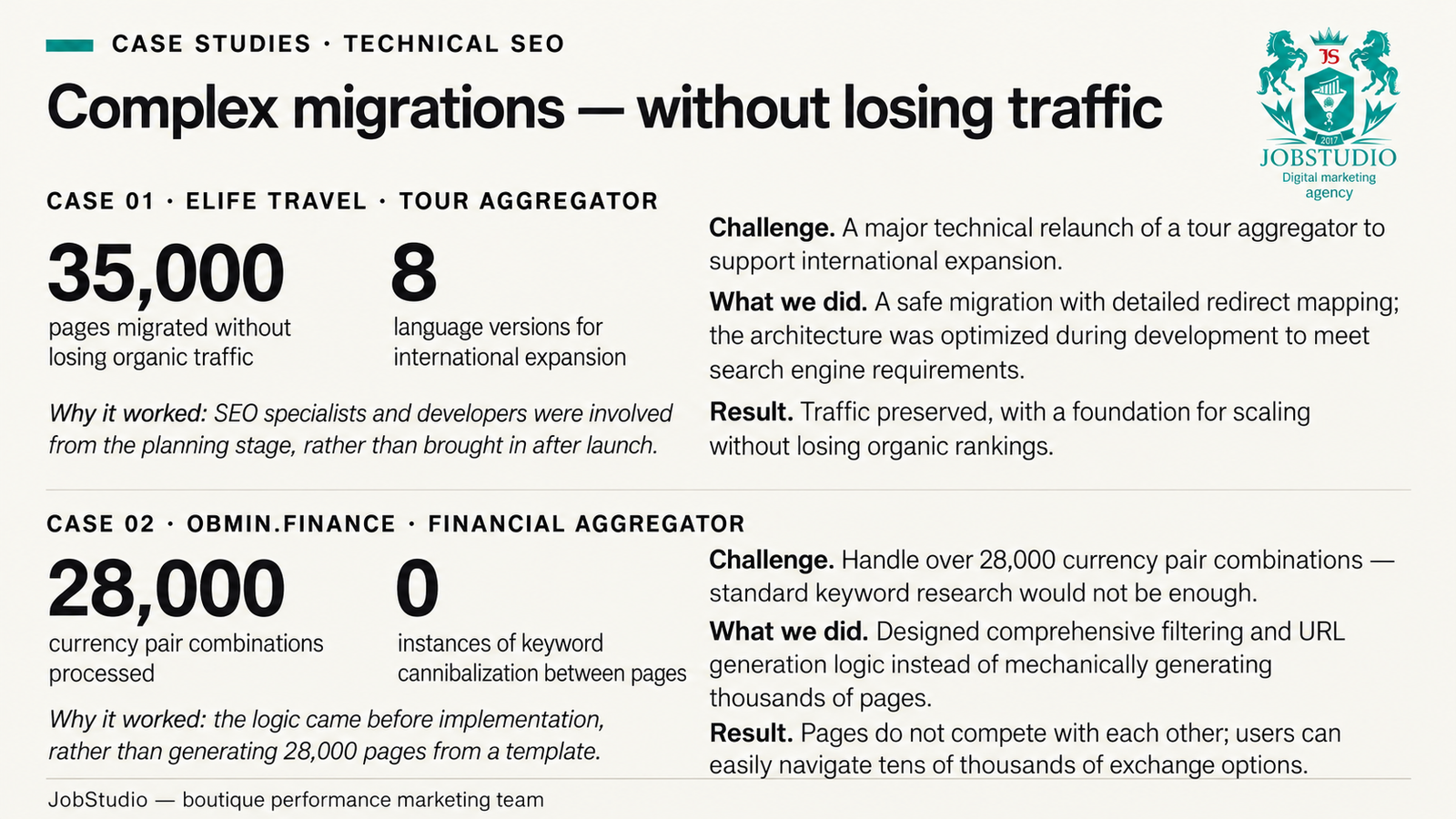
Objective: The Elife Travel tour aggregator required a major technical relaunch: migrating over 35,000 pages and implementing 8 language versions to enter international markets.
What we did: a safe migration with careful configuration of the redirect map. We optimized the architecture during the development phase—not a “we’ll see after launch” approach, but one that took search engine requirements into account from the very beginning.
Result: Traffic was maintained. The project gained a foundation for scaling into new geographic markets without losing organic rankings.
Why it worked: Bringing in specialized SEO experts and developers during the design phase, rather than after the fact. This is possible in a boutique setting: the team isn’t spread thin across 15 projects at once.
Task: The financial aggregator Obmin.Finance needed to process more than 28,000 combinations of currency pairs. Standard approaches to semantic extraction do not work in this case.
What we did: Instead of mechanically creating thousands of pages, our technical optimization and SEO specialists developed a comprehensive system of filters and URL generation.
Result: Avoiding search query cannibalization (competition among pages on the same website). Easy navigation among tens of thousands of exchange options.
Why it worked: in-depth analysis and planning before launch. Not “let’s create 28,000 pages using a template,” but first the logic, then the implementation.
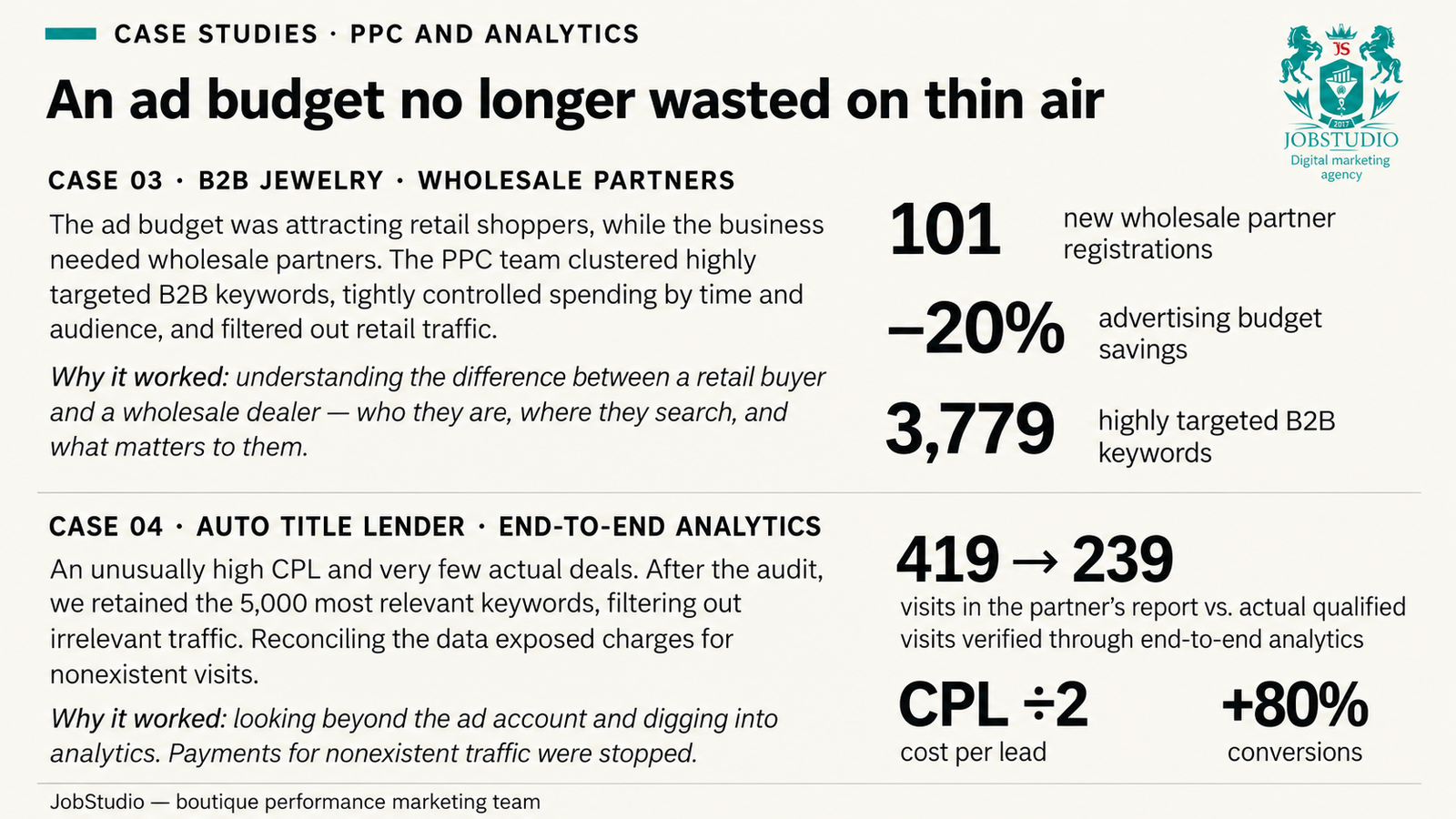
Challenge: A jewelry brand. The advertising budget was being spent on retail traffic, while the business needed wholesale B2B partners.
What we did: The PPC team collected and clustered 3,779 highly targeted B2B queries. We implemented a strict allocation of spending based on time and audiences. Retail traffic was filtered out.
Result: Savings of up to 20% on the advertising budget. 101 new wholesale partners signed up.
Why it worked: a deep understanding of the difference between a retail customer and a wholesale dealer. Not “let’s run ads for jewelry,” but “who is your wholesaler, where do they look, and what matters to them.”
Challenge: The client was struggling with an abnormally high cost per lead (CPL) and an extremely low conversion rate into actual deals.
What we did: Following the audit, we selected the 5,000 most relevant keyword queries, filtering out non-targeted traffic. At the same time, web analytics specialists performed data reconciliation.
Result: CPL was cut in half. The number of conversions increased by 80%. Most importantly, a critical discrepancy was identified: the partner’s statistics recorded 419 clicks, while end-to-end analytics showed only 239 actual target visits. The client stopped paying for non-existent traffic.
Why it worked: a deep dive into analytics, not just into the advertising department. In a traditional agency, a project is viewed through the lens of “clicks, conversions, and CPL.” In a boutique setting, it’s viewed through the lens of “how much money you’re actually paying for something that doesn’t exist.”
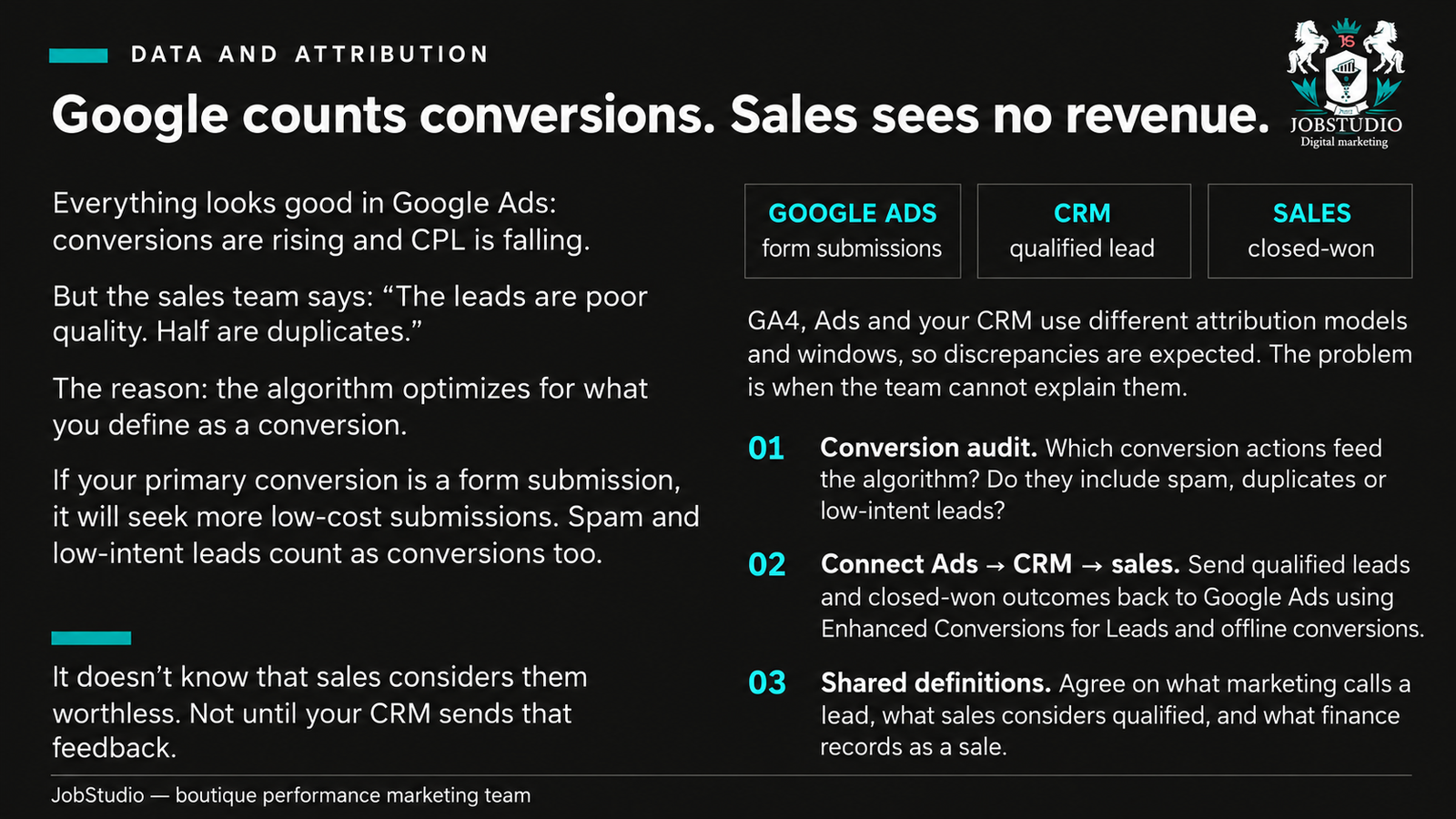
This is the most pressing issue we hear from clients. And it is often the reason why they part ways with their previous contractor.
It’s a common scenario: everything looks great in the Google Ads dashboard. Conversions are up. CPL is down. The account manager is thrilled. But your sales team says, “The leads are junk. Half of them are duplicates. A third are off-target. We don’t understand what you’re paying for.”
Why does this happen?
Google Ads optimizes what you’ve defined as a conversion. If you set “form submission” as your primary conversion, the algorithm will look for more form submissions. More low-value forms. Spam, duplicates, low intent—to the algorithm, these are all “conversions.” It doesn’t know that your sales department calls this junk. As long as the CRM stays silent.
GA4, Ads, and CRM have different attribution models, attribution windows, and re-attribution rules. Discrepancies in the numbers are to be expected. The problem arises when the team cannot explain the difference and lacks a single business “source of truth.”
What we do:
By the time the application came in, the shortlist was already almost complete. And if your contractor optimizes based on “number of forms” rather than “number of deals,” they’re training the algorithm to look for customers who aren’t yours.
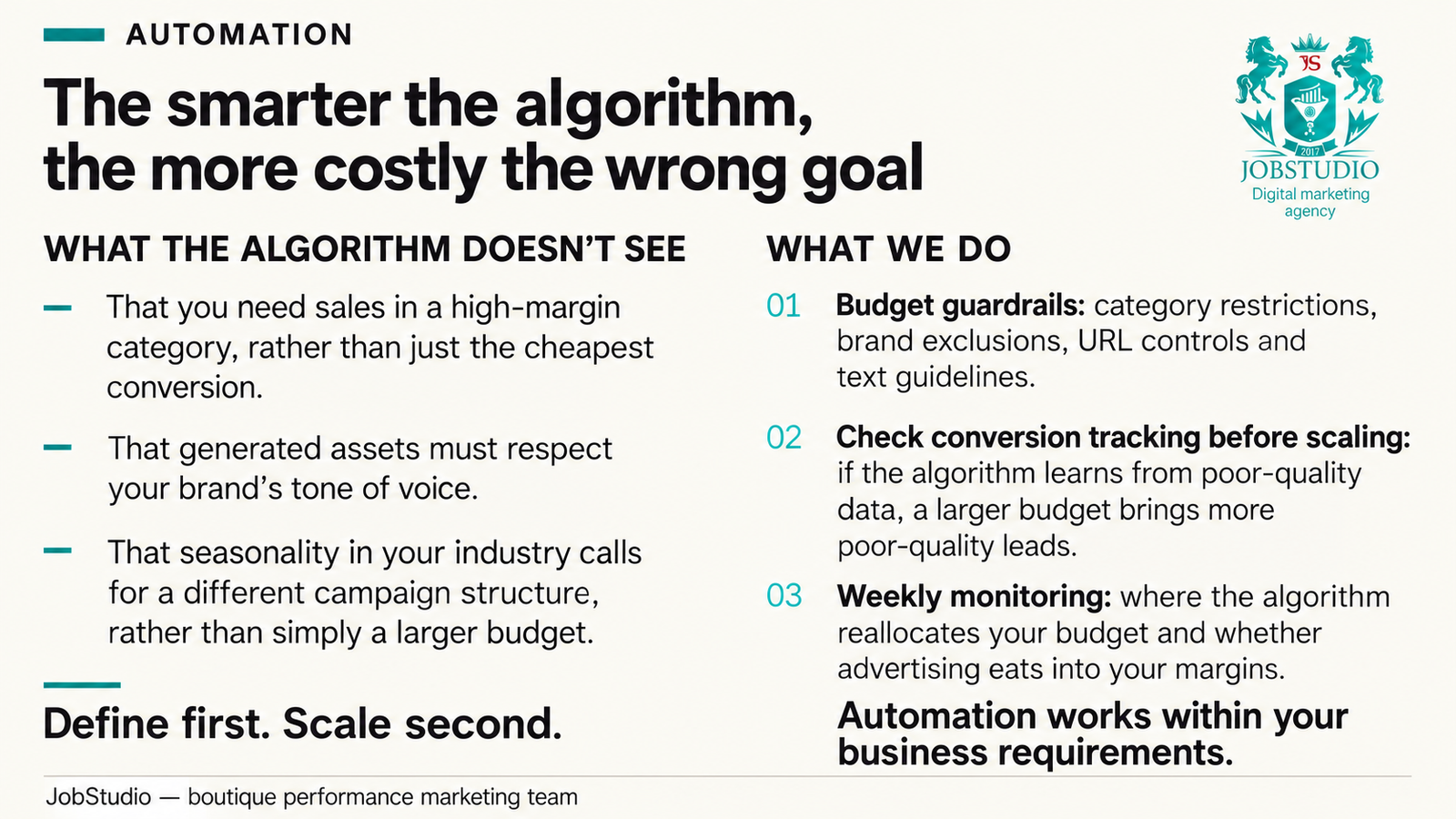
Ad automation hasn’t eliminated the need for expertise. It has simply shifted its focus. People now spend less time managing individual bids and more time focusing on the overall economics, the quality of signals, feeds, exclusions, and protecting the algorithm from junk conversions.
Let’s take AI Max or Performance Max as an example. The platform sells “automation uplift”: “Give the algorithm more data, and it will find you more conversions.” And that’s partly true. The algorithm really does find them.
But here’s the question: what business condition does the algorithm fail to recognize?
He doesn’t realize that you need a specific, high-margin category—not just “any conversion at the lowest cost.” He doesn’t realize that your brand has a specific tone that generated assets must not violate. He doesn’t realize that seasonality in your niche means not “a bigger budget,” but “a different campaign structure.”
What we do:
The smarter the algorithm, the more costly a poorly defined goal becomes. And the more valuable the specialist who defines that goal correctly.
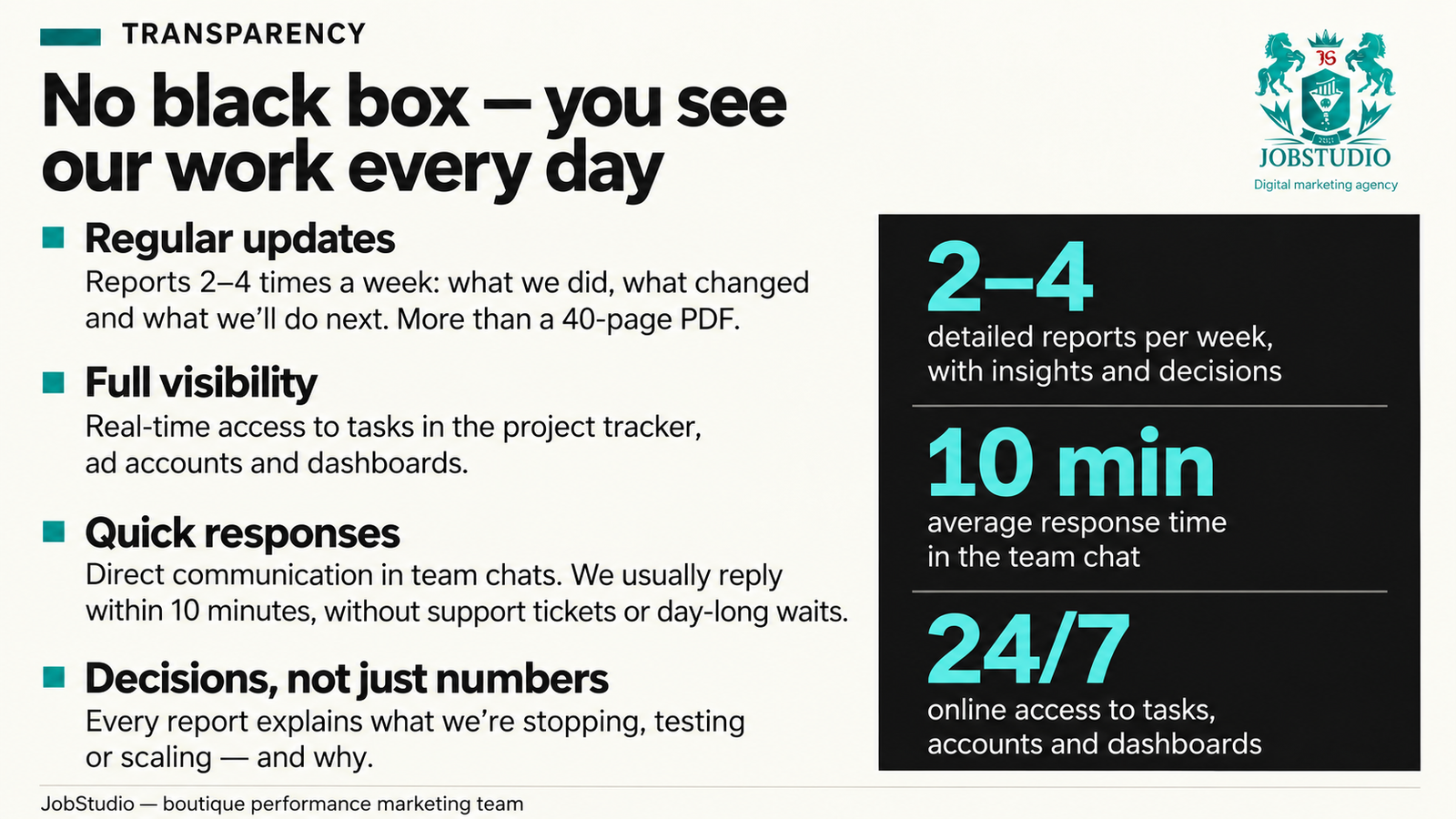
One of the biggest fears when working with agencies is the “black box” effect. The client sees the contractor once a month during the report presentation. And between presentations—silence.
In a boutique-style team, communication works differently:
Consistency. Clear and detailed reports 2 to 4 times a month. Not “here’s a 40-page PDF—read it.” But specifically: what we’ve done, what’s changed, and what decision we’re making next.
Transparency. Clients have full online access to monitor our work: tasks in the tracker, advertising accounts, and dashboards. You can see the process in real time, not just the results once a month.
Promptness. We communicate directly in work chat rooms. You’ll usually receive a response within 10 minutes. There’s no need to create tickets and wait days for a response from a manager.
Decisions, not just numbers. Each report includes not only metrics but also a conclusion: what we’re stopping, what we’re testing, and what we’re scaling. And why.
How often does a client receive not just a report, but explanations and solutions? For us, it’s 2–4 times a week. Plus, daily online access to tasks and working files. If needed, we hold an online meeting to discuss the results, answer questions, and agree on next steps.
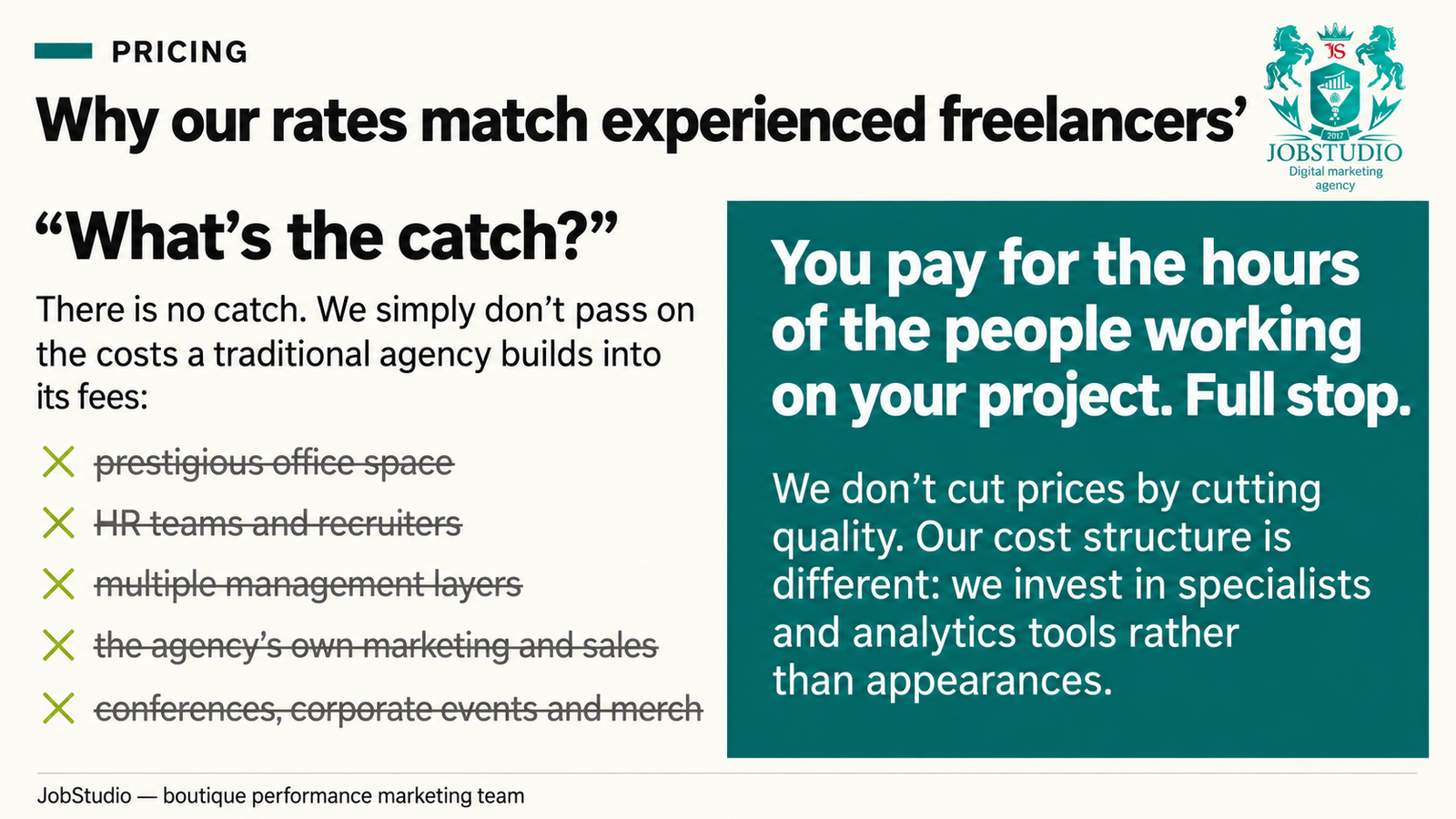
We’re always asked this question. And it’s a valid question.
If you have a team that handles SEO, PPC, analytics, development, and design—why aren’t your prices the same as those of a large agency? What’s the catch?
There’s no catch. We simply don’t pass on to the client the items that a traditional agency includes in the invoice:
You pay for the hours worked by the people on your project. Period.
This isn’t “magic” or a “discount at the expense of quality.” It’s a different cost structure. A boutique team doesn’t need infrastructure designed for 100+ people. We invest in salaries for specialized professionals and analytics tools—not in facades.
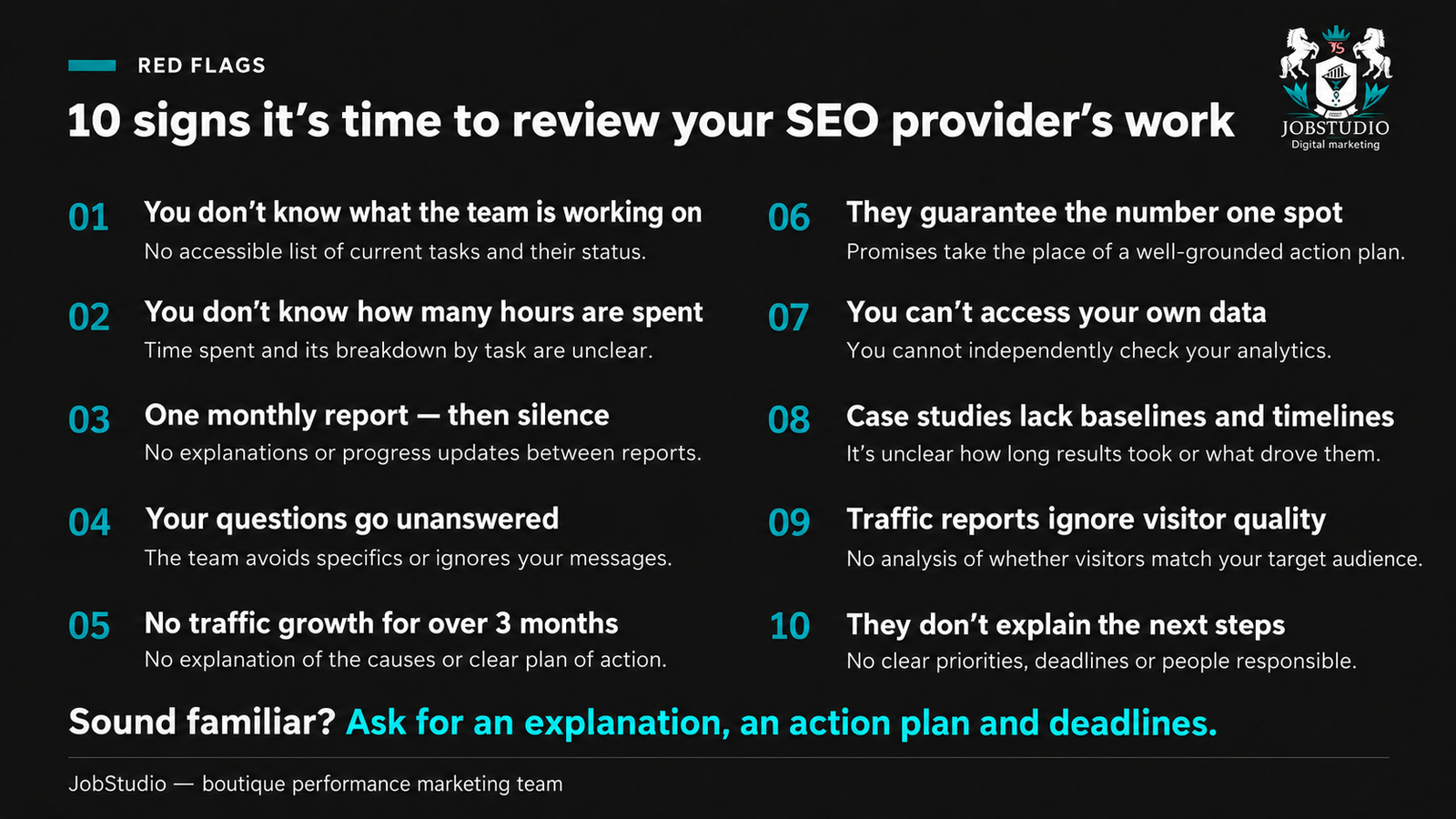
Answer these questions. They will help you assess how transparently the work is organized and whether you have enough information to monitor your project.
If some of the questions are difficult to answer, discuss them with the contractor. Ask to see the current plan, have the results explained, and agree on a convenient way to communicate.
If you see at least three of these issues in your current contractor’s work, it’s time to think twice. Not tomorrow. Right now.
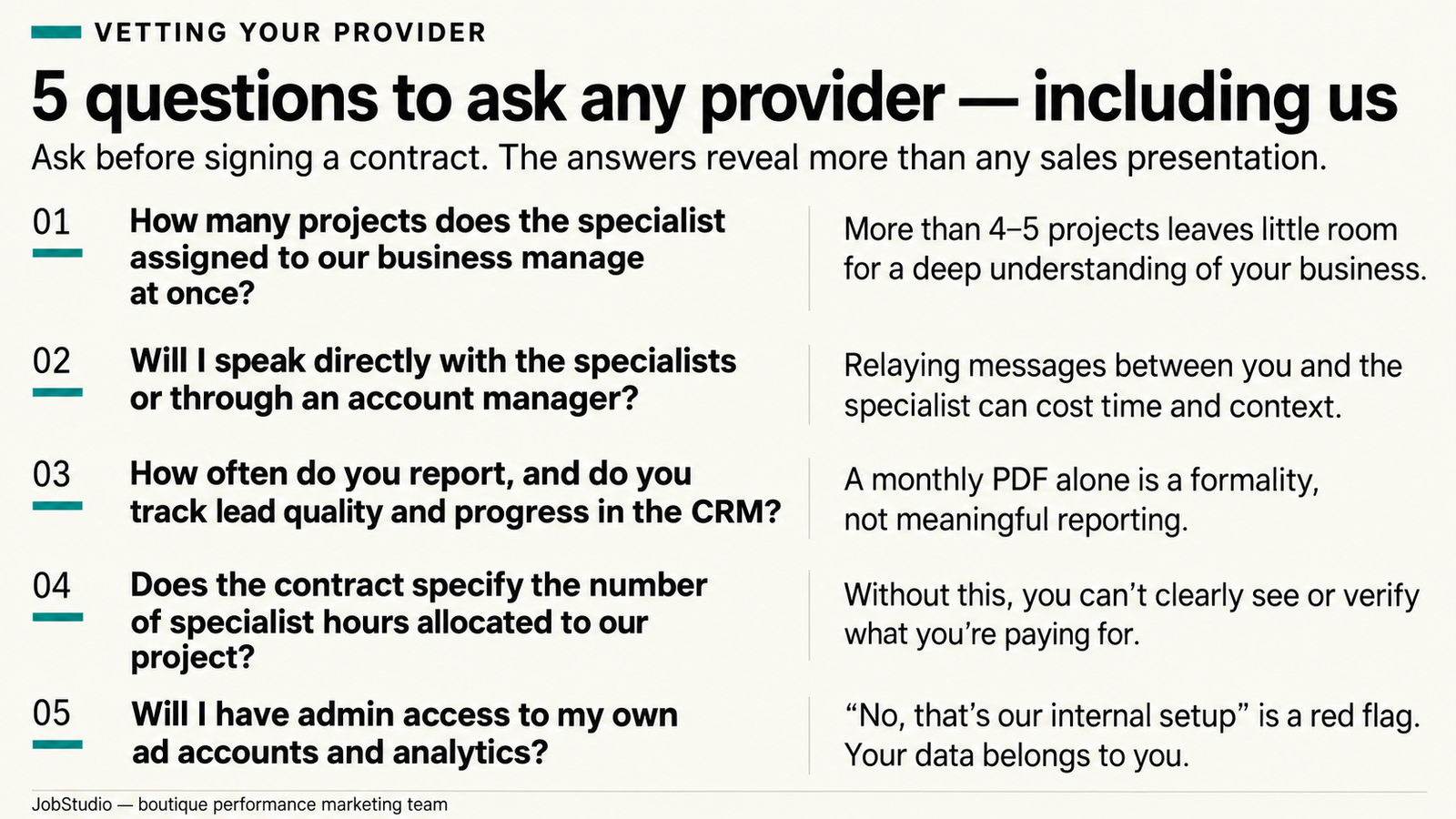
Before signing the contract, ask these questions. The answers will reveal more than any presentation.
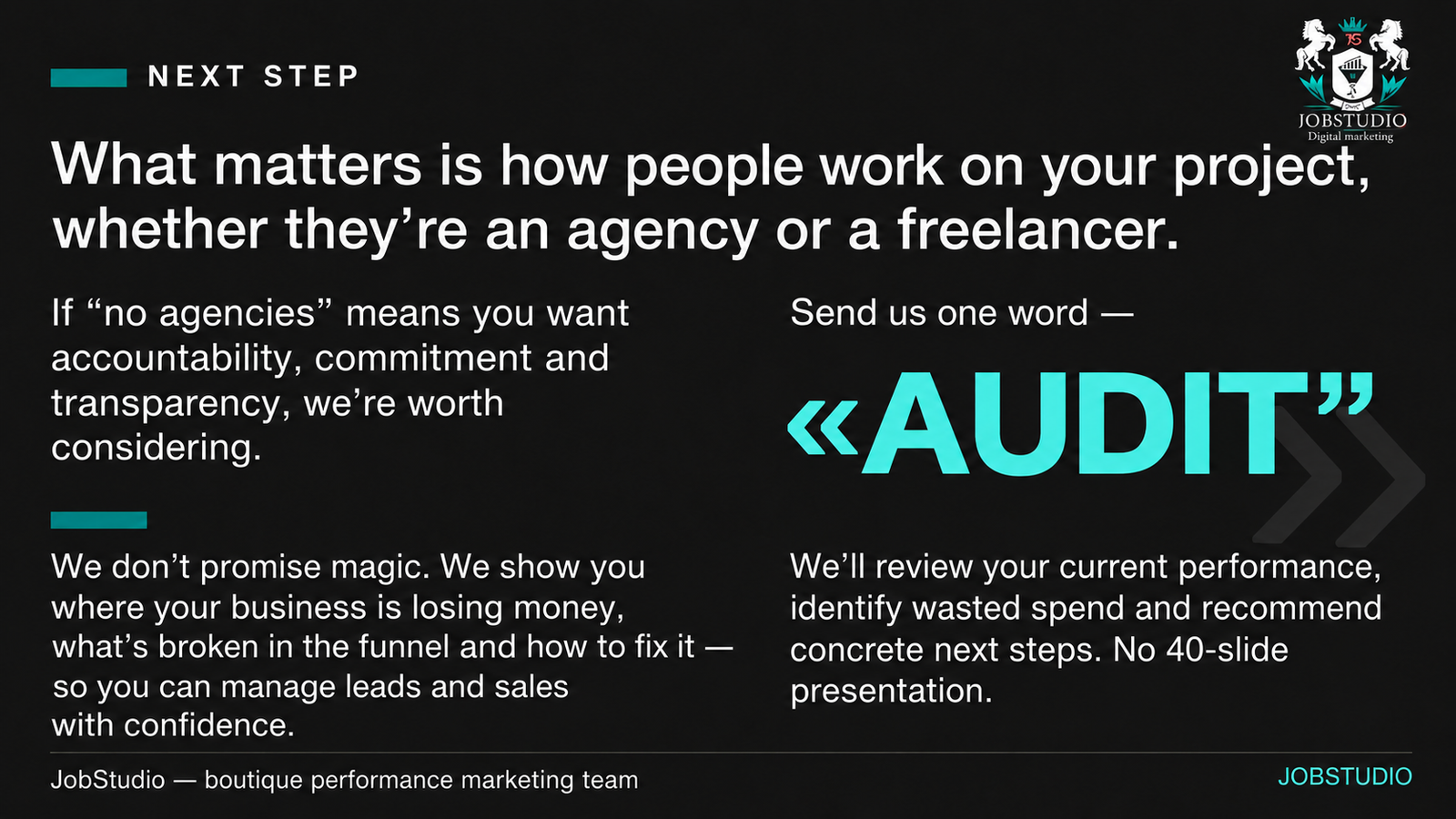
When a business is looking for a partner with the tagline “just not an agency,” it’s actually looking for accountability, commitment, and transparency. No assembly-line approach. No bureaucracy. No dozens of projects per specialist. No inflated costs for someone else’s infrastructure.
And this format does exist.
If by “no agencies” you mean exactly that, then you should consider us.
We’re JobStudio, a boutique performance team. We don’t promise magic. We show you where your business is losing money, what exactly is broken in the sales funnel, and how to fix it so that leads and sales become manageable.
If your business needs a contractor that acts as a full-fledged in-house marketing department without formal reports or red tape—just send us the word “AUDIT.” We’ll analyze your current metrics, identify where your budget is being wasted, and suggest specific steps to take—without any 40-slide presentations.
Perhaps it’s not about whether it’s an agency or a freelancer. It’s about how people actually work on your project.
We have optimized our internal processes and eliminated administrative costs from our pricing: offices, sales managers, and multi-tiered management. You pay only for the direct work of specialized professionals. There’s no catch—it’s just a different cost structure.
Usually within 10 minutes. We maintain direct communication in our work chat groups (Telegram, Slack). There’s no need to create tickets and wait days for a response from a manager.
Depending on the goals: SEO, Google Ads, web analytics (GA4, GTM), technical optimization, content, developers, designers, and marketing research specialists. Not a single jack-of-all-trades, but specialized experts.
2 to 4 times a month. Plus 24/7 online access to dashboards, tasks in the tracker, and advertising accounts. We avoid the “one PDF once a month” format.
Yes, always. All advertising accounts, Google Analytics accounts, and other tools belong exclusively to the client. We operate transparently and provide full administrative access to all settings. Your business is never held hostage.
No. Anyone who promises top rankings on Google or quick sales without analyzing your business is a manipulator. We guarantee something else: a thorough measurement audit (Ads–GA4–CRM), setting up accurate conversion actions, daily work on campaigns, and reports with specific solutions.
Meet the specialists who will be working on your project. Pay attention to whether they ask about your product, customers, and business goals, or whether they immediately offer a standard package. Ask them to show you an example of a report and explain how they will set priorities. Before signing the contract, agree on the scope of work, who’s responsible for what, the reporting process, and access to data. It’s a good sign if the team justifies its proposals, openly discusses limitations, and clearly explains its obligations.
Request a list of completed and ongoing tasks, and compare it to the agreed-upon plan. If payment is based on hours, review the time-spent report. Review the trends in organic traffic and targeted inquiries in your analytics, taking into account seasonality and any changes that have been implemented. The contractor should explain what has been done, what results are already visible, what is preventing further progress, and what the next steps are. If the answers remain vague, an independent audit will help verify the quality of the work and identify what needs to be corrected.

 Contacts
 Language
 Book a call
 Order a proposal


