


Get a responsible approach in promoting client project.
Contact us now!
Contact us now!



 Order a call
  Get an offer
In 2026, it’s not just advertising that’s getting more expensive. It’s businesses’ lack of readiness for advertising that’s getting more expensive.
That’s an important difference.
Table of Contents
Google Ads and Meta Ads remain strong channels for customer acquisition. But they no longer tolerate chaos in the advertising system: weak semantics, vague offers, low-quality creatives, poorly optimized landing pages, inaccurate conversions, a lack of CRM integration, and a failure to understand the true quality of leads.
In the past, some of these mistakes could be offset by a lower cost per click. Today, every weak point quickly shows up in CPL, CPA, CAC, ROAS, ROMI, and margins.
In PPC, the logic of “launch a campaign—and the algorithm will take care of the rest” no longer applies.
An algorithm can indeed be helpful. But it doesn’t know your business better than you do. It doesn’t understand which leads turned into sales unless you provide that data. It doesn’t see profit margins unless they’re integrated into the analytics. It can’t distinguish between a “low-value lead” and a “high-value customer” if all leads look the same to it.

Therefore, the main question for businesses isn’t:
“Why has advertising become so expensive?”
And here’s how:
“Is our system ready to buy traffic at a higher cost but generate predictable revenue from it?”
Paid advertising is getting more expensive for everyone. But it’s getting the most expensive for those who don’t realize exactly where they’re losing money.
Businesses can pay more per click—and still remain profitable.
Or you could pay less per click—and still blow through your budget.
The difference isn’t in the cost per click. The difference lies in the system: which search terms are targeted, which ads are displayed, where the ads lead, whether the form works, whether conversions are tracked, whether leads are imported into the CRM, whether they result in a sale, and whether customers return.
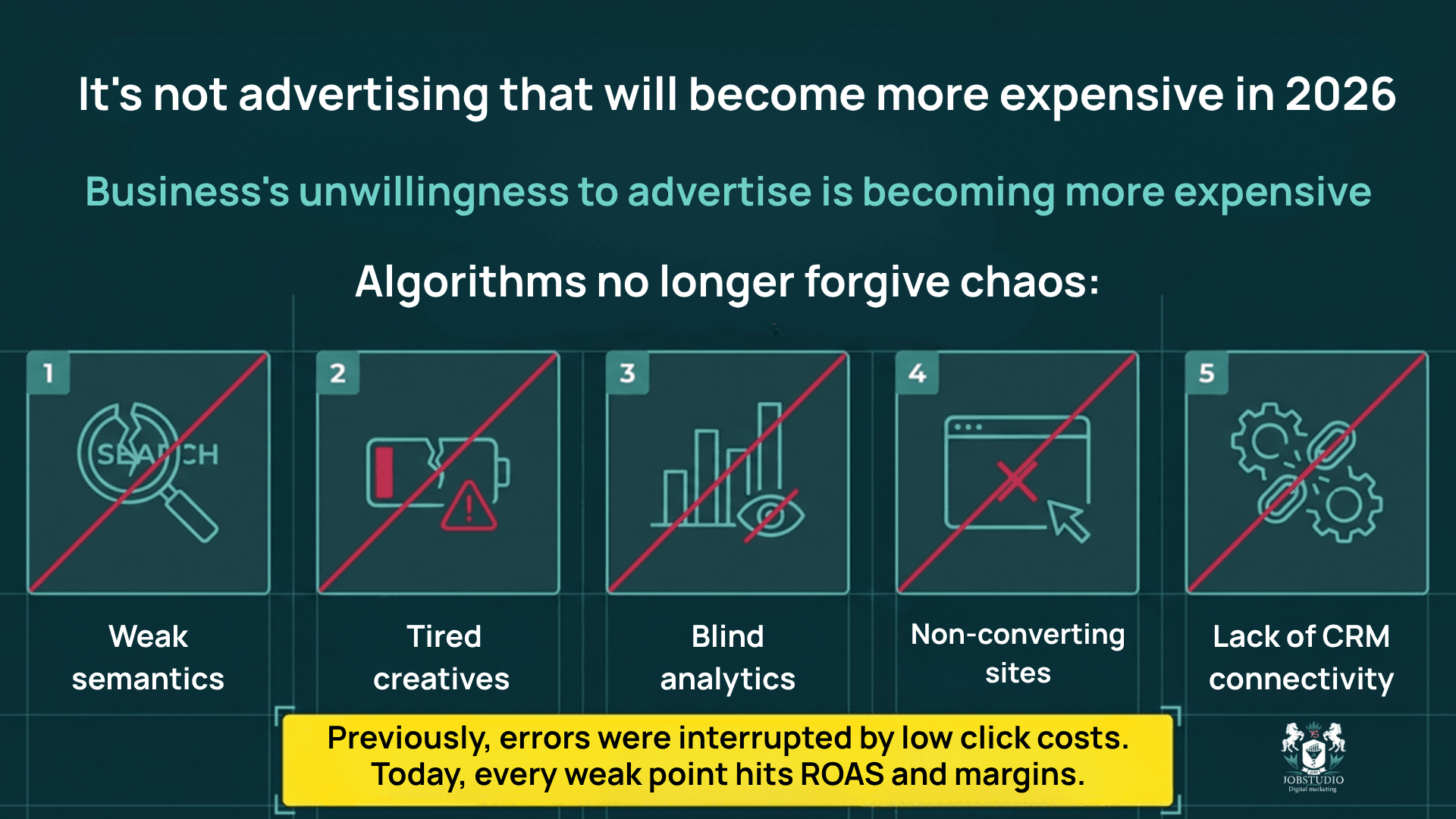
Advertising is getting more expensive not because digital is “dying.” On the contrary—the market continues to grow.
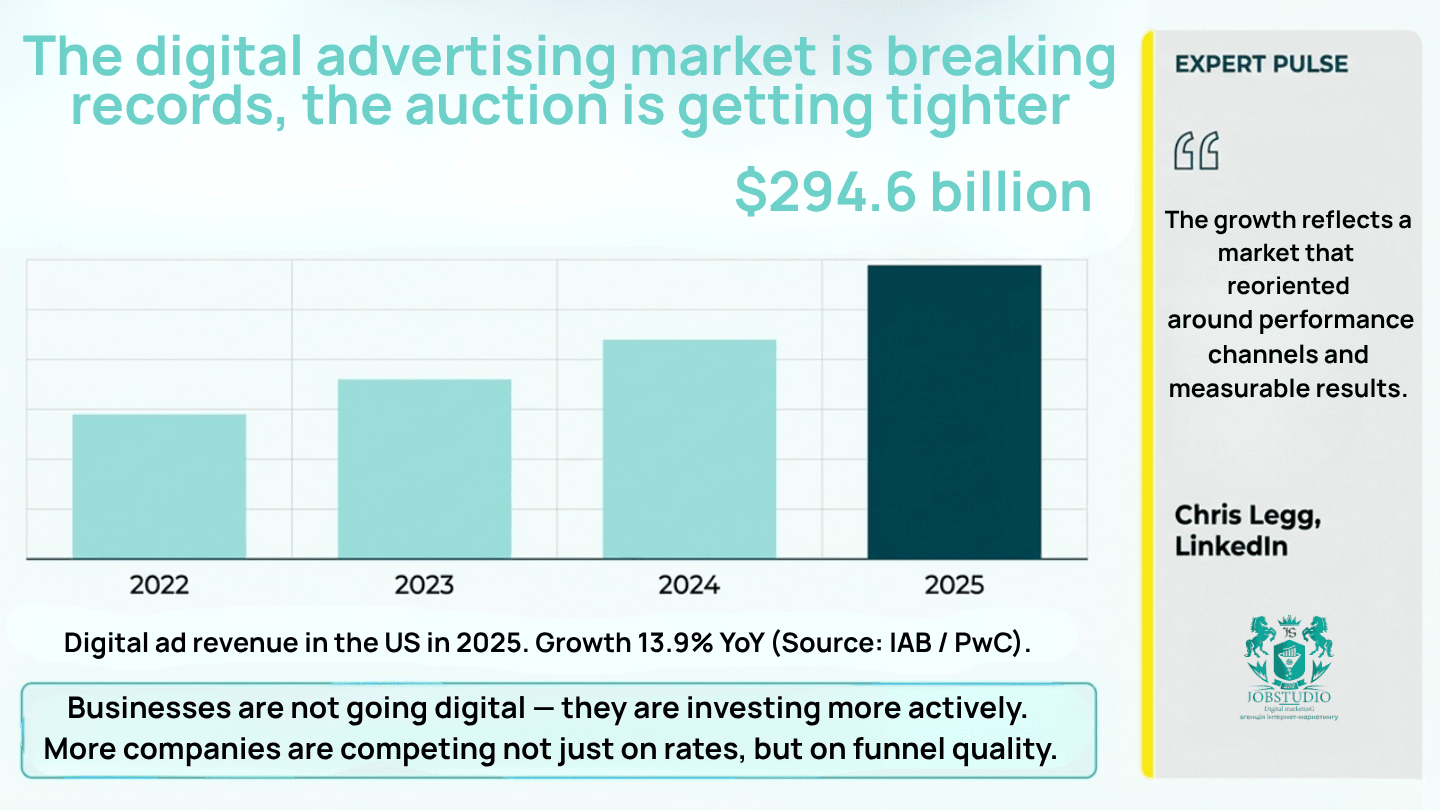
According to the IAB/PwC Internet Advertising Revenue Report, digital advertising revenue in the U.S. reached $294.6 billion in 2025 alone, marking the highest figure in the report’s history. Annual growth stood at 13.9%. The IAB specifically highlights that the market is shifting toward performance-driven and AI-powered growth, meaning higher expectations for measurable results and automated optimization.
This means one simple thing: businesses aren’t moving away from digital. They’re moving into it more actively. And when more advertisers are competing for the attention of the same users, the auction becomes more intense.
On both Google Ads and Facebook/Instagram, companies compete on more than just their products. They compete on bid prices, creative content, website speed, the quality of their analytics, brand strength, and the precision of their offers.
Reason: The rising cost of advertising is a consequence of the maturity of the digital market, where demand for user attention exceeds supply. A few more factors: intense competition, ad clutter, rising CAC, privacy restrictions, and the need to rely not just on a larger budget, but on strategy, creativity, and analytics.
That is the main change in the market.
In the past, digital advertising was often a channel for rapid growth: you’d launch a campaign, get cheap clicks, and collect leads.
In many niches today, advertising has become part of the infrastructure. It’s difficult to compete without it, but advertising alone no longer provides a competitive advantage. The advantage doesn’t come from launching an ad campaign, but from how a business manages the entire system.
This trend is also clearly visible on LinkedIn. For example, Chris Legg, commenting on the IAB report, points out that the growth in digital advertising revenue reflects a market that has shifted its focus toward performance-based channels and measurable results. This is an important observation: advertisers aren’t just spending more; they expect a clearer link between spending and business results.
And that’s where the conflict arises.
Platforms are becoming more automated. Business expectations are getting stricter. But the sales funnel often remains the same: poorly defined semantics, a vague offer, weak creative, and incomplete analytics.
This is precisely why the ads subjectively feel “more expensive,” even though the problem lies not only with the market but also with the traffic management system.
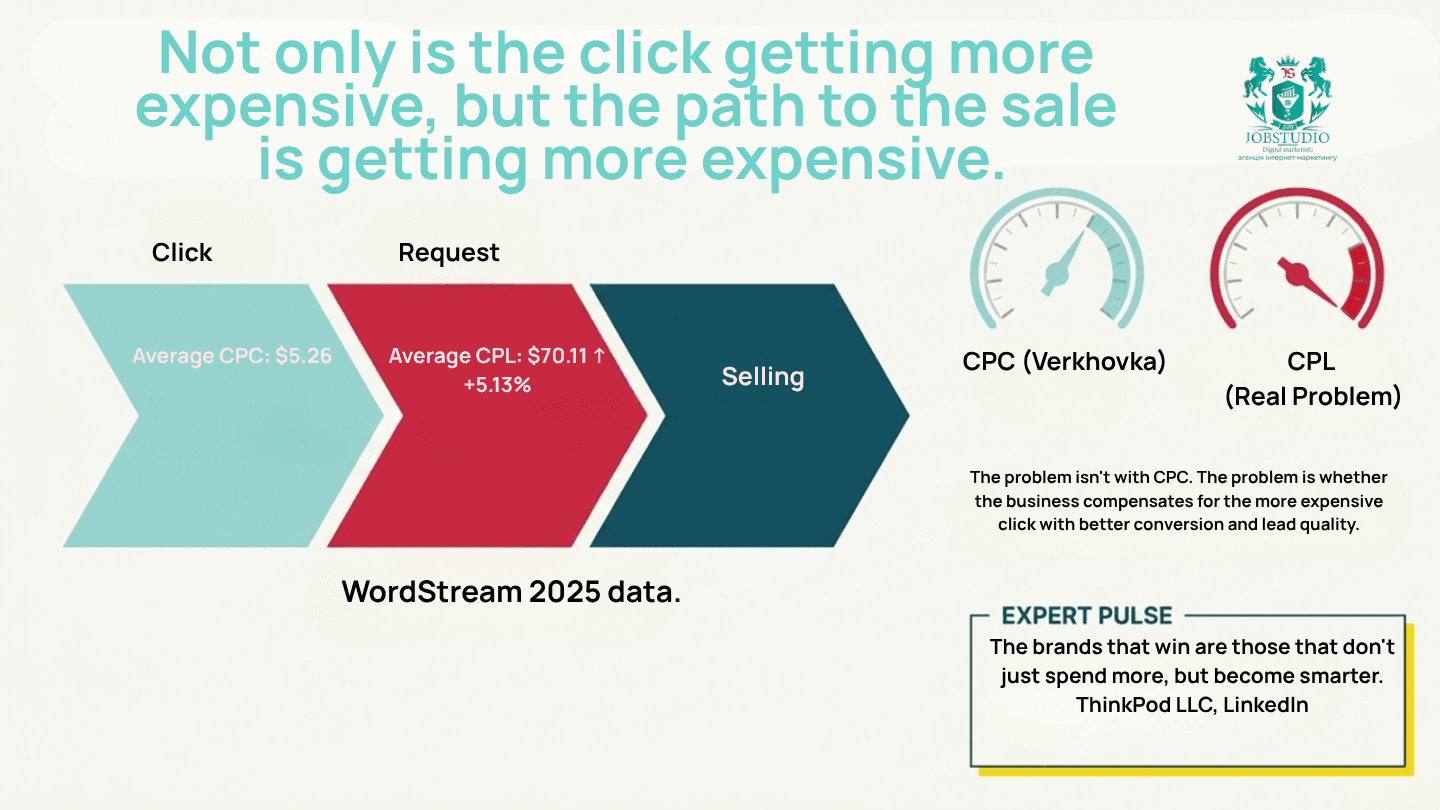
According to WordStream’s Google Ads Benchmarks 2025, the average cost per lead on Google Ads across all industries rose from $66.69 in 2024 to $70.11 in 2025, an increase of 5.13%.
A separate WordStream article on Google Ads costs estimates the average CPC in Google Ads in 2025 at $5.26 and the average CPL at $70.11.
Posts on LinkedIn by PPC specialists discussing this report highlight another important point: according to WordStream/LocaliQ, CPC has been rising in most industries, but conversion rates have also been improving in some markets. In other words, the problem isn’t always the rise in CPC itself. The problem is whether a business can offset the higher cost per click with better conversion rates and lead quality.
CPC is just the beginning.
For businesses, it’s not the click that matters, but the entire journey:
impression → click → lead → qualified lead → sale → repeat purchase → profit.
If you look only at CPC, you might draw the wrong conclusion. For example, an expensive click can be acceptable if it brings in a customer with a high average order value and repeat purchases. Conversely, a cheap click can be risky if it attracts a random audience that doesn’t make purchases.
So the question isn’t how to make a click as cheap as possible. The question is how to make paid traffic manageable and profitable.
At LinkedIn, ThinkPod LLC framed this in terms of B2B advertising: the brands that succeed don’t just spend more—they’ve “become smarter.”
This is entirely in line with JobStudio’s approach: the weak point is often not the bid itself, but rather the signals the advertising system receives.
In Google Ads, the cost of an error is particularly evident in the semantics.
If a campaign mixes “hot” and “cold” queries, if there isn’t proper negative keyword targeting, and if high-frequency phrases are eating into the budget allocated for more precise, low-frequency queries, the business is paying not for demand, but for noise.
The JobStudio Google Ads audit case study includes a key recommendation: reorganize your keyword groups, separating campaigns based on queries that generated clicks and those that did not, because high-volume queries can drain the budget allocated to low-volume ones and complicate further optimization
This is important not only for Google Ads, but also for the business’s bottom line.
Semantics isn’t just a “list of keywords.” It’s a map of the user’s intent. If the map is wrong, the ad leads in the wrong direction.
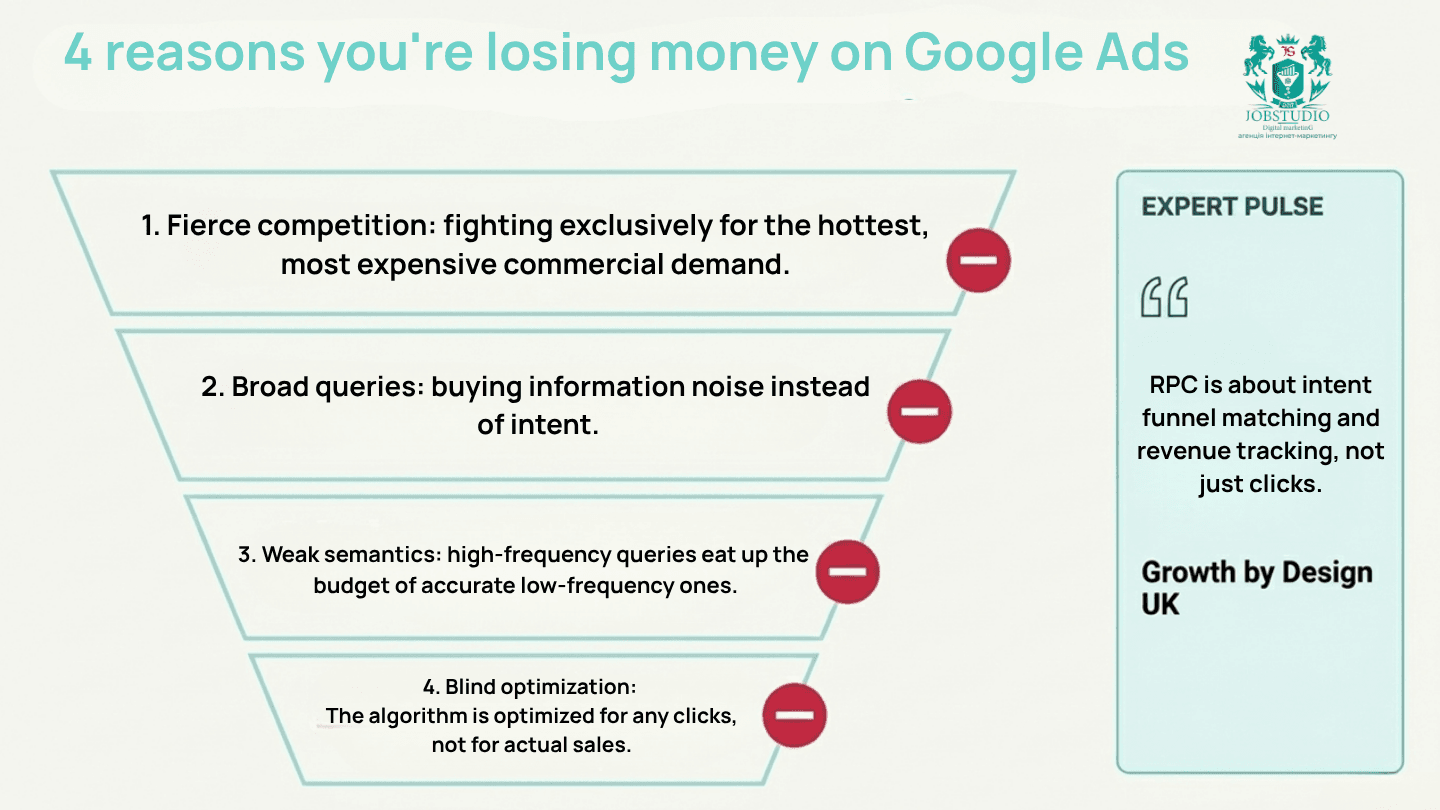
PPC specialists are increasingly shifting the discussion away from the buttons in the dashboard and toward the economy. In a publication about PPC in 2026, Growth by Design UK writes that PPC isn’t about “being on every platform,” but rather about aligning with the intent channel, identifying the right paths for the target audience, and tracking revenue—not just clicks.
This is put even more bluntly in one of the LinkedIn posts about bidding strategies: the problem isn’t always with the bidding strategy. The problem could be with the targeting, the offer, or the landing page. The author compares bidding strategies to a “car’s steering wheel”: it won’t help if the “engine” isn’t running.
Here’s a good takeaway for business owners: if advertising costs are rising, don’t start by asking, “Which bidding strategy should we choose?” Start by asking, “Do we even have a system we can trust to handle scaling?”
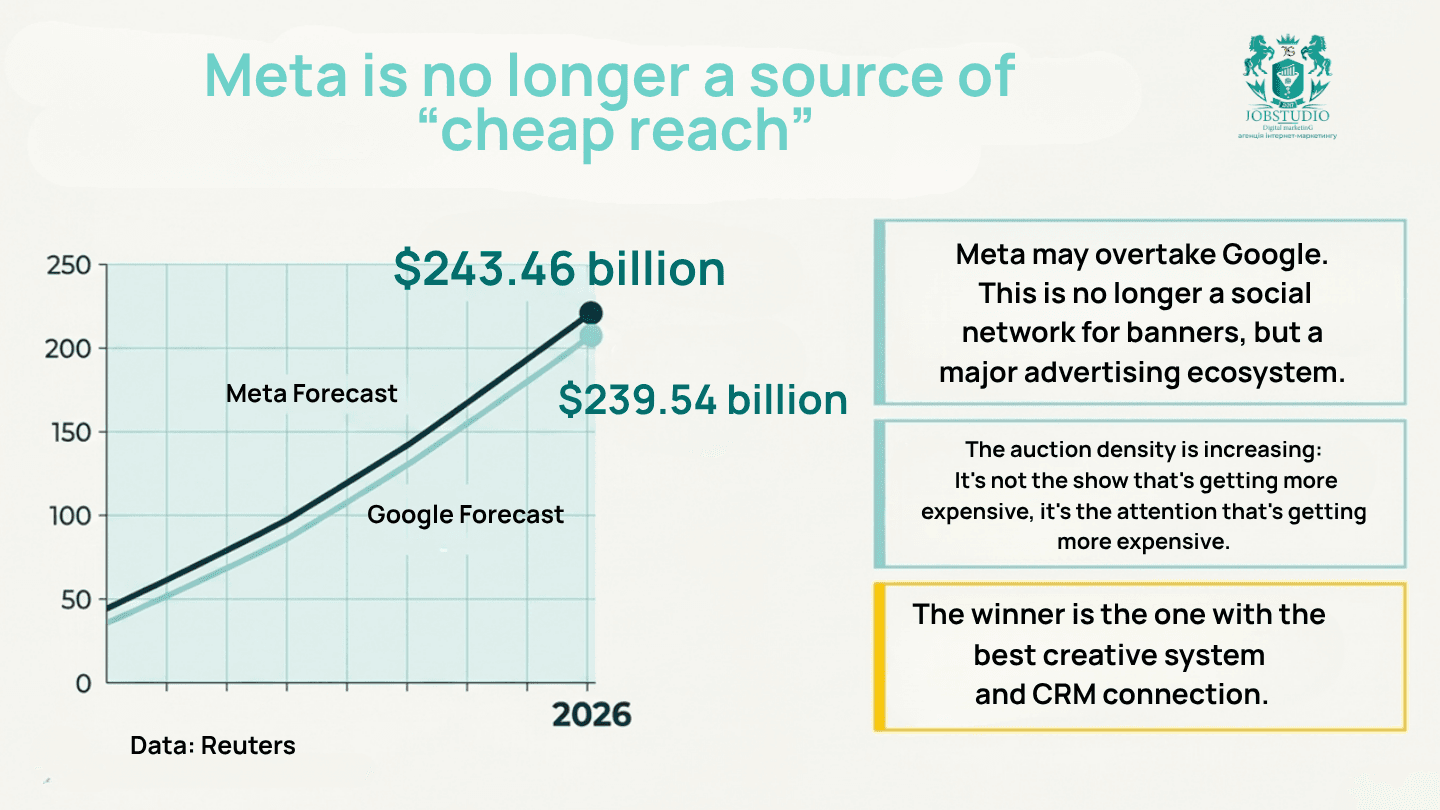
Facebook and Instagram can no longer be viewed as a “cheap secondary channel.”
Reuters, citing eMarketer, reports that in 2026, Meta could surpass Google in global digital advertising revenue for the first time: the forecast for Meta is $243.46 billion, and for Google, $239.54 billion. The same article notes that Meta, Google, and Amazon together could account for 62.3% of the global digital ad market in 2026.
This means that Meta is no longer just a “social network for banner ads.” It is one of the world’s leading advertising ecosystems.
As a result, competition on Facebook, Instagram, WhatsApp, and Threads will only intensify. And when a platform becomes more crowded, it’s not just ad impressions that get more expensive—attention does, too.
Meta Ads often seem simpler than Google Ads: there’s no traditional keyword targeting, and you can quickly launch a campaign by providing the system with your target audience, creative assets, and budget.
But that is precisely what creates the trap.
When many advertisers launch campaigns using similar automated tools, the advantage goes not to whoever “launched the ad,” but to whoever has better prepared their offer, creative strategy, sales funnel, CRM, and analytics.
We’re aware of this problem and have dubbed it the “illusion of simplicity”: Google Performance Max, Meta Advantage+, and other automated tools create the impression that all you need to do is click a few buttons—and your campaign is up and running. But without a strategy, optimization, and an understanding of your goals, your business could end up overspending, achieving a low ROI, and even damaging your brand.
Meta explicitly defines “creative fatigue” as a situation where an audience has seen the same creative too many times. In such cases, people may engage less with the ad, which can potentially lead to an increase in the cost per result.
This is critical for Facebook/Instagram.
On Google, users often already have a specific query in mind. On Meta, ads tend to focus on attention, emotion, a problem, a trigger, or a visual image. If the creative doesn’t grab attention, doesn’t explain the value, or doesn’t stand out from previous banners, the system may continue to serve the ad, but audience engagement will drop.
That’s why at Meta, creative isn’t just “design.” It’s part of the advertising economy.
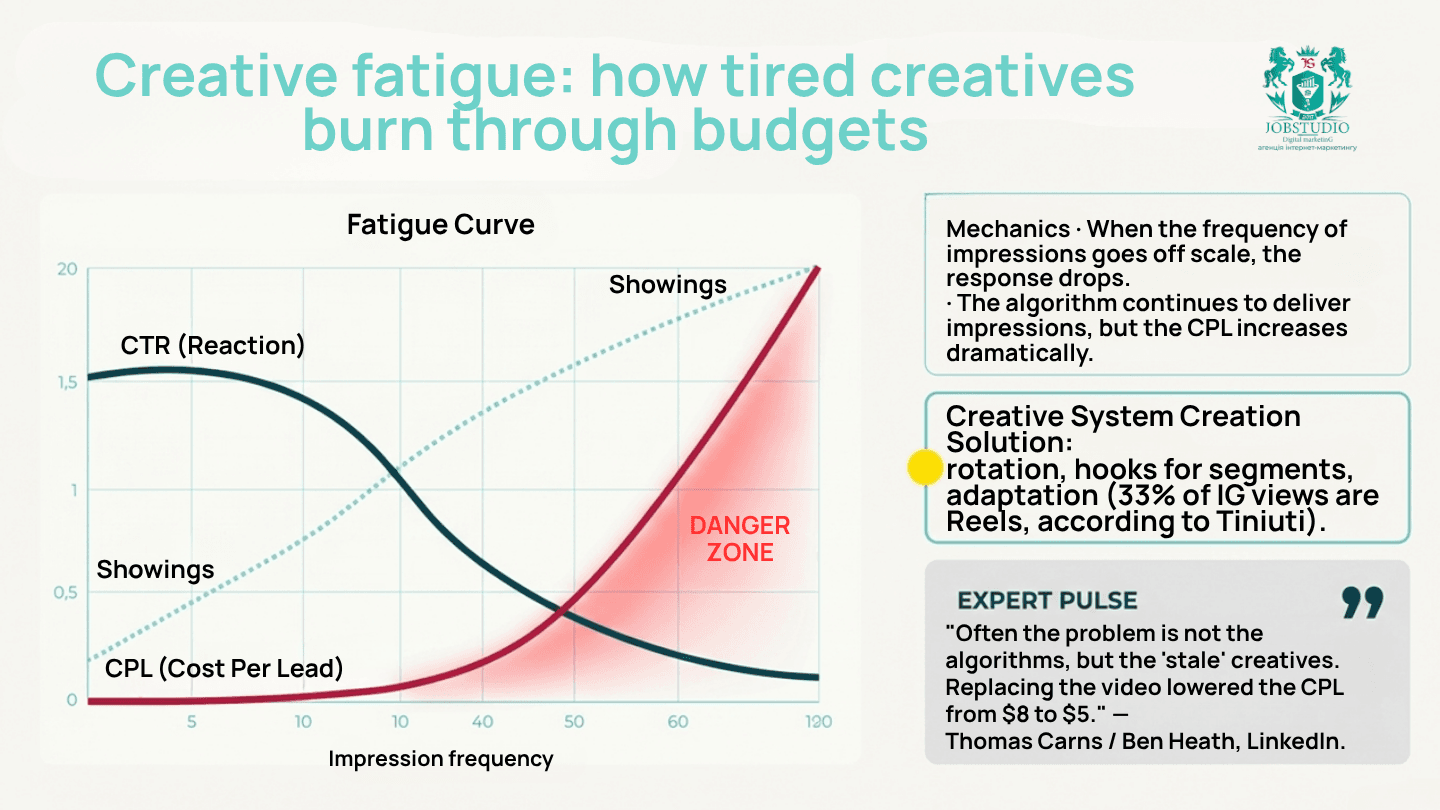
On LinkedIn, paid social experts are actively discussing “creative fatigue.” For example, Ben Heath cites this phenomenon as one of the main reasons for the failure of Meta Ads in 2025 and writes that the problem isn’t always CPM or platform changes, but rather “stale creative.”
On LinkedIn, Thomas Carns analyzed Meta’s new capabilities for tracking such creatives and provided a practical example: for one account, part of the budget was being spent on “fatigued videos”; after replacing the creatives, the CPL dropped from $8 to $5. But he also highlighted another perspective: for another client, the problem wasn’t creative fatigue, but page load speed.
This is a very important takeaway for businesses: even with Meta Ads, you can’t just focus on the banner. You need to look at the entire journey: creative → click → landing page → form → CRM → sale.
Tinuiti’s Q1 2026 Digital Ads Benchmark Report also highlights just how important Reels have become: 33% of Instagram ad impressions came from Reels.
This means that businesses need to think not in terms of individual banners, but in terms of a comprehensive creative system: hooks, formats, scenarios, rotation, adaptation for Reels/Stories/the feed, frequency control, and analysis of the creative’s impact on CPL/CPA.
In 2025, Google introduced AI Max for Search campaigns—a set of AI features for Search campaigns. In the Google Ads Help Center, AI Max is described as a tool that includes improved search term matching, headline and description optimization, and final URL extensions to increase the relevance of the landing page to the user’s intent.
At first glance, this sounds like a gross oversimplification. And in a way, it is.
But for businesses, this doesn’t mean that oversight is no longer necessary. On the contrary: the more the system selects queries, texts, and URLs on its own, the more important the quality of the input data becomes.
If a website has a weak structure, its pages don’t align with user intent, conversions are set up incorrectly, and the semantics aren’t optimized, AI can amplify not only the results but also the chaos.
Reuters reported that Meta plans to automate the advertising process using AI by the end of 2026: from creative development to targeting and budget recommendations.
This changes the roles of the marketer and the contractor.
In the past, a PPC specialist could gain an edge through manual adjustments. Now, algorithms are taking over part of that work. But this doesn’t diminish the value of expertise. It simply shifts the focus to higher-level areas: strategy, data, offers, creatives, funnel structure, analytics, and interpretation of results.
In her 2026 PPC forecast on LinkedIn, Hana Kobzová puts it this way: AI is evolving from a tool to a strategic partner, and the human role is shifting toward training AI with high-quality signals and clear brand guidelines.
This is a very accurate description of the new reality.
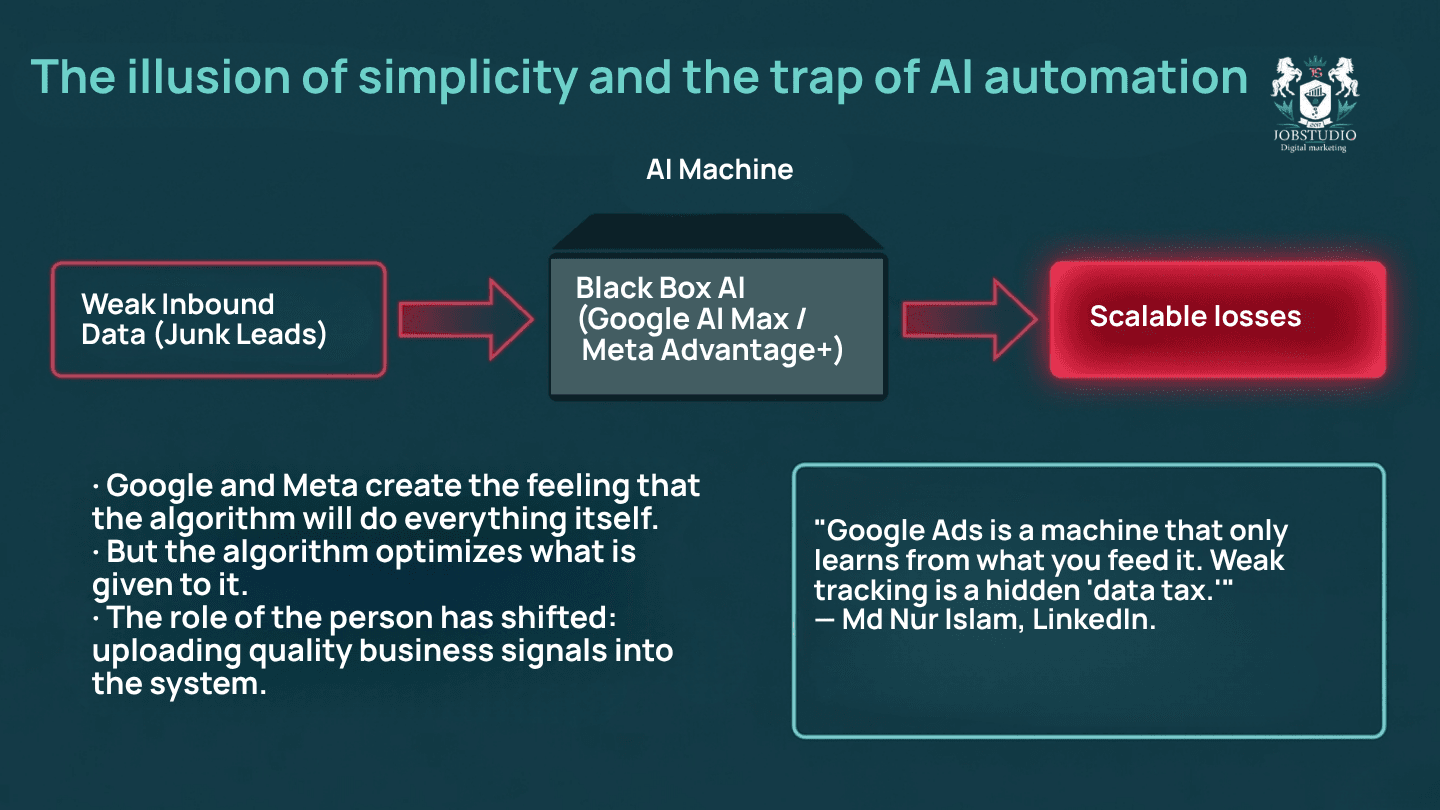
An algorithm is not a business strategist. It optimizes what it is given.
If you feed it weak conversions, it will look for more weak conversions.
If all leads are of equal value, he won’t be able to tell the difference between a random lead and a future major client.
If the website doesn’t lead to a conversion, the algorithm won’t fix the UX.
If the offer doesn’t meet the audience’s expectations, bidding won’t save the day.
On LinkedIn, Md Nur Islam put it very bluntly: “Google Ads is a machine that learns only from what you feed it.” In the same post, he emphasizes that incorrect or weak click-tracking setup creates a hidden “data tax” for businesses.
This is one of the key points of the article: automation does not replace strategy. It either strengthens a strong system or a weak one.
One idea comes up repeatedly in LinkedIn posts about PPC 2026: it’s not those who simply use AI who will succeed, but those who provide the algorithms with high-quality signals.
In his roundup on PPC in 2026, Marius Lazar writes about the importance of reliable tracking, first-party data, and micro-conversions, which help the system identify who the actual buyers are.
This is a practical answer to the question of why advertising is getting more expensive.
The cost of traffic is rising. But poor analytics is becoming even more expensive. That’s because businesses aren’t just paying for clicks. They’re paying for decisions made based on incomplete or incorrect data.
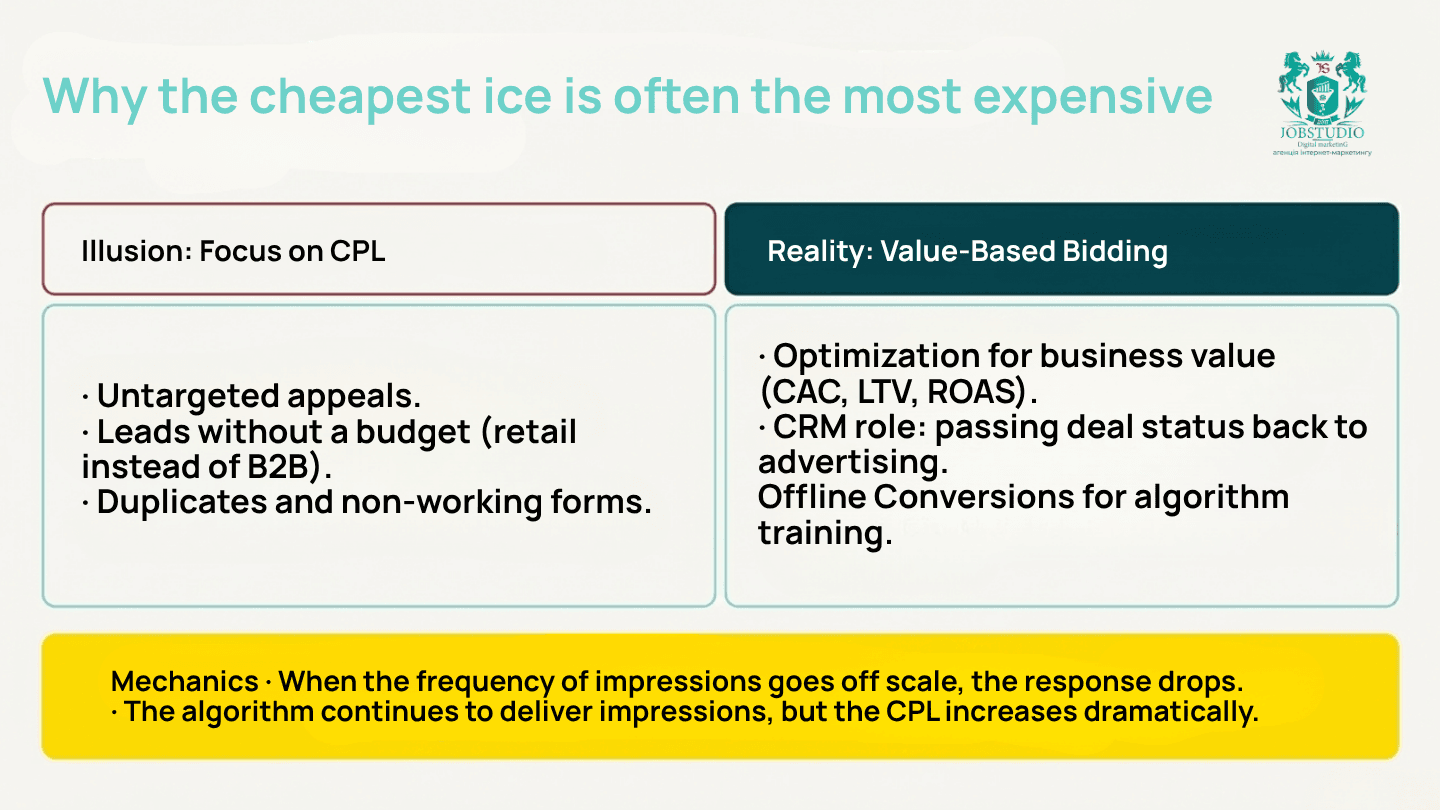
CPL alone does not answer the key question: Did the lead generate revenue for the business?
You can have a low application fee and still receive:
Therefore, what matters to a business is not only the cost of a lead, but also its quality, the path to a sale, and the bottom line.
In its guide on cost-based bidding, Google explains that this strategy allows you to maximize the total value of conversions, rather than just their quantity. Google AI optimizes bids in real time to attract people who are more likely to bring greater value to the business. As examples of value, Google cites sales revenue, profitability, or lead quality.
In a separate article, Google Business also explains that businesses should first define what “value” means to them: revenue, profit margins, or the value of the customer’s experience.
This is a very significant shift.
In 2026, it won’t be enough to simply send the “submit form” event to Google Ads. You’ll need to provide value: which leads turned into sales, which had high order values, which were off-target, and which were repeat customers.
Google Ads sees the ad. But it doesn’t see what happened next.
Meta sees the lead form, but doesn’t know if the manager got through on the phone.
GA4 detects the event, but it doesn’t know whether the visitor was a high-value customer.
That is exactly why businesses need:
Otherwise, the PPC team will optimize the ads based on what’s visible in the dashboard, rather than on what actually generates revenue.
In LinkedIn posts about Google Ads for 2025–2026, the view that “the cheapest wins” is no longer a sound strategy is being expressed more and more often. ThinkPod LLC explicitly states that cost-based bidding trumps the “lowest-cost wins” approach, and tracking offline conversions is becoming a necessity.
On LinkedIn, Phil Byrne highlights a set of metrics that really matter for Google Ads: CPA, ROAS, CTR, conversion rate, quality score, impression share, search network impression share, and CPC. Interestingly, he places CPA and ROAS at the center—that is, the issue of profitability, rather than simply the cost of traffic.
For businesses, the takeaway is this: cheap leads can end up being the most expensive if they don’t result in a sale.
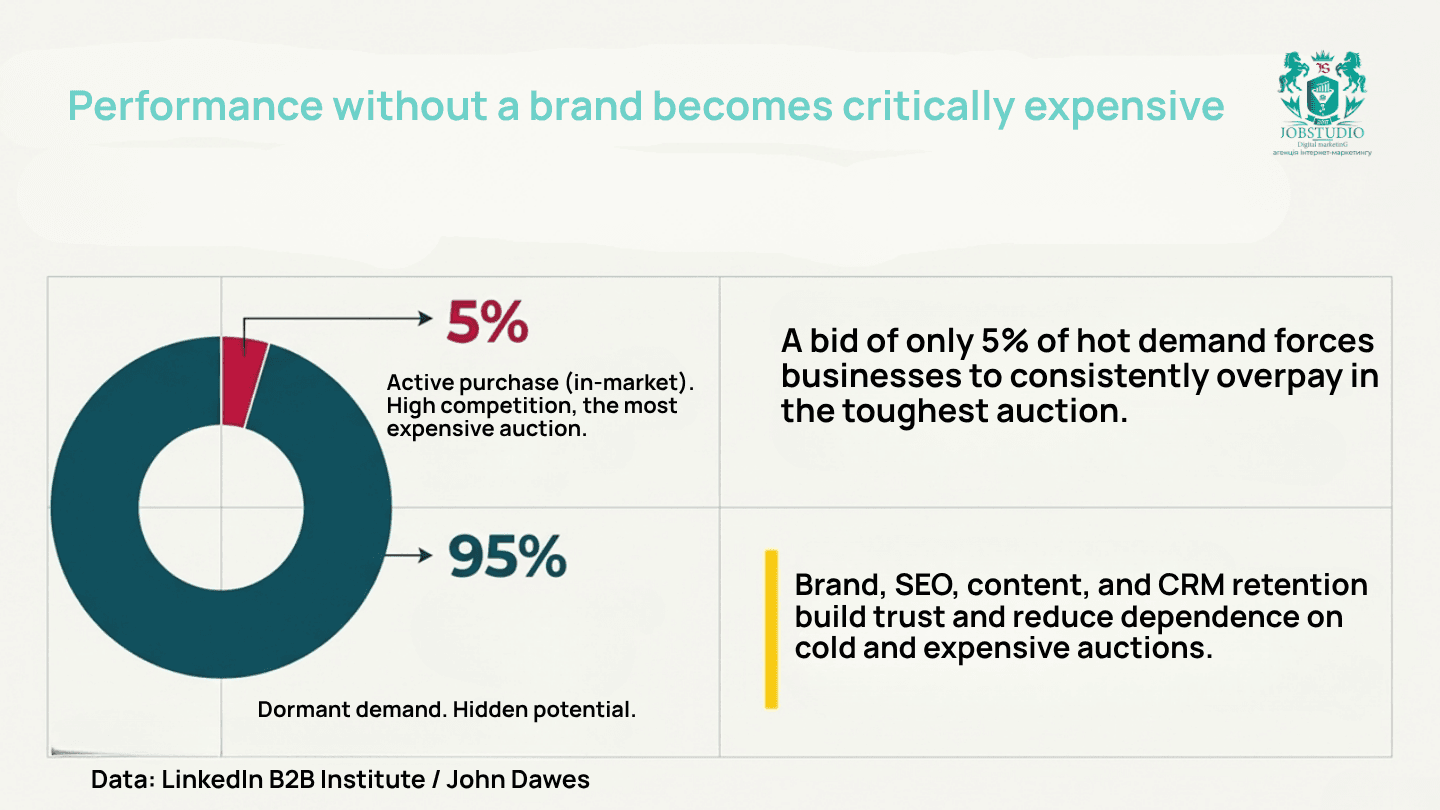
In an article about the 95-5 Rule, the LinkedIn B2B Institute explains that most B2B buyers are not actively shopping at any given moment. In the same article, LinkedIn cites a survey of B2B marketers: 96% expected to see the main impact of their ad campaigns within two weeks, but LinkedIn calls this the “short-term horizon myth.”
Professor John Dawes, who is associated with the 95/5 rule, explains it using simple logic: if companies switch their primary supplier once every few years, then only a small fraction of buyers are “in-market” during any given short period.
If a business focuses solely on urgent inquiries, it is constantly competing in the most expensive part of the sales funnel.
In Google Ads, these are commercial queries with high intent.
In Meta Ads, these are audiences that are already ready to take action.
In remarketing, these are users who are already familiar with the brand.
But if the brand is unknown, the offer is vague, the content doesn’t engage, and trust hasn’t been established, every subsequent lead costs more.
That’s why unbranded performance advertising becomes more expensive over time. Not because the performance is poor, but because it has to constantly bid on the hottest and most expensive demand.
PPC should not operate separately from the brand.
Google Ads is good at capturing established demand.
Meta Ads can generate and sustain demand.
SEO and content help answer questions before a purchase is made.
Email/CRM brings users back without having to pay for another expensive click.
Remarketing targets people who have already interacted with the brand.
And the better all these elements are integrated, the less the business depends on a cold, expensive auction.
Expert commentary on B2B advertising, long sales cycles, and demand
There are many discussions on LinkedIn about the 95/5 Rule. For example, Tom Hume’s post on “B2B Marketing and the 95/5 Rule” cites John Dawes’ conclusion: up to 95% of buyers may not be “in-market” at any given time.
This doesn’t mean that performance advertising isn’t necessary. It means that it should be part of a broader system: brand, demand, content, retention, CRM, and sales.
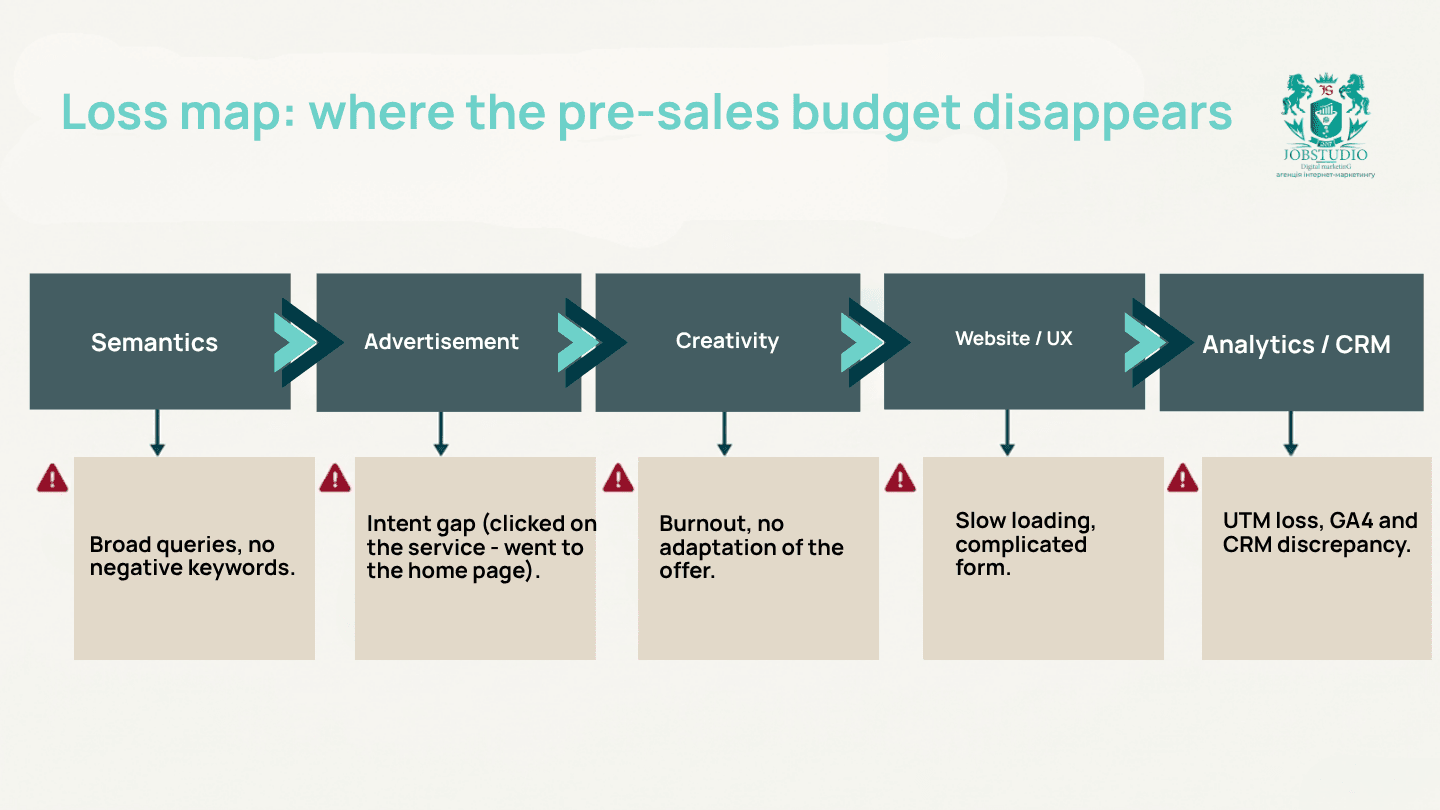
At JobStudio, we regularly see that “expensive Google Ads” often stem not from a high CPC, but from the fact that businesses are targeting the wrong intent.
The second area is the gap between what a person is looking for, what they see in the ad, and where they end up after clicking.
If a person is looking for a specific route, service, product, or category but ends up on the home page, they have to search for the information they need on their own.
That’s a weak scenario.
The ad has already been paid for. But instead of a direct path to the form, the user is forced to take an extra step. And every extra step in performance advertising is a potential loss of a conversion.
The third area is analytics.
Common problems:
And this isn’t just a technical detail. It’s the foundation of budget management.
If the data is incomplete, the business makes decisions based on a distorted picture.
On Meta Ads, weak creative can eat up your budget just as quickly as poor targeting on Google Ads.
Issues:
JobStudio’s articles on SMM and video content highlight an important point: strong B2B content is driven not just by dynamic editing, but by an accurate identification of the problem, a credible message, a narrative element, and semantic density.
This works for advertising, too. Creative content shouldn’t just “look pretty.” It has to accurately capture the audience’s mood.
The fifth area of loss is the website.
This may be the most painful part, because the business has already paid for the click.
And then the user encounters:
And that’s when the ad technically works. But the business starts losing money right after the click.
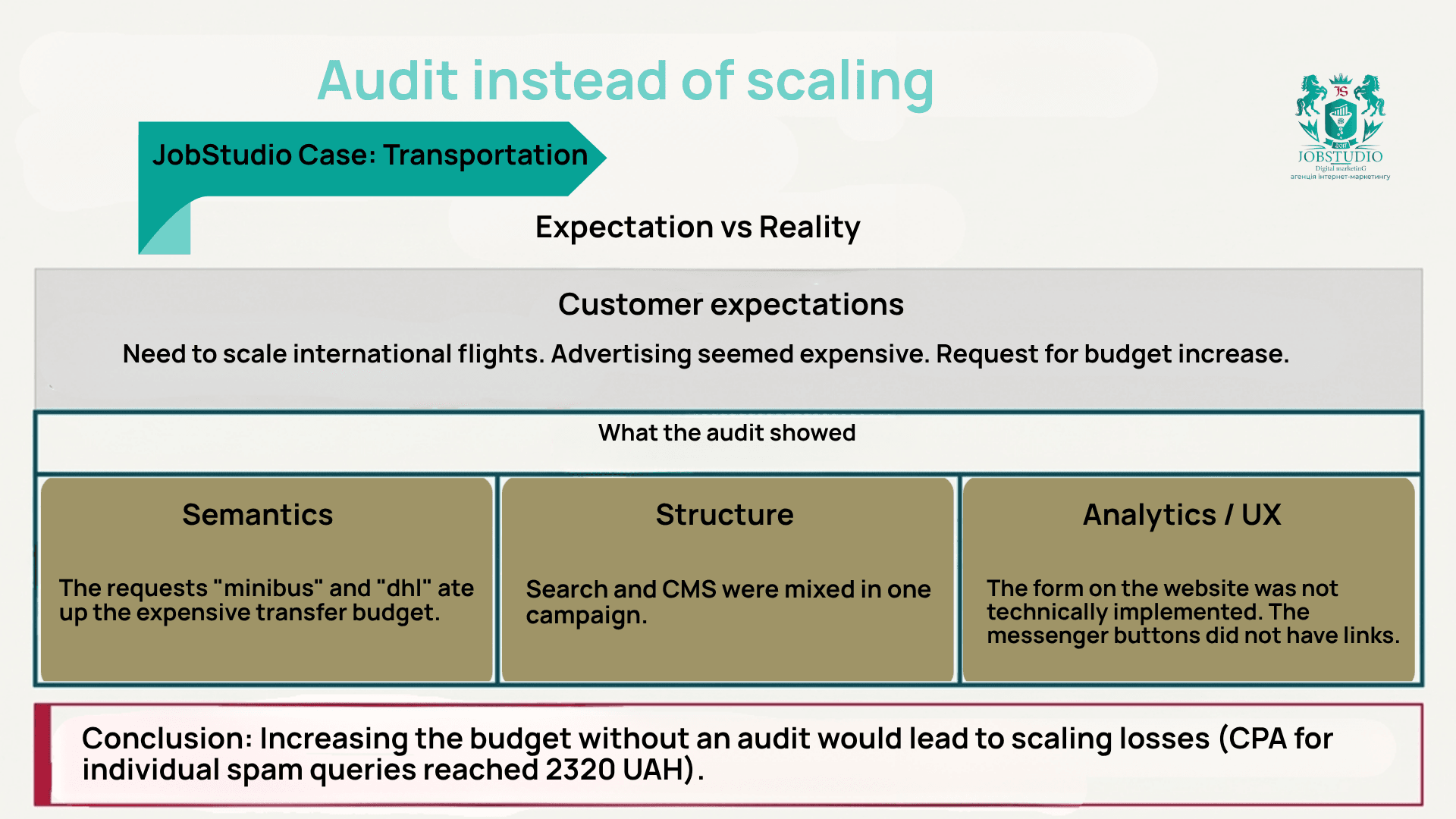
In our JobStudio case study, we analyzed Google Ads for a project in the passenger transportation and shuttle service sector. The ad campaign focused on intercity and international routes: “Kyiv–Warsaw,” “Warsaw–Kyiv,” “Chisinau–Odesa,” “Odesa–Chisinau,” and other destinations.
In this niche, effectiveness depends on precision.
Everything matters here: direction, geography, search query language, device, ad, landing page, contact button, form, and analytics.
The purpose of the audit wasn’t just to “take a look at the ad account.” The goal was to understand exactly where efficiency was being lost: in the campaign structure, the ads, the keywords, budget allocation, conversions, or after the click—on the website.
The team checked:
This is what a boutique performance approach is all about: not looking at a single feature in isolation, but analyzing the entire user journey—from the initial inquiry to the submission of a request.
The audit revealed that the account structure was incomplete: there was no separate brand campaign, no campaign targeting competitors, no comprehensive breakdown into hot and cold queries, and there were no campaigns for general queries, PPC, search and display remarketing, video campaigns, and geographic segmentation. One of the campaigns mixed Search and PPC, even though these are different mechanisms with different operating logics
There were also some weaknesses in the semantics. The search queries included irrelevant phrases such as “tickets,” “minibus,” “bus station,” and “DHL.” This is critical for the transfer niche, because someone searching for a “minibus” and someone searching for a transfer have different commercial value.
One particular problem was that a single glance at the advertising office wasn’t enough.
Conversions were set up in GA4 and GTM for clicks on phone numbers, email, Telegram, Viber, WhatsApp, and form submissions. However, the audit revealed that the form itself had not actually been implemented, and some of the messaging app buttons lacked links. In other words, in theory, the system was set up, but in practice, some users simply couldn’t complete the action.
It was also noted that UTM tags had not been set at the campaign level, meaning that the management overview was incomplete even after the ads had already gone live.
The most important takeaway from this case study: the problem wasn’t with a single element. It was with the system.
Part of the demand was not processed due to the account structure.
Part of the budget was spent on less targeted traffic due to semantic matching.
Some of the effectiveness was lost after the click due to irrelevant URLs, forms, buttons, and mobile UX.
The audit also revealed differences in effectiveness between individual campaigns and queries: for example, one campaign had the highest target price of 472.85 UAH (excluding VAT), while some queries reached 2,320.57 UAH per conversion; at the same time, it was specifically noted that a conversion does not equal an order.
Therefore, increasing the budget without an audit would be premature.
In this situation, scaling doesn’t mean “more results.” It can mean “more losses.”
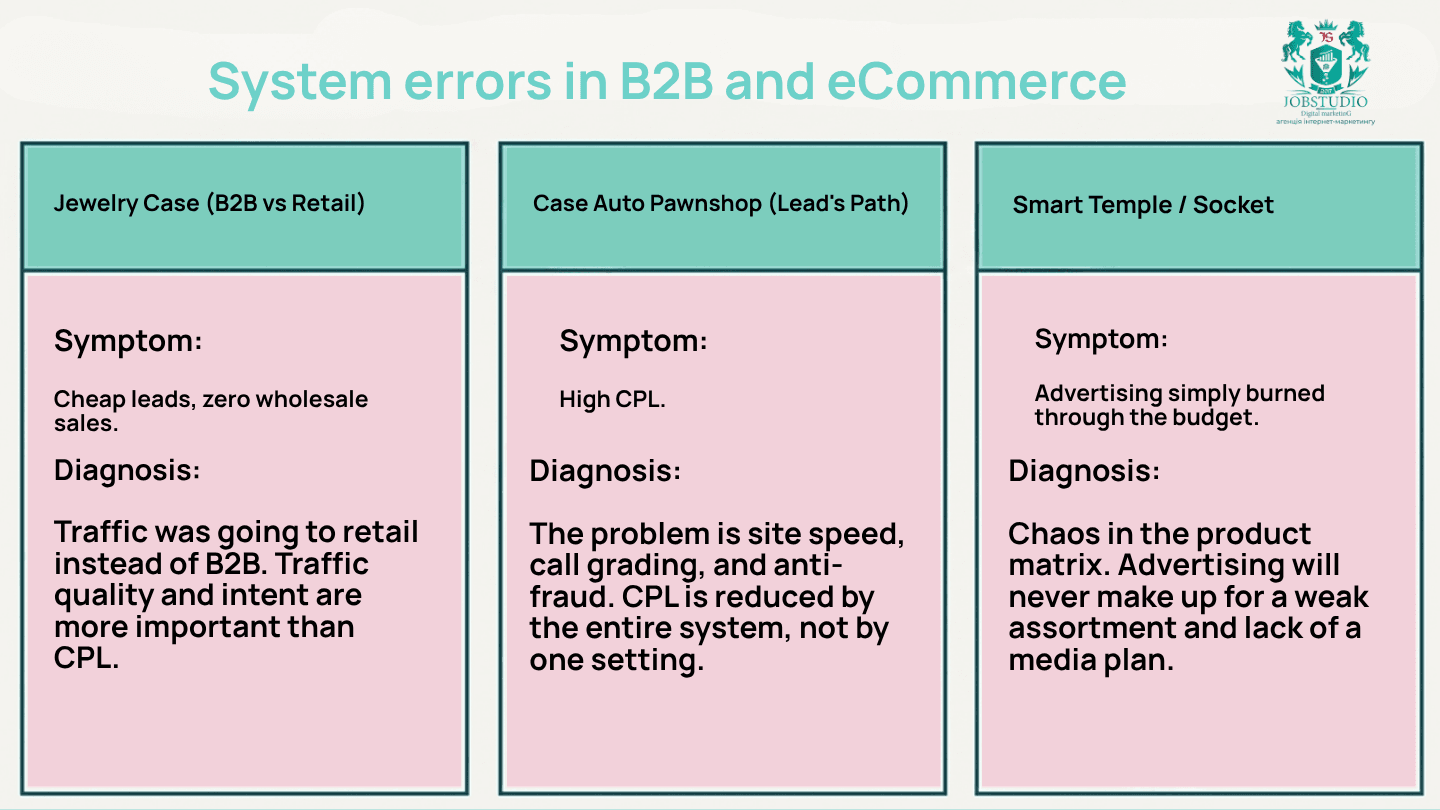
In the Jewelry case, the main problem wasn’t simply that advertising was expensive. The problem was the quality of the traffic.
For the B2B segment of the jewelry business, it is critical to distinguish between wholesale and retail demand. If advertising attracts people who are looking for jewelry for themselves, but the business needs wholesale partners, even cheap traffic becomes expensive.
In this situation, you can’t evaluate an ad based solely on clicks or the total number of leads. You need to determine whether the lead aligns with your business model.
This is where the difference between “there’s traffic” and “there’s the right traffic” becomes apparent.
In the Autolombard case, the result wasn’t due to a single setting change in Google Ads.
What mattered most there was the system itself: analytics, click tracking, campaign structure, negative keywords, landing page optimization, site speed, the mobile version, anti-fraud measures, Google Business Profile, and regular optimization.
This is a good example related to the topic of rising advertising costs: when the CPL goes up, businesses often ask to “make it cheaper.” But it’s better to ask: where exactly is the excess cost of the lead coming from?
In traffic?
Website conversion?
As for calls?
In the sales department?
In irrelevant regions?
In the boats?
Is it due to an incorrectly chosen strategy?
Without answers to these questions, lowering the CPL becomes a matter of guesswork.
For e-commerce and marketplaces, PPC performance depends heavily on the quality of the product management system.
For the Smart Temple / Rozetka project, the team worked not only on the budget but also on media planning: categories, ad formats, budgets, target clicks, CPC, CR, and projected number of leads. The media planning table shows the distribution of campaigns by product categories, formats, budgets, and target metrics.
This highlights an important point: in product advertising, you can’t just “throw money at it.” You need to understand which categories to promote, which products are ready for advertising, which ones have potential, where there are limitations, and where scaling up actually makes sense.
If your ad cards, categories, moderation, creative assets, and product selection aren’t ready, the ad will simply highlight your weaknesses more quickly.
The first step is not to increase the budget.
The first step is an audit.
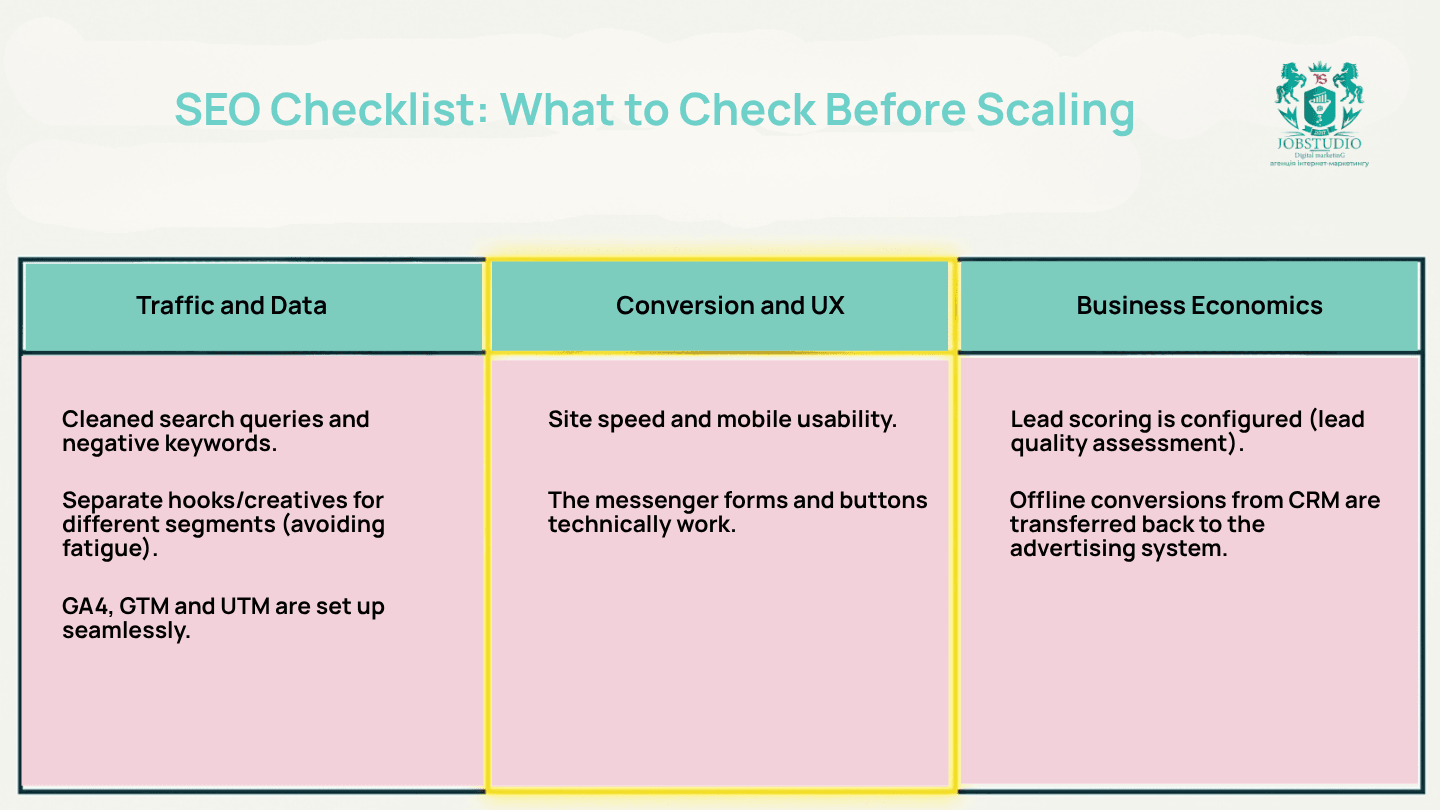
Please check the following:
The JobStudio case study on Google Ads audits clearly shows that simply checking the account isn’t enough: some of the losses occurred after the click—due to inactive buttons, an incomplete form, irrelevant landing pages, and a poor mobile experience
A high cost per click isn’t always a problem.
The problem is when an expensive click doesn’t turn into a high-quality lead or sale.
Therefore, businesses need to consider not only CPC, but also:
In that case, it may turn out that one channel generates low-cost leads but weak sales, while the other generates higher-cost leads but better ROI.
In Google Ads, you need to regularly clean up search queries, expand negative keywords, separate hot and cold clusters, and review geographic targeting, devices, search partners, and campaign overlap.
In Meta Ads, you need to monitor frequency, placements, creative fatigue, the quality of lead forms, audience segments, remarketing, and whether the creative aligns with the stage of the sales funnel.
Optimization and analytics have also become important: regularly auditing campaigns, pausing ineffective ads, and focusing on the most profitable channels.
The landing page must match the search query and the ad.
Please check the following:
In PPC, there’s no point in buying expensive traffic for a page that doesn’t prompt the user to take action.
For Meta Ads, businesses need a creative system, not just individual banners.
This means:
Strong creative isn’t just beautiful. It explains who the offer is for, what problem it solves, why it’s worth paying attention to right now, and what to do next.
Businesses need to teach their advertising systems to distinguish valuable leads from non-targeted ones.
To do this, you’ll need:
Without this, Google Ads and Meta Ads may be optimized for low-cost actions that don’t deliver business results.
PPC should not be used in isolation, but rather in conjunction with SEO, content, email/CRM, remarketing, social media, branding, and repeat sales.
Among the adaptation strategies, we’ll specifically highlight working with our own customer base, retention, email marketing, loyalty programs, CRM, niche channels, and a focus on strategy rather than just the budget.
This is especially important for B2B and complex services, where decisions aren’t made with a single click.
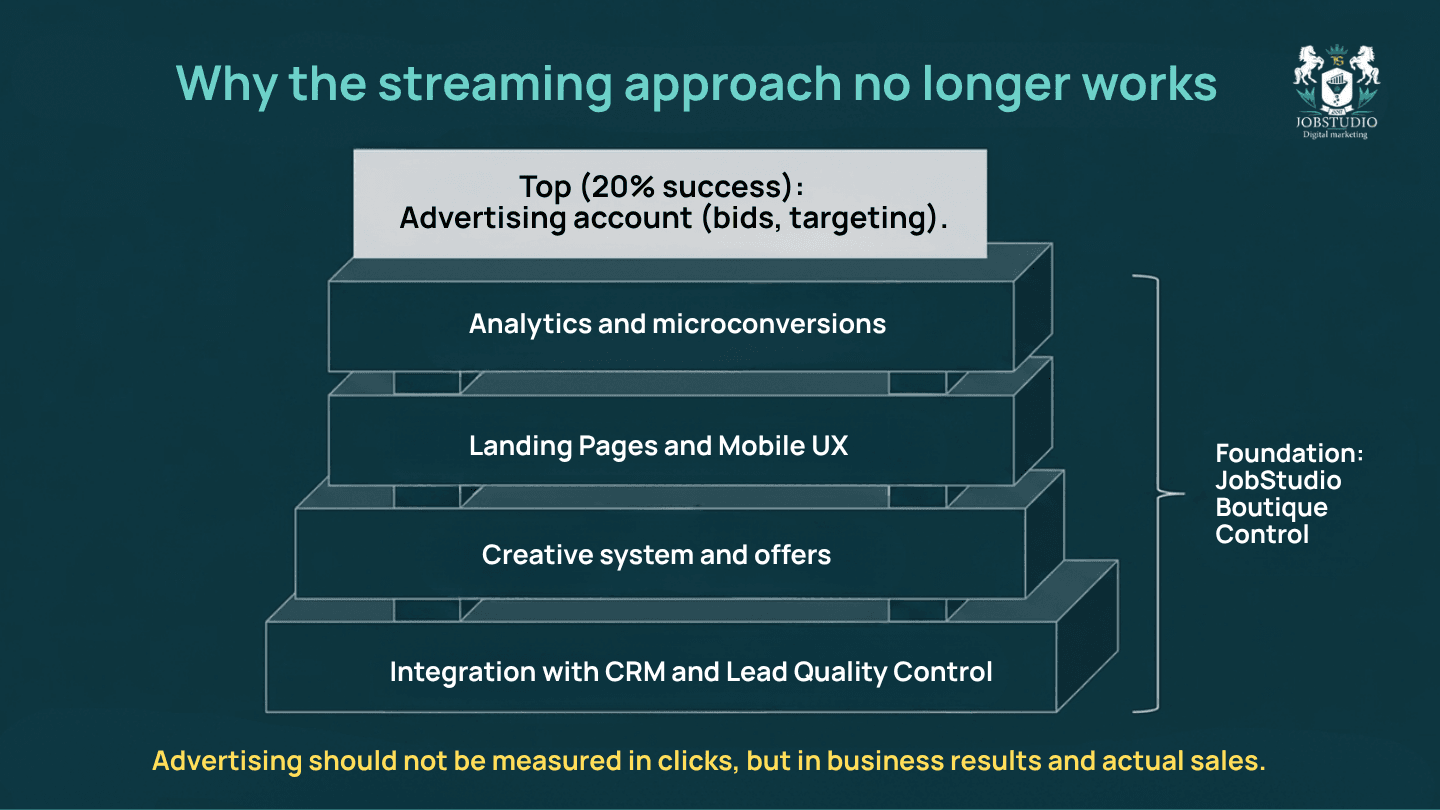
When clicks are cheap, businesses can sometimes afford to let things get chaotic.
When clicks get more expensive, chaos becomes costly.
That is precisely why the “set it and forget it” approach—where you just follow a template and check the report once a month—becomes dangerous.
For JobStudio, the boutique approach is the opposite of a cookie-cutter approach: a customized strategy for each project, greater attention to detail, direct contact with experts, deep immersion in the business, flexibility, a focus on quality, and a drive toward applications, sales, and business growth.
The advertising department is just one layer.
To get real results, you need to focus on:
The JobStudio Google Ads audit case study explicitly documents this approach: the team didn’t limit itself to the dashboard, but also checked the destination URLs, page speed, mobile usability, the presence of forms, the functionality of contact buttons, and basic UX scenarios.
A boutique performance approach isn’t just “pretty positioning.”
This is management logic:
Other key roles within JobStudio’s organizational structure include: PPC specialists, SEO specialists, Head of SEO/PPC, a programmer, a tester, a content manager, a designer, a UX/UI designer, and an account manager. This structure is important precisely because the problem with advertising often lies not only in the advertising itself.
For JobStudio, the correct logic is as follows:
It’s pragmatic, evidence-based, to the point, and focused on the system, monitoring, leads, conversion, ROI/ROMI, analytics, the sales funnel, lead quality, and an action plan.
Businesses should stop:
Advertising is getting more expensive for everyone. But not everyone is losing money at the same rate.
The first thing to check:
In 2026, it won’t be advertising that gets more expensive.
A business’s lack of readiness for advertising is becoming more costly.
If analytics aren’t set up, conversions aren’t tracked, the offer is weak, creatives are stale, the landing page is subpar, and there’s no CRM integration or lead quality analysis—Google Ads and Meta Ads will simply highlight these issues in the numbers.
Advertising hasn’t gotten any worse.
She has become less tolerant of chaos.
Before increasing the budget, check the system.
Type “AUDIT”—we’ll show you where your ads are losing money and what you should fix first.
.webp)
 Contacts
 Language
 Book a call
 Order a proposal


