


Get a responsible approach in promoting client project.
Contact us now!
Contact us now!



 Order a call
  Get an offer
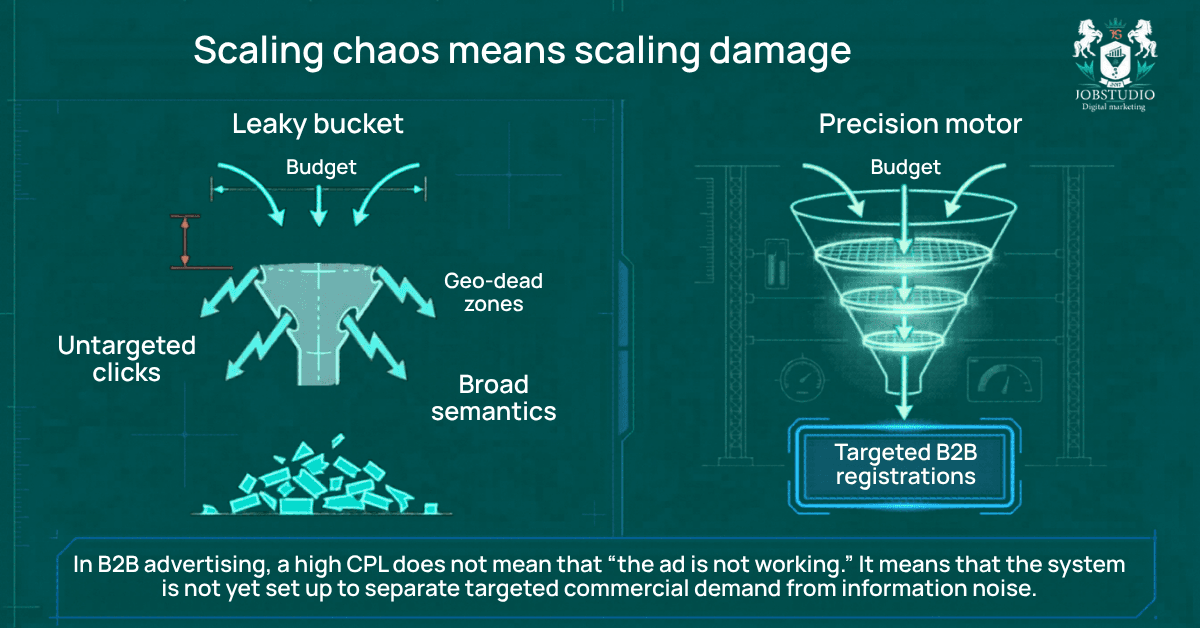
In B2B advertising, a high-cost lead doesn’t always mean that “the ad isn’t working.” Often, it means something else: the system isn’t yet set up to filter out the noise and identify genuine demand.
Table of Contents
The semantics may be driving unnecessary traffic. The campaign structure may prevent proper analysis of segments. Some regions may be spending the budget without generating any sign-ups. And while the analytics may show the big picture, they may not answer the key question: what exactly is bringing new users to the business.
The client is an industrial equipment marketplace with an annual audience of 2 million visitors. The portal brings together buyers, sellers, suppliers, and agents who work with business equipment.
The project’s target audience is not the mass B2C segment. It consists of industrial plant managers, top executives, workshop and department heads, technical specialists, marketers, sales professionals, and representatives of companies involved in industrial equipment.

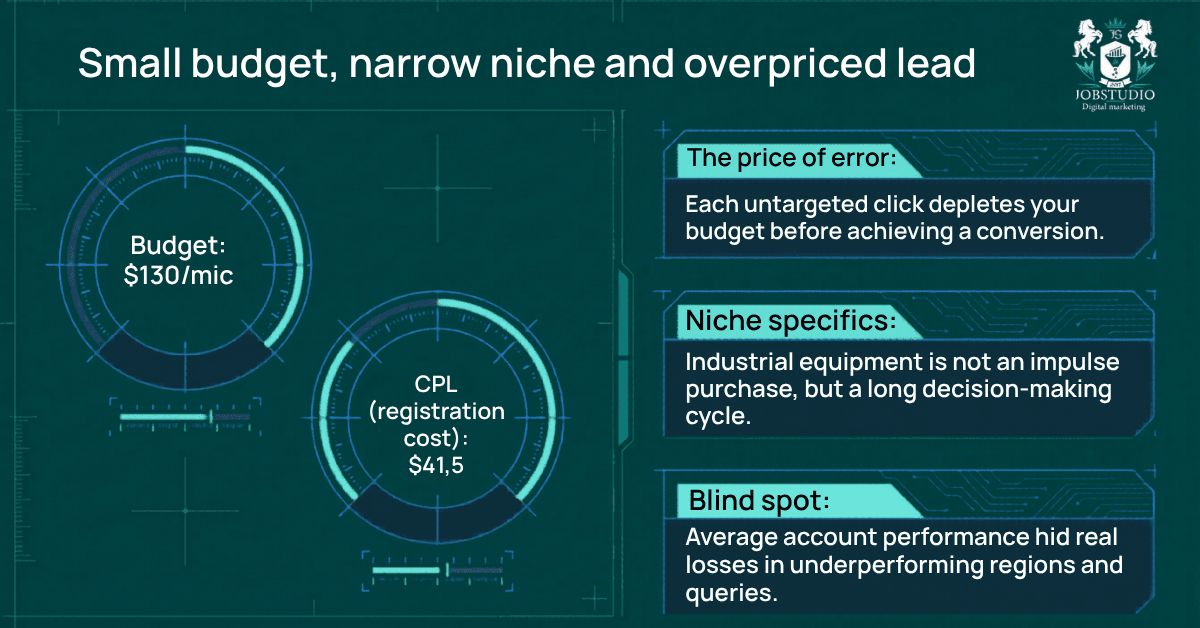
This niche has its own unique characteristics. Industrial equipment is not an impulse purchase. It involves a longer decision-making process, a narrower audience, more complex terminology, and a much higher cost of error in advertising traffic.
While in e-commerce, a portion of accidental clicks can be “swallowed up” by the overall volume, in B2B, every non-targeted segment directly impacts the cost per lead or registration. That is why, in this case study, it was important to focus not on the number of clicks, but on the quality of traffic.
Our challenge wasn’t simply to launch an ad campaign on a search engine. The business needed a managed channel for attracting new users to the portal.
The primary call to action is to register a new user.
This is an important point. In this case, the conversion wasn’t just a click, a page view, or some abstract interaction. We measured effectiveness based on new user registrations on the portal—that is, based on an action that had direct business value for the client.
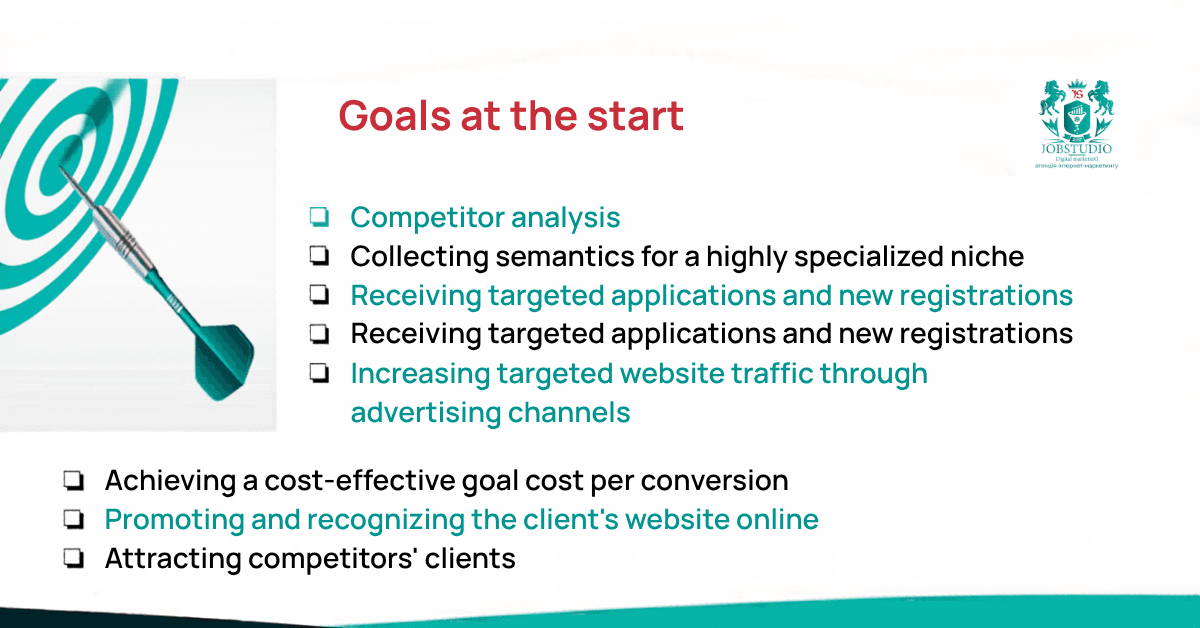
The main objectives were as follows:
Initial goals also included analyzing competitors, gathering keywords for a highly specialized niche, increasing targeted traffic, achieving a profitable cost per acquisition, and attracting competitors’ audiences.
In this case study, we worked with a B2B portal for buying and selling used industrial equipment. The goal wasn’t simply to “launch contextual advertising.” We needed to build a managed advertising channel that would drive new users to sign up and allow us to scale the budget not randomly, but based on data.
As a result, over the course of its operation, the advertising channel generated 1,673 new registered users, 3,477 targeted visits, and accounted for over 55% of all targeted visits to the website. The cost per registration dropped by more than 17 times—from approximately $41.50 to $2.45. Additionally, the ad CTR increased by more than 17 times, and the number of targeted conversions rose by more than 14 times.
This is an archived case study that was implemented in another market prior to 2022. In this article, we do not focus on geography or a specific advertising platform. What interests us most is the approach, the logic behind the work, and the results.
This case study demonstrates how, in a challenging B2B niche, a systematic approach to advertising helps not only to generate clicks but also to reduce the cost per conversion, scale the budget effectively, and build a predictable user acquisition channel.
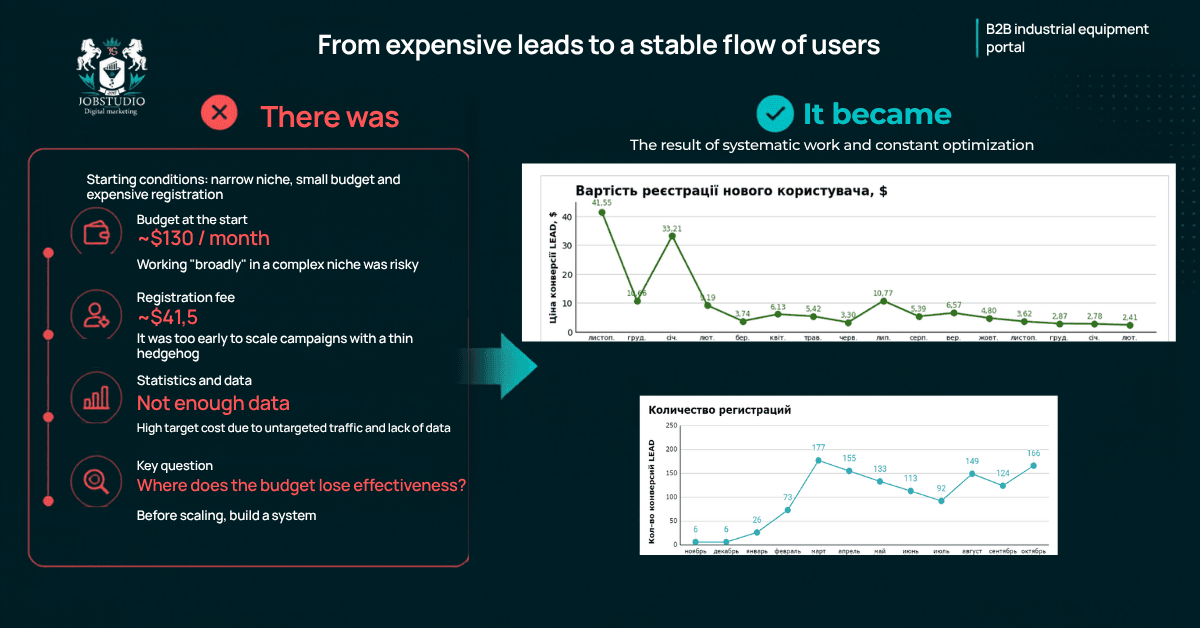
At the outset, the advertising budget was approximately $130 per month. For a B2B portal in a niche industrial sector, this meant that every non-targeted click mattered.
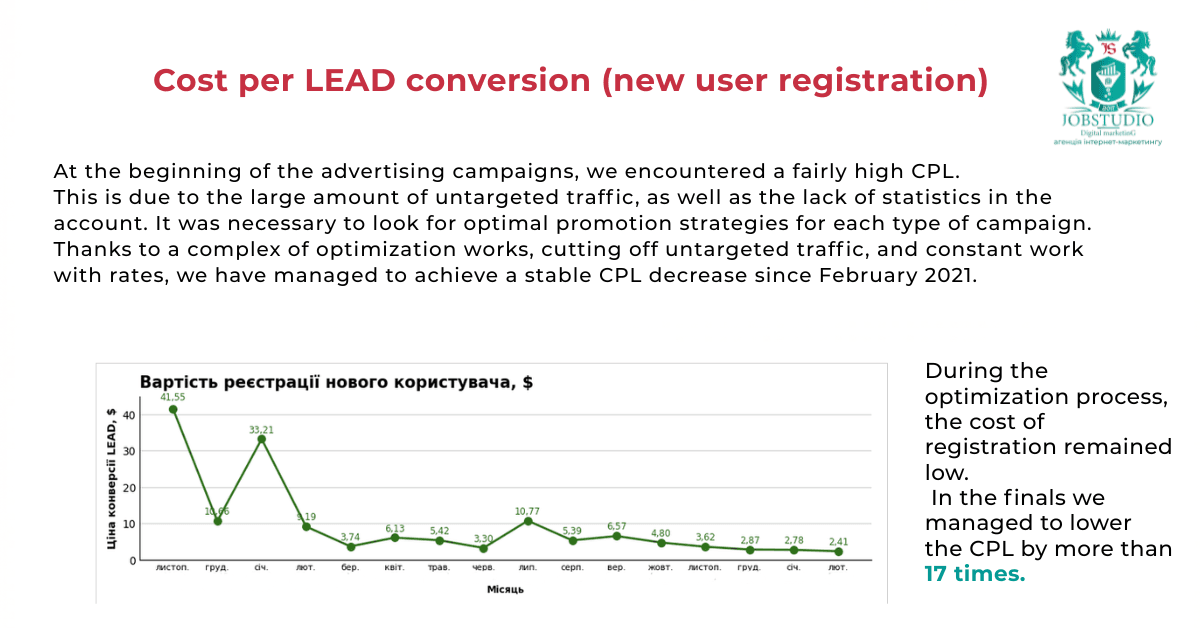
The cost per registration at the start of the project was approximately $41.50. For a complex B2B project, this wasn’t a disaster, but scaling that model was risky. Before increasing the budget, we needed to understand which search queries, regions, ads, and audiences were actually driving new users, and which were merely creating the appearance of activity.
At the outset, there wasn’t enough data to scale the campaign with confidence. The high cost per conversion was due to a large amount of non-targeted traffic and a lack of historical data in the account.
Following systematic optimization, the cost per registration dropped to approximately $2.45. Over the entire period, the client gained 1,673 new registered users, averaging 104 new users per month.
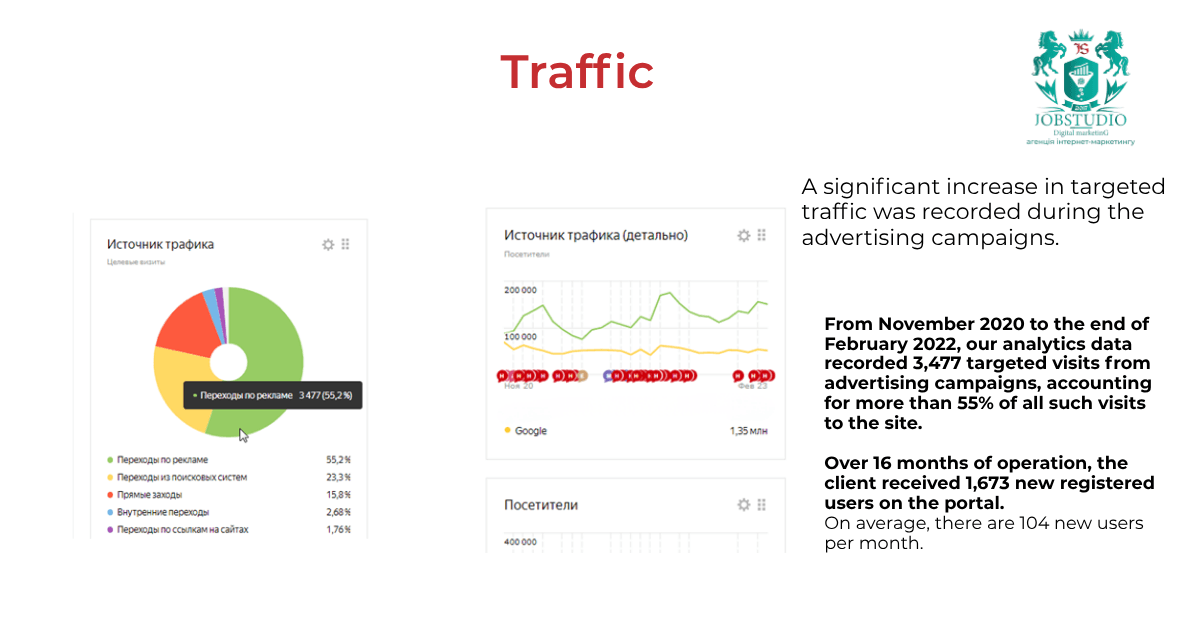
The advertising channel generated 3,477 targeted visits—more than 55% of all targeted visits to the website during the campaign period. The remaining targeted visits came from other traffic sources. The ad CTR increased more than 17-fold, the number of targeted conversions increased more than 14-fold, and after the results stabilized, the budget was gradually scaled up to approximately $650 per month.
At the outset, the advertising budget was approximately $130 per month. For a complex B2B niche, this meant that casting a wide net was risky. It wasn’t possible to simply gather all related search terms, launch an ad campaign, and expect the system to quickly find an effective audience on its own.
The initial cost per registration was approximately $41.50. For an industrial equipment marketplace, this can still be attributed to the complexity of the niche, but it was too early to scale the campaign with such low ROI.
In this situation, the first question wasn’t “How can we increase the budget?” but “Where exactly is the budget losing its effectiveness?”
It was necessary to understand:
That’s exactly why we didn’t rush to scale up at the start. First, we needed to build a system that would show us what worked and what didn’t.
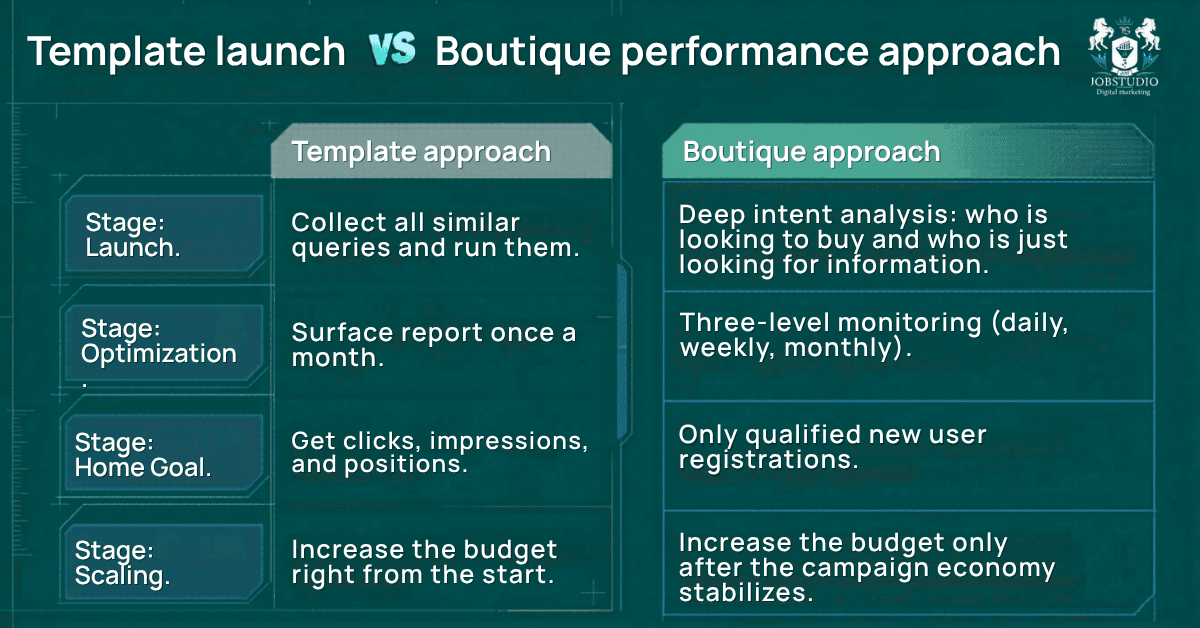
In mass-market niches, it’s sometimes possible to quickly test broad segments, gather initial data, and then refine campaigns. In B2B advertising for industrial equipment, this approach can quickly turn into a costly mistake.
It’s important to consider not only keywords but also the user’s intent. One person might be looking to buy equipment. Another might want to sell equipment. A third might simply be gathering information. A fourth might be comparing platforms. To an advertising system, these queries may seem similar, but they have different value for a business.
In this case, the outcome depended not on a larger budget, but on precision:
Therefore, a “cookie-cutter” approach wouldn’t have worked here. It required manual work with the segments and constant monitoring of campaign performance.
In a stream-based approach, advertising campaigns are often launched following a basic pattern: gather keywords, write ads, launch the campaign, and review the report once a month.
In this project, that approach wouldn’t have yielded the desired results. We needed to delve deeper into the niche, analyze the competitive landscape, organize the semantics, review the ad copy, set up analytics, monitor regions, adjust bids, and continuously filter traffic.
This is what we call a boutique performance approach: rather than running cookie-cutter ads, we analyze the economics of a specific project and identify the areas where the business is actually losing money.
For JobStudio, the “boutique” format isn’t just a catchy phrase. It’s about a personalized approach, a deep dive into the business, a focus on quality, flexibility in decision-making, and a focus not only on ad placements or clicks, but also on applications, conversions, and business results.
In this case, this approach meant that we didn’t try to “spend more of the budget.” Instead, we first identified which parts of the system needed to be overhauled so that every additional dollar would be spent more effectively.
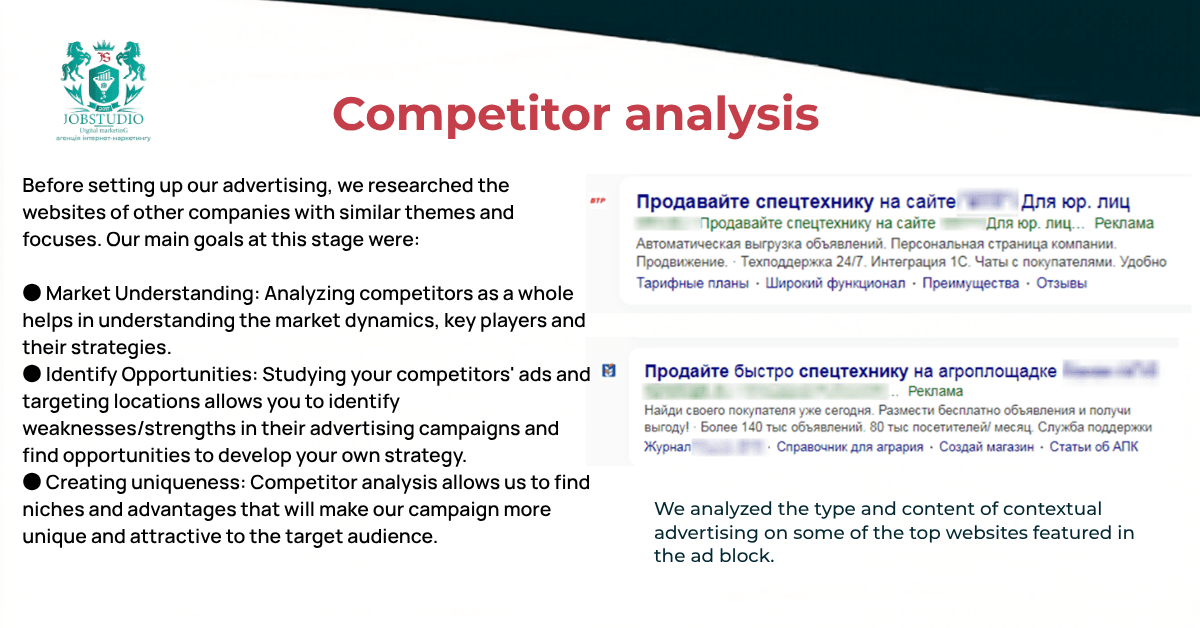
The first step was to analyze the competition. Before setting up the ads, we researched the websites of companies with similar themes and areas of focus.
We weren’t just interested in who appeared in the search results. We looked deeper:
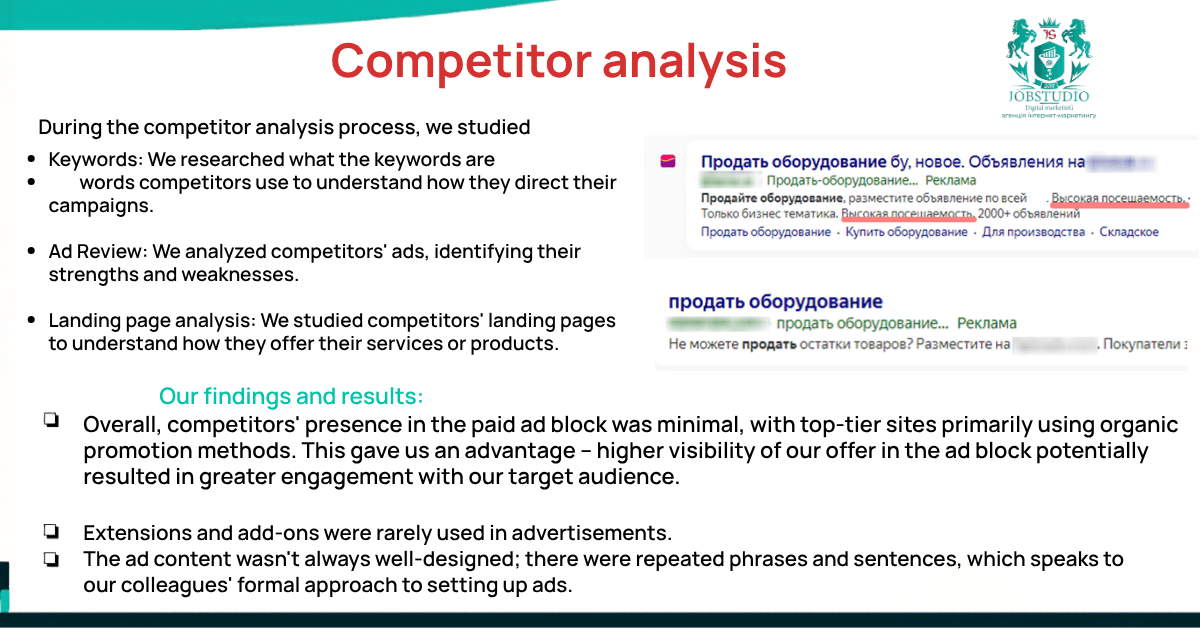
The conclusion was telling: competitors had a minimal presence in the paid section. Many relied more on organic promotion. Where ads did appear, they often looked perfunctory: ad extensions weren’t used consistently, repetitive phrases were common, and the copy wasn’t always well-crafted.
For us, this presented an opportunity. While our competitors weren’t consistently using paid channels, we were able to secure a more prominent position in search results more quickly, test demand, and better convey our message to our target audience.
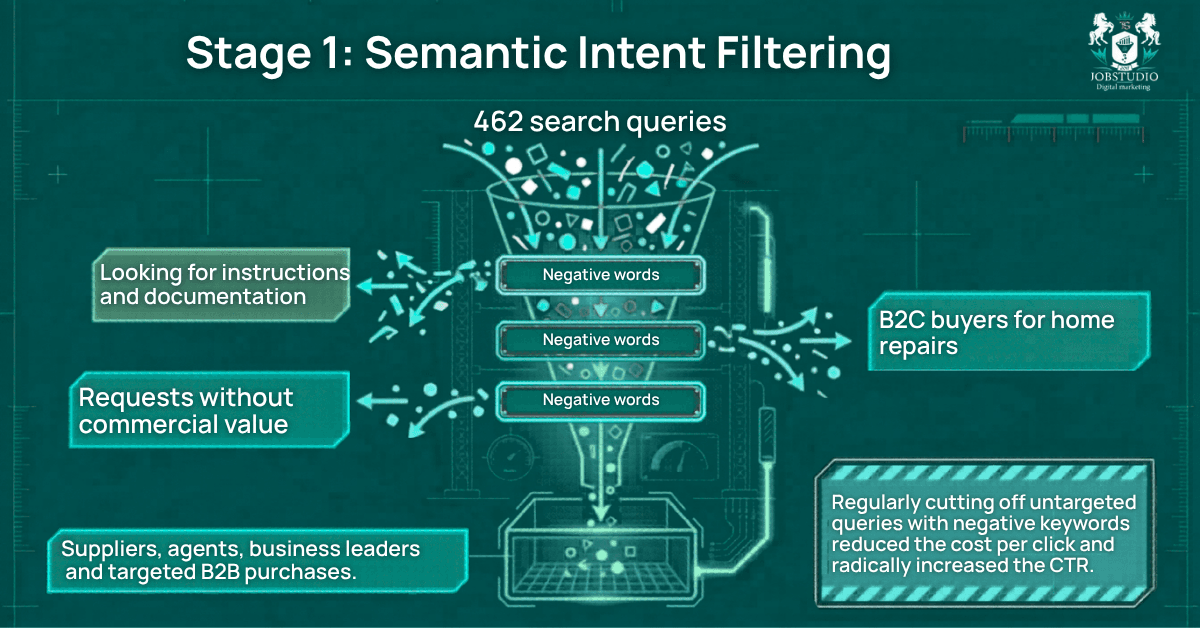
After analyzing the competition, we moved on to compiling a semantic core for our search campaigns. Initially, we gathered over 460 key search terms—not as a “broad” core designed to cover every possible search query, but as a working foundation for precisely targeting ads within the narrow B2B niche of industrial equipment.
The key here was not to collect as many phrases as possible, but to distinguish queries with genuine commercial intent from informational noise. Therefore, even during the semantic research phase, we began compiling an initial list of negative keywords—irrelevant phrases for which ads should not be displayed.
After the launch, work on semantics continued. The team regularly analyzed actual search phrases, identified irrelevant queries, expanded the list of negative keywords, and kept those segments that were likely to lead users to sign up.
For this project, it wasn’t enough to simply collect a large number of keywords. Quantity alone doesn’t guarantee results. In a narrow B2B niche, semantics must act as a filter: letting in potential target users while filtering out those who aren’t likely to convert into customers.
Just because a query is technically related to industrial equipment doesn’t necessarily mean it’s valuable to the portal. Some users may be looking for information. Others may be searching for specific products. Still others may be looking for services or documentation. And some queries may not align with the portal’s intended purpose at all.
That’s why, from the very beginning, working with semantics wasn’t about “collecting everything,” but about “collecting what’s relevant and removing what’s unnecessary.”
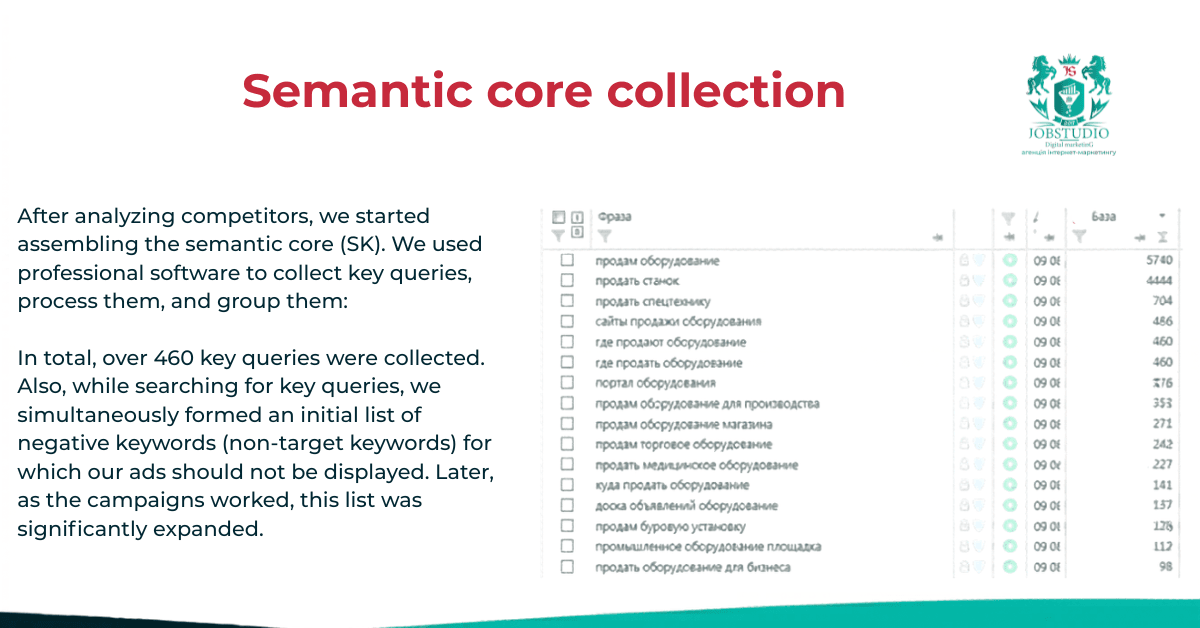
We compiled a list of niche-specific search queries, grouped them by category, identified the most valuable segments, created initial lists of negative keywords, and laid the groundwork for further optimization.
The work on semantics didn’t end after the launch. The team regularly analyzed search phrases, identified irrelevant queries, expanded the list of negative keywords, and tracked which segments actually generated sign-ups.
It was precisely this approach that made it possible to gradually reduce the proportion of non-targeted traffic and improve the quality of clicks.
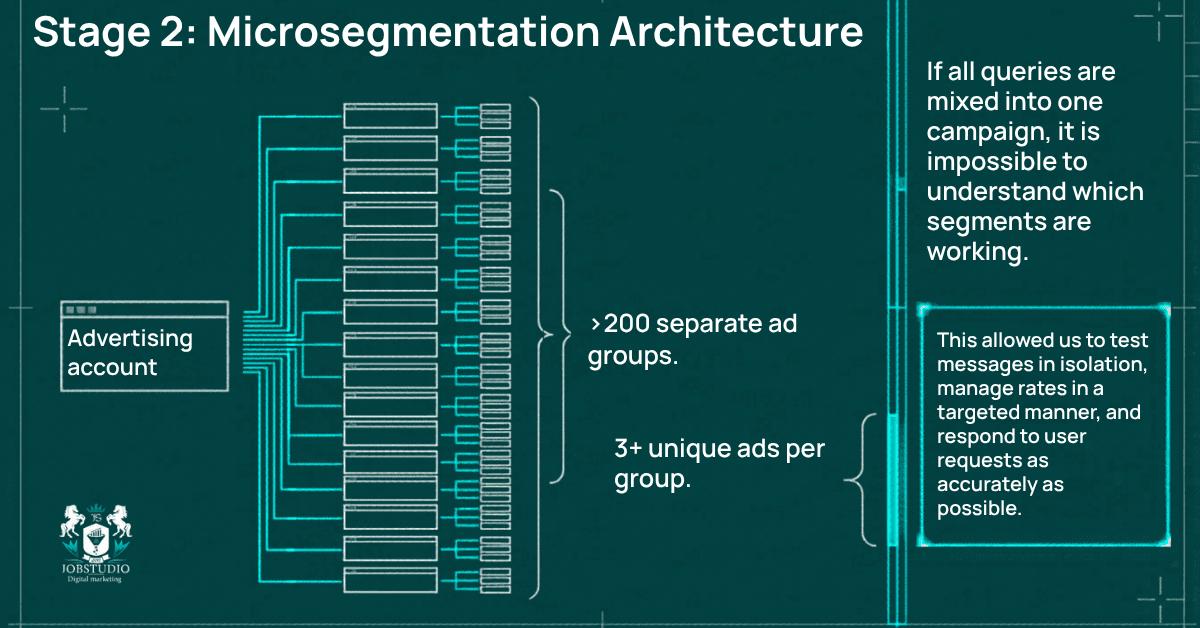
Based on the collected semantic data, we built the structure of the advertising account. Over 200 ad groups were created. Each group was populated with selected keywords, negative keyword lists were prepared, and these were assigned to the appropriate groups.
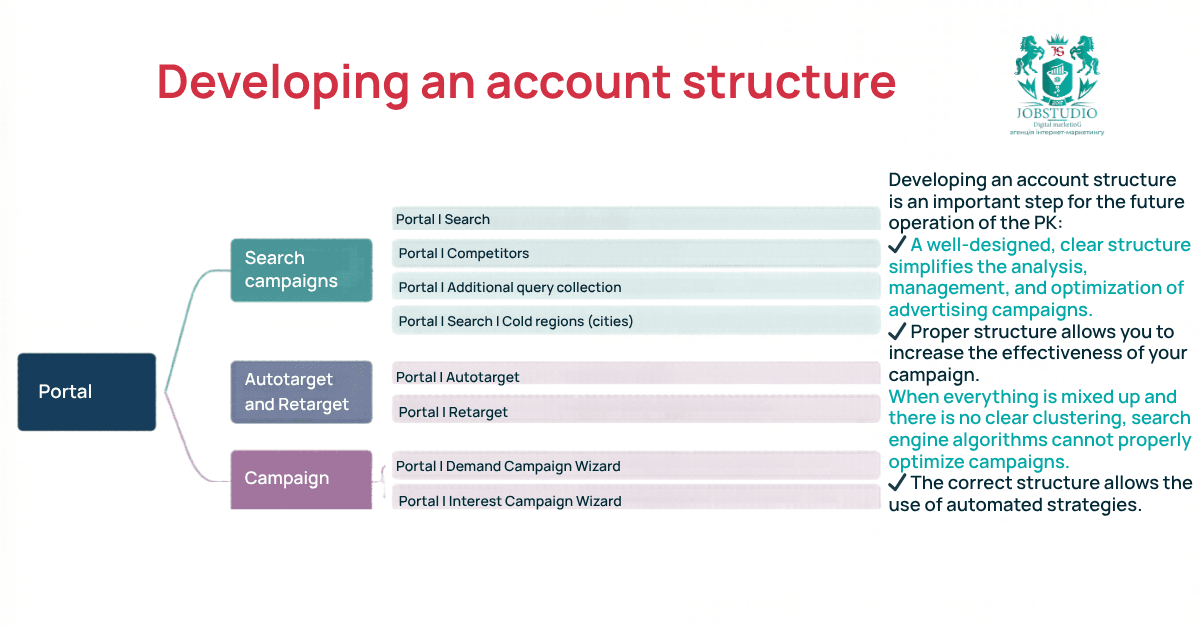
This is an important point. In performance advertising, account structure isn’t just a technical formality. It determines how manageable the entire system will be.
If all the queries are mixed together, it’s hard to tell which segments are performing well. It’s impossible to effectively compare ads, adjust bids, identify weak spots, and scale successful campaigns.
The right structure made it possible to view advertising not as a single large stream of clicks, but as a set of distinct segments, each of which can be analyzed, tested, and optimized.
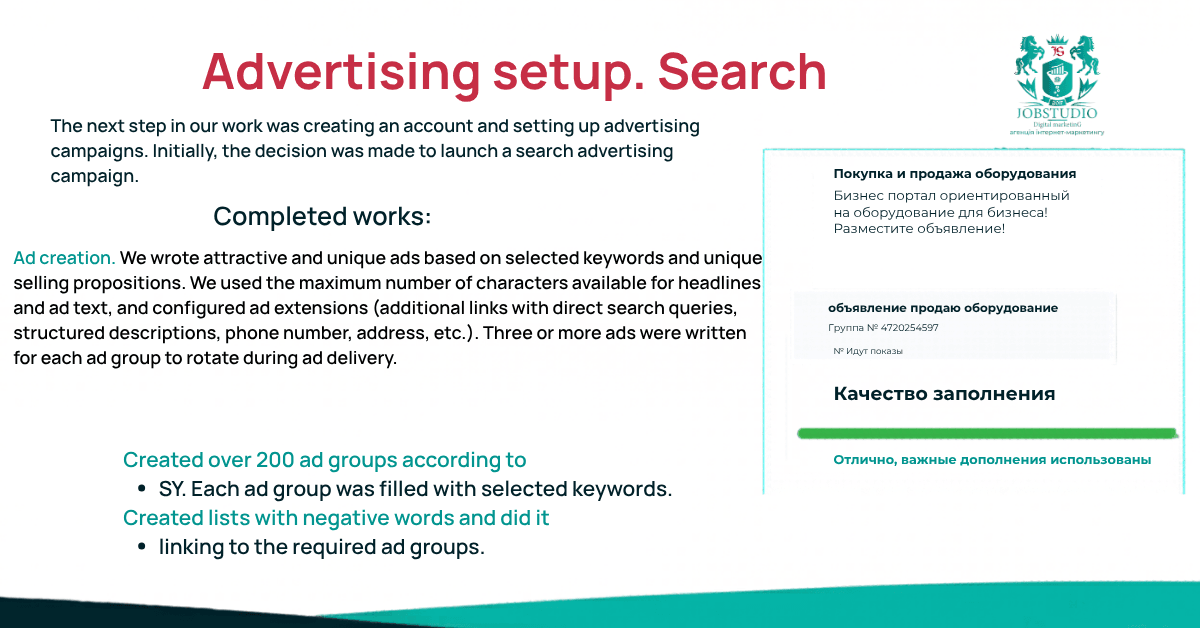
The structure, comprising over 200 ad groups, allowed us to manage bids more precisely, test different ad messages, improve the relevance between search queries and ads, analyze the performance of individual channels, and prepare campaigns for scaling.
In addition, this level of detail made it easier to spot problems early on. If a particular segment was spending its budget but not generating sign-ups, it didn’t have to be dragged along with the entire campaign; instead, it could be optimized, scaled back, or paused on its own.
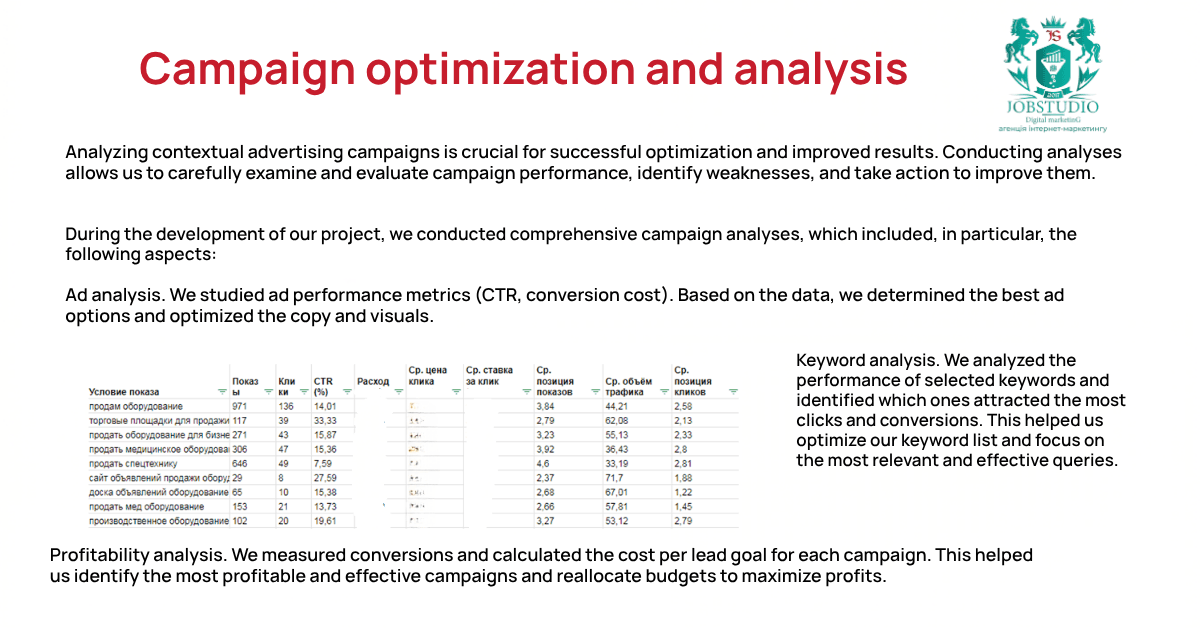
For each group, three or more ad creatives were prepared for rotation and testing. This allowed the system to compare different messages and gather statistics not just on a single version, but across several advertising approaches.
The ads utilized the maximum character count allowed for headlines and body text, incorporated keywords and USPs, and included extensions such as additional links, structured descriptions, phone numbers, addresses, and other elements that help make the ads more visible and useful to users.
In this niche, the ad was meant to do more than just “get a click.” It was designed to filter out casual visitors and immediately show the user that the site matched their intent.
This is critical for B2B. Clicks from non-targeted users also cost money. That’s why a strong ad doesn’t just boost the CTR—it also helps improve the quality of traffic.
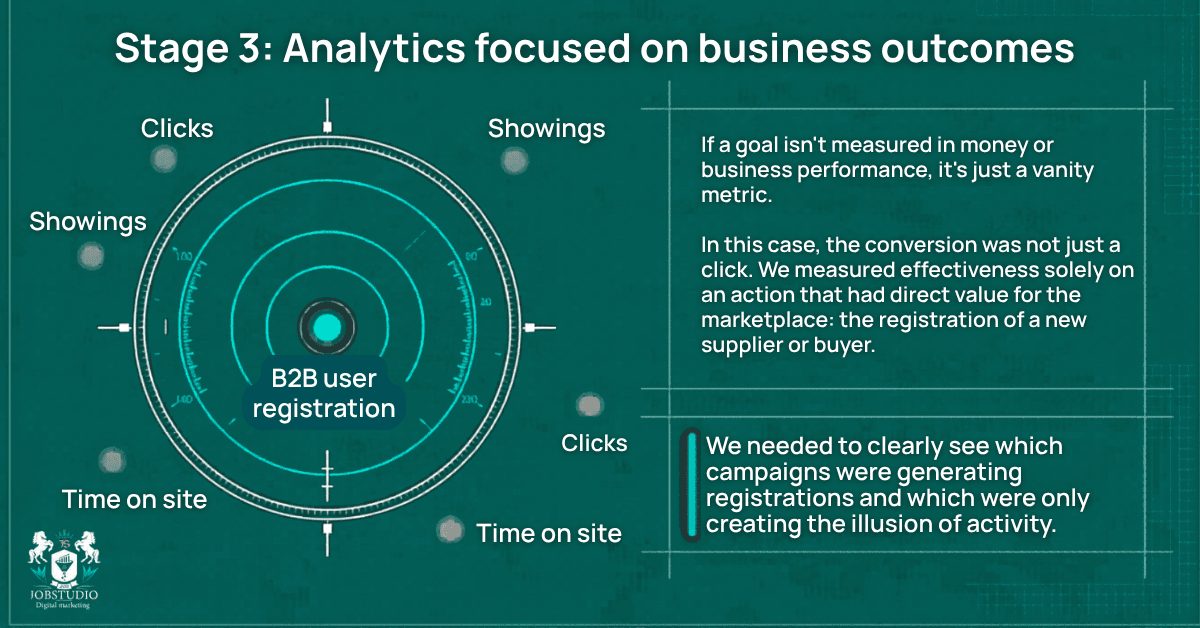
The next key component was analytics. Without it, advertising becomes a collection of campaigns where you can see costs and clicks, but it’s not always clear what actually drives results for the business.
A web analytics system was integrated into the project, and goals were set up, including registrations, calls, forms, clicks, and page views. Reports were also prepared for regular analysis of CTR, CR, CPC, ROI, and other performance metrics.
The basic principle is simple: if a goal isn’t measurable, it can’t be managed.
Therefore, the reduction in registration costs didn’t start with a budget increase, but with the implementation of a monitoring system. We needed to identify which campaigns were generating registrations, which segments were more expensive, which ads were performing better, where there were non-targeted clicks, and where we needed to adjust our strategy.
Analytics has made it possible to make decisions based on data rather than on a hunch.
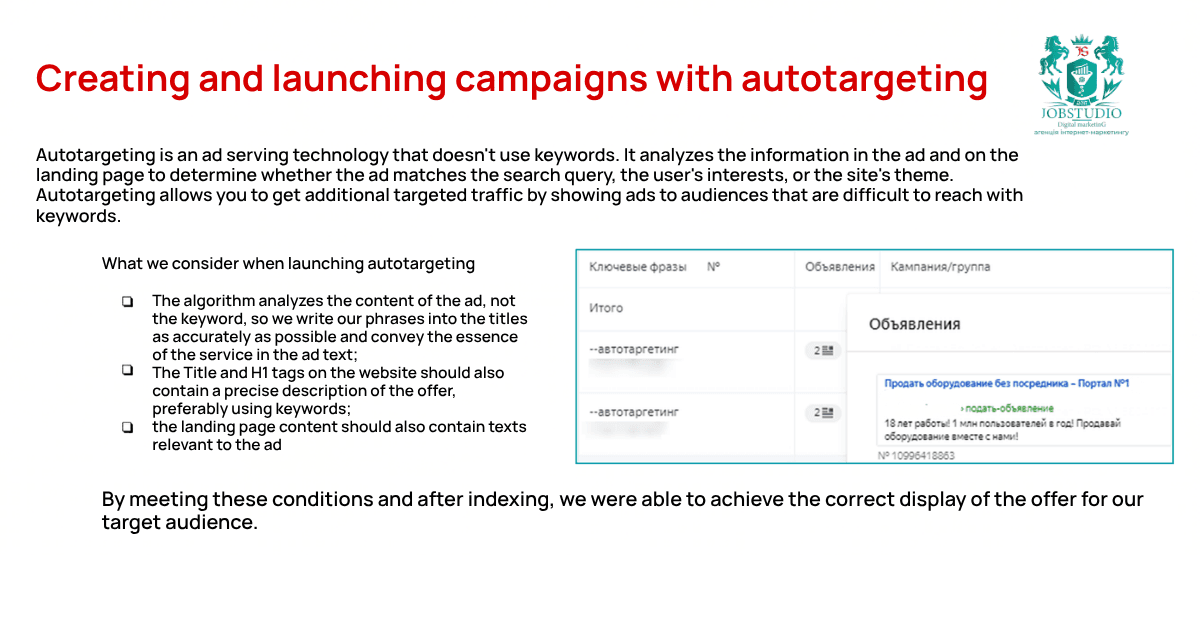
After finalizing the structure, semantics, ad copy, and analytics, we moved on to launching the ad campaigns.
Search campaigns were launched first. This is a logical starting point for a niche where it’s important to capitalize on existing demand: a user enters a query, sees a relevant ad, and clicks through to the website.
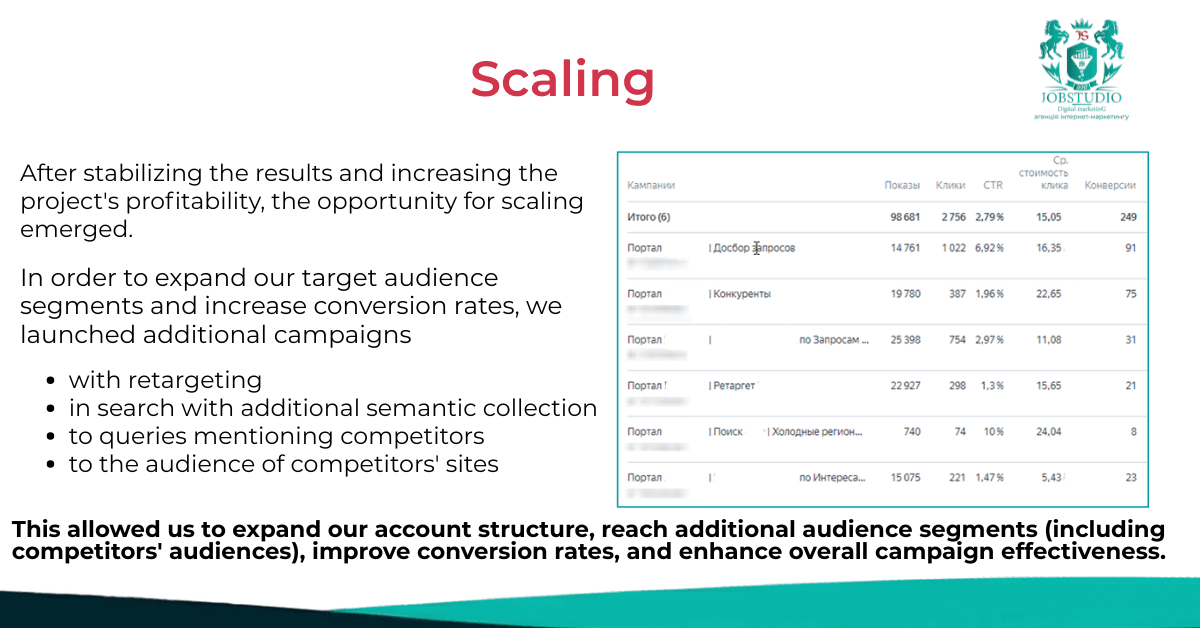
After gathering initial statistics and stabilizing the results, the marketing strategy was expanded. The campaign utilized search campaigns, display ads, retargeting, automated search ad campaigns, competitor audiences, and additional segments based on interests and behavior.
It’s important that we didn’t scale everything at once. First, we needed to test which segments were working, and only then add new formats and gradually increase the budget.
This is the fundamental difference between a systematic performance-based approach and a haphazard “let’s try something else” approach.
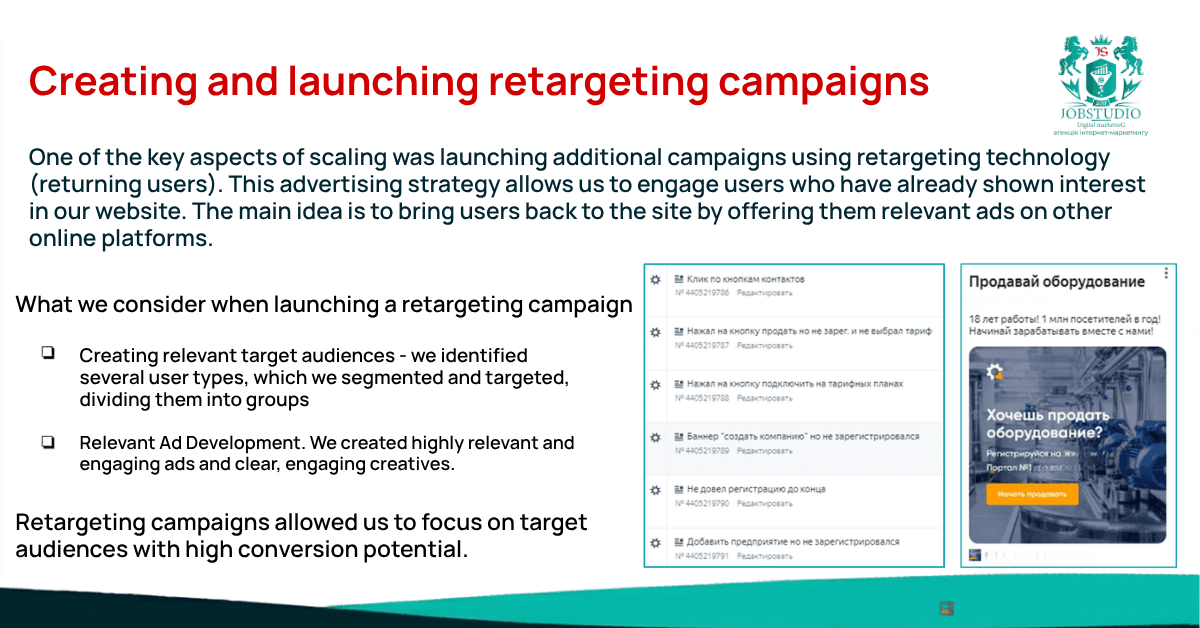
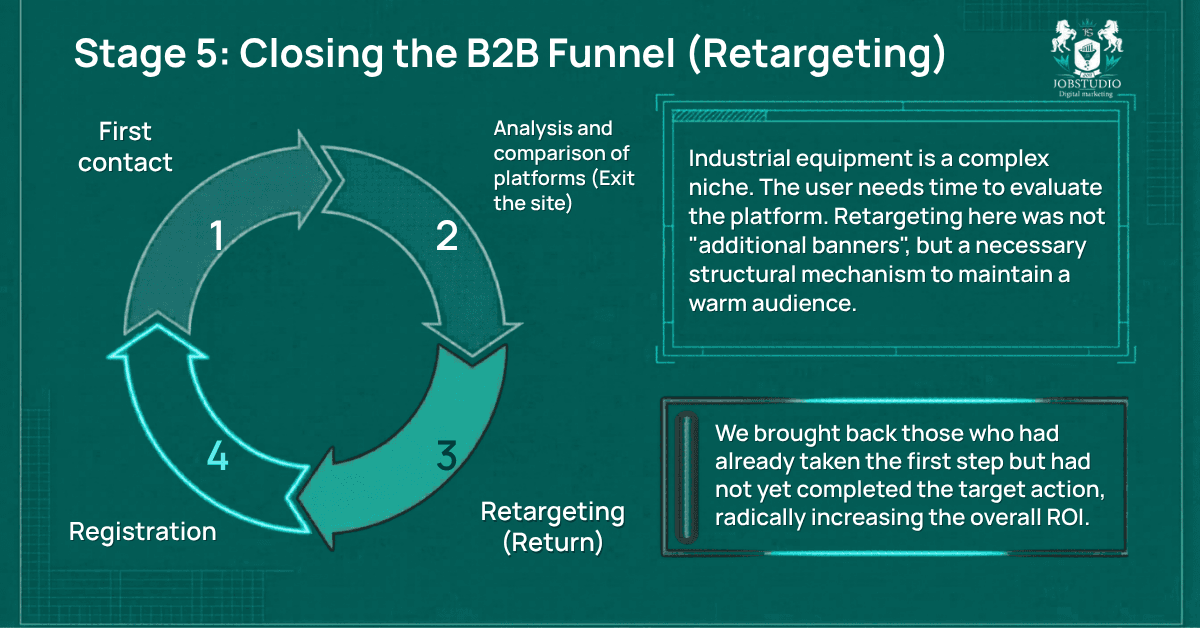
For a B2B project, users don’t always sign up on their first visit. This is especially true when it comes to industrial equipment, where the decision-making process can be complex, and users need time to compare options, evaluate the platform, and return to take action.
That is precisely why retargeting was an important part of the marketing strategy.
Its goal is to bring back users who have already visited the site or shown interest in the portal but haven’t registered yet. This allows us to re-engage with a warm audience, increase the likelihood of registration, and use our budget more effectively.
In this case, retargeting wasn’t just an “additional banner for reach,” but part of the funnel. It helped ensure we didn’t lose those who had already taken the first step but hadn’t yet completed the desired action.
Working with negative keywords has become one of the key steps in optimizing advertising campaigns. In the B2B industrial equipment niche, it’s important not just to get more impressions and clicks, but to filter out queries that have no real value for the business.
We regularly analyzed the search terms that triggered our ads and excluded irrelevant queries. This ensured we didn’t waste our budget on an audience that had no intention of registering on the portal, selling equipment, becoming a supplier, or interacting with the platform as a potential customer.
During the project, the team:
Thanks to this work, we reduced the share of non-targeted traffic, lowered the cost per click, increased the CTR, and improved the overall performance of the campaigns. The ads began to attract higher-quality traffic, and the number of targeted conversions gradually increased.
In this case, negative keywords were not used for technical “cleaning” but rather as a tool for managing the advertising budget. They were instrumental in filtering out irrelevant search queries and focusing the budget on users who were more likely to become registered members of the portal.
In the industrial B2B niche, some search queries may seem relevant only at first glance. But if the user has no intention of registering, selling equipment, becoming a supplier, or working with the portal, such a click does not bring the business any closer to its goals.
On the contrary, it increases costs, skews statistics, and prevents the advertising system from better understanding which audience is the target audience.
Therefore, in this case, negative keywords were not merely a technical measure, but one of the key tools for reducing registration costs.
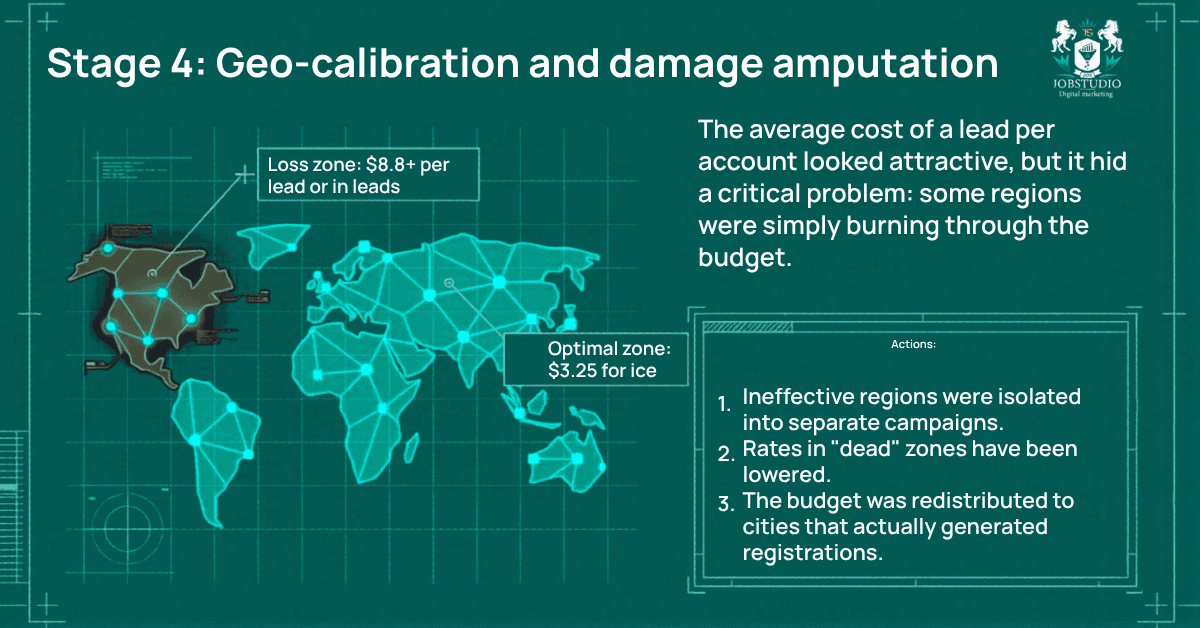
Geographic optimization was another key component.
The team analyzed campaign performance by region and city. They found that in some regions and cities, there were no leads at all over an extended period, even though the budget was being spent there. There were also regions with high lead acquisition costs: over $6.50 per lead. Overall, these cities yielded 18 registrations with an average cost of approximately $8.80, while the optimal cost for the client was around $3.25.
For businesses, this meant one simple thing: while the average account performance might look acceptable, there were regions within it that were dragging the results down.
What we did:
This wasn’t just an analysis “for the report.” It was practical work on campaign economics. We didn’t just look at the average cost per registration per account. We analyzed which regions actually helped the business grow, and which ones created the illusion of activity without producing results.
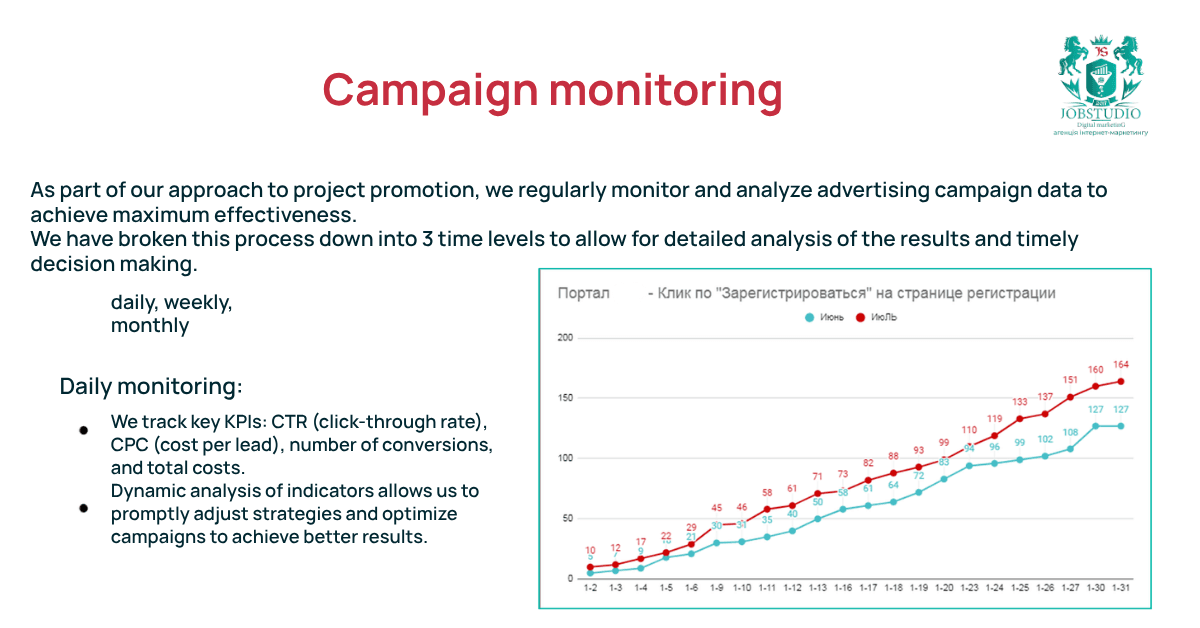
The results in this case didn’t come after just one run. They were the result of consistent work with the data.
The monitoring process was divided into three levels: daily, weekly, and monthly. This approach made it possible to respond quickly to changes in the campaigns rather than waiting until the end of the month to identify a problem.
On a daily basis, the team monitored key metrics: CTR, costs, number of conversions, campaign performance, and potential drops in performance.
This kind of monitoring is necessary to ensure that we don’t lose control of the budget. If a campaign suddenly starts spending more without generating sign-ups, we need to catch that quickly. If a particular segment shows better performance, it’s also important to notice that in a timely manner.
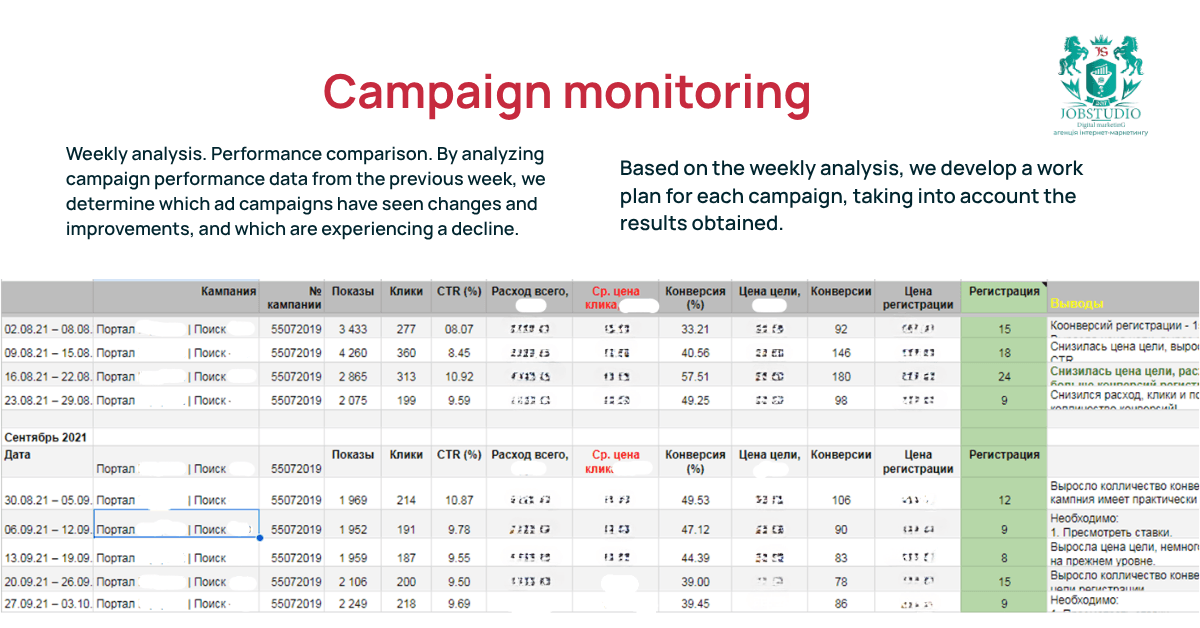
Every week, the team compared the effectiveness of the campaigns, identifying areas of improvement and areas where performance was declining. Based on this, a work plan was developed for the following period.
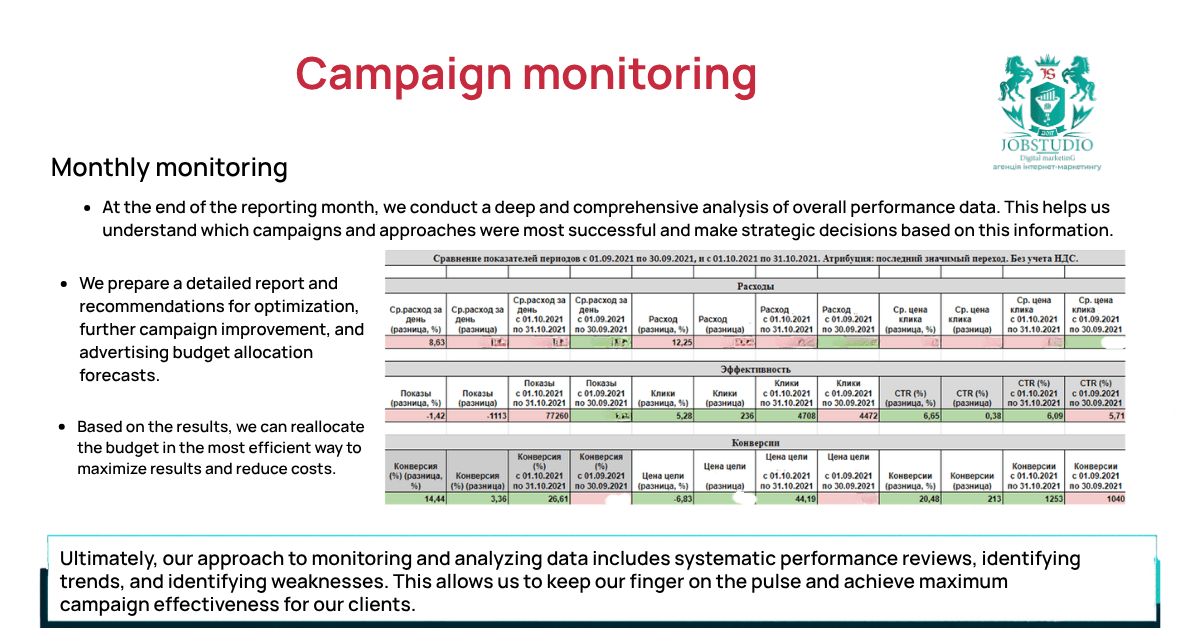
At the end of the reporting month, a more in-depth analysis was conducted to determine which campaigns and approaches performed best, where the budget should be reallocated, which segments could be scaled up, and which needed to be scaled back.
It was precisely this consistency that allowed us to gradually reduce registration costs without losing control as we scaled up.
Initially, the advertising budget was approximately $130 per month. Once results stabilized and the cost per registration gradually decreased, the budget was scaled up to approximately $650 per month.
But it’s not the budget increase itself that matters. What matters is when and why it happened.
Scaling wasn’t the first step. First, the team gathered statistics, identified high-performing segments, filtered out some of the non-targeted traffic, set up analytics, analyzed regions, tested ads, and determined which campaigns to scale up.
Only then did they begin to increase the budget.
You can only scale what is already measurable and working. Otherwise, the business is simply increasing its costs due to the same mistakes.
In this case, we didn’t let things get out of hand. We first brought order to the system, and then strengthened the parts that had proven effective.
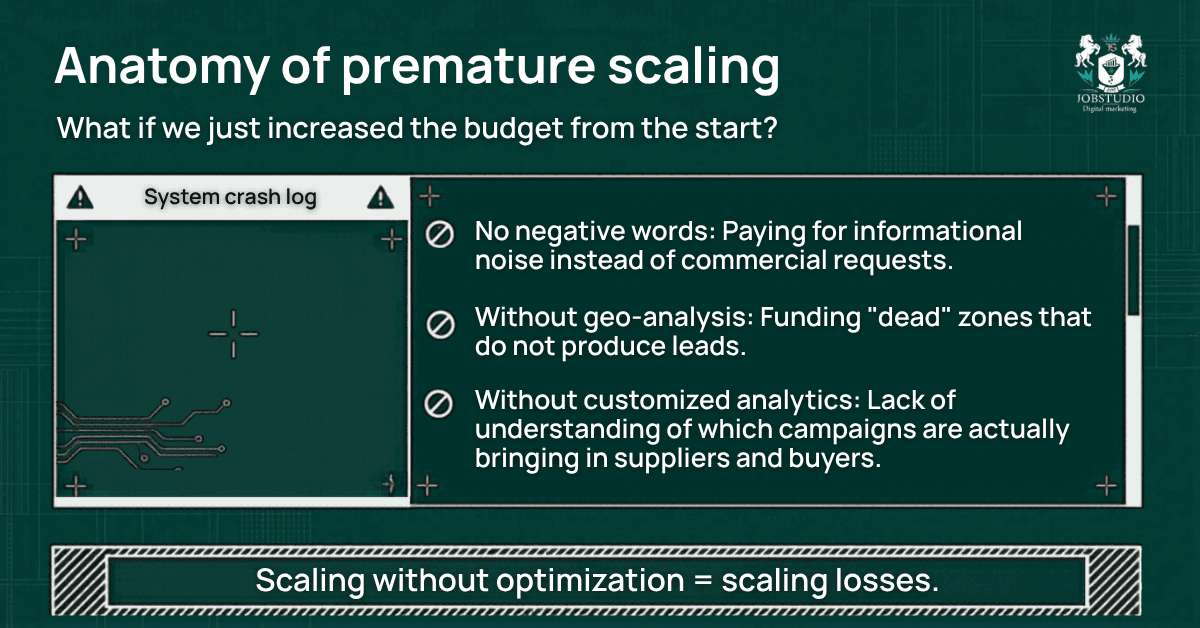
This case study clearly illustrates why it is important to perform diagnostics and optimization before scaling.
If the budget had been increased right from the start without any preparation, the business might have gotten more clicks, higher costs, and more data, but not necessarily more targeted sign-ups.
The budget would continue to be spent on queries that do not attract the target audience.
Some campaigns might appear to be performing well in terms of clicks and impressions, but fail to generate the desired business outcome—new user sign-ups.
Some of the funds would continue to go to cities and regions that lack leads or where registration costs are prohibitively high.
The account’s average performance might mask these losses, but the budget would still be spent inefficiently.
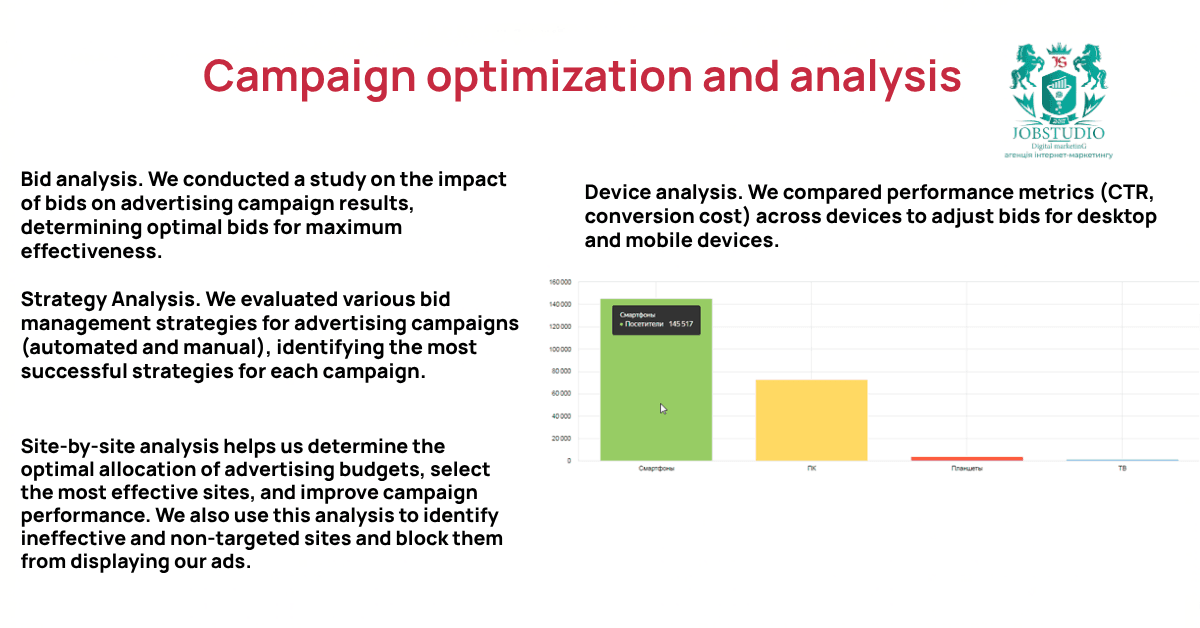
Ad click-through rate, or CTR, is one of the key metrics for measuring the effectiveness of advertising campaigns. It shows what percentage of users click on an ad after it is displayed.
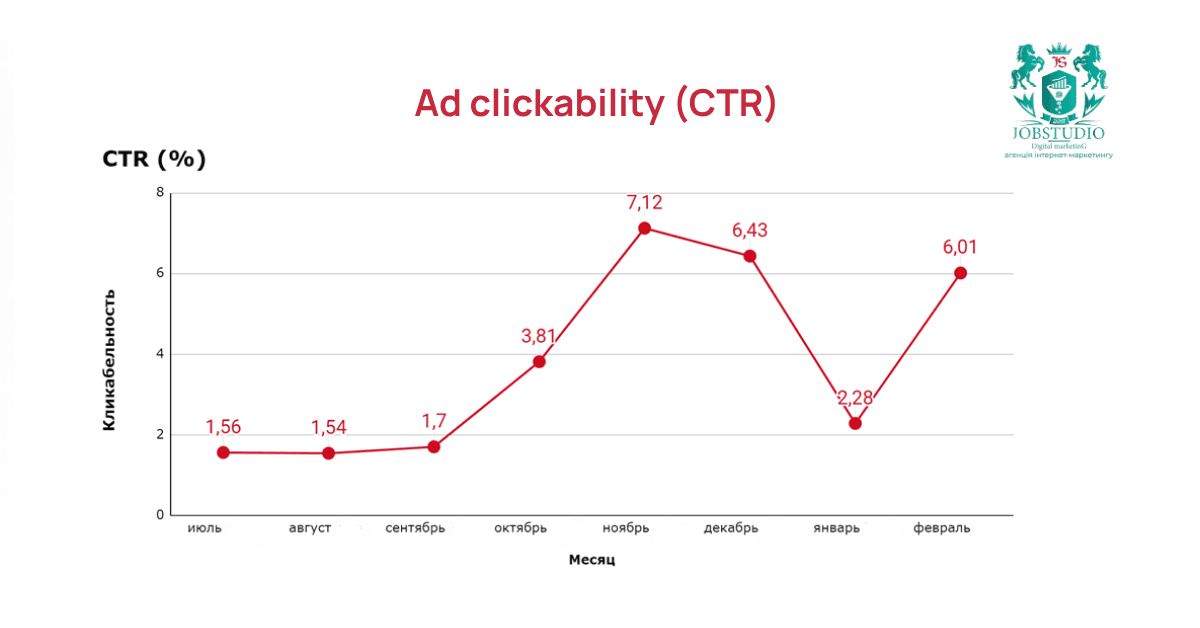
In this case, CTR was important not merely as a “nice metric,” but as an indicator of the advertising system’s quality. If an ad receives more clicks from the target audience, it means that the search queries, ad copy, and advertising offer better align with the user’s intent.
Throughout our collaboration, we have managed to significantly increase the click-through rate of our ads. Several factors contributed to this:
The increase in CTR helped drive more high-quality traffic to the portal and directly impacted the number of new registrations. The more precisely the ad matched the user’s query, the higher the chance that the click would result in a conversion.
It is worth noting that the decline in the metric in January 2022 was due to seasonal shifts in demand. For a B2B industrial equipment portal, this is a natural occurrence: at the start of the year, a portion of the audience sees changes in priorities, budgets, and activity as they search for new platforms to buy or sell equipment.
Therefore, we did not evaluate CTR in isolation over a single month, but rather over time. It was the long-term increase in click-through rates that demonstrated that the ad campaigns were becoming more relevant to the target audience and were more effective in achieving the primary business goal—new registrations on the portal.
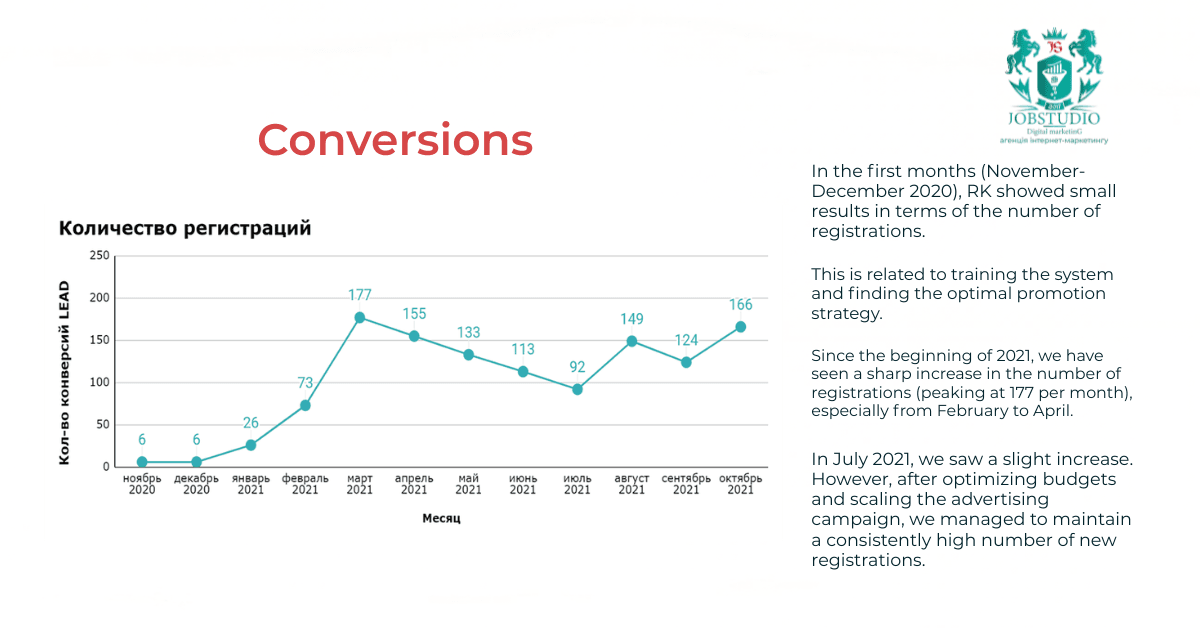
During the first few months of operation—in November and December 2020—the advertising campaigns yielded modest results in terms of the number of sign-ups. This was an expected phase: the system was still gathering data, and the team was searching for the optimal marketing strategy for a niche B2B market.
At the outset, we needed to figure out which search queries brought in our target users, which ads best aligned with the audience’s intent, which regions delivered results, and which ones were just draining the budget. Therefore, the first few months were not a failure, but rather a period of learning, testing, and gradually fine-tuning the system.
Since the beginning of 2021, the number of registrations has begun to rise sharply. The strongest growth was observed between February and April: at the peak of the campaign, up to 177 new registrations were recorded per month.
This was the result of a comprehensive effort:
In July 2021, we saw a slight decline in the number of registrations. However, after optimizing our budgets and scaling up effective campaigns, we were able to regain momentum and maintain the number of new registrations at a consistently high level.
What’s important about this case study isn’t just that the number of conversions increased. What’s important is that, following the testing phase, the advertising system became more predictable: the team already understood which campaigns to scale up, which segments to scale back, and where to continue optimization.
That is precisely why the increase in conversions here was not a random spike, but rather the result of systematic work with data, budgets, semantics, and audiences.
The team wouldn’t be able to tell which campaigns are actually effective and which ones are just creating the appearance of activity.
Without accurate analytics, it’s difficult to make decisions: what to prioritize, what to scale back, which features to keep, and which to remove.
It would be harder to figure out which messages are more effective at engaging the target audience.
Ads might get clicks, but they don’t necessarily attract users with the right intent.
The business could end up scaling not its profits, but its losses.
That is why, in this case, we first focused on the quality of the system and only then on its scale.
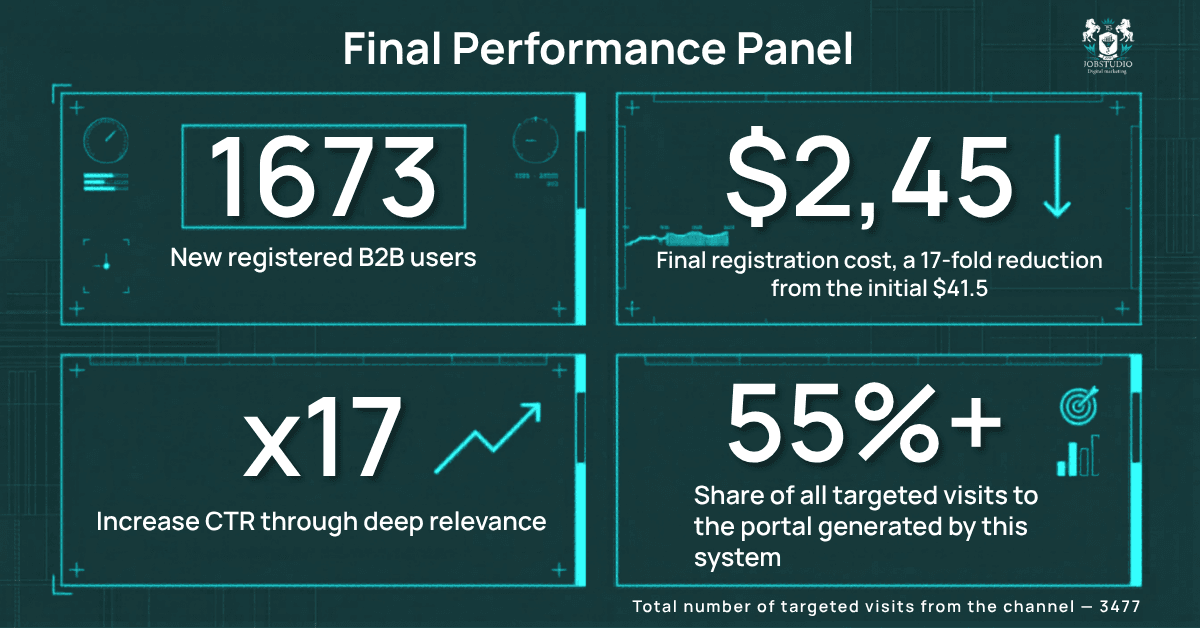
Following a comprehensive campaign, the advertising channel became one of the key sources of targeted visits and sign-ups.
During this period, the client gained 1,673 new registered users. On average, that’s 104 new users per month. The advertising campaigns generated 3,477 targeted visits, accounting for over 55% of all such visits to the website.
The ad CTR increased more than 17-fold. The number of target conversions increased more than 14-fold. The cost per registration decreased more than 17-fold: from approximately $41.50 at the start to approximately $2.45 by the end of the campaign.
The cost of registration didn’t drop because of a single “secret” tool. The result came from a series of measures that systematically addressed the weaknesses in the advertising system.
The following factors influenced the result:
In this case, the ads started performing better not because “the algorithm figured it out on its own.” They started performing better because the team consistently removed everything that prevented the system from generating targeted sign-ups.
We reduced the share of non-targeted traffic. We improved ad relevance. We separated strong segments from weak ones. We monitored regions. We focused not only on clicks but also on sign-ups. And we scaled only what had already proven effective.
This case study illustrates a simple yet important point: in a complex B2B niche, it’s not a larger budget alone that delivers results, but a better advertising management system.
To reduce the cost per registration, it’s not enough to simply launch campaigns. You need to understand demand, segment it, filter out irrelevant traffic, set up analytics, regularly analyze campaigns, optimize regions, bids, and ads, and then scale only what has proven to be effective.
This is exactly how JobStudio’s boutique performance approach works: instead of running cookie-cutter ads, we conduct an in-depth analysis of the niche, monitor campaign performance, and identify areas for growth where the business is actually losing money.
In this case study, we didn’t just drive traffic. We helped transform the advertising channel into a manageable system where it’s clear what’s working, what needs to be scaled up, and what should be cut before it eats up the budget.
If you already have ads running but your bid costs are high, your conversion rates are inconsistent, or you’re unsure which campaigns are actually delivering results, start with an audit.
JobStudio will check:
We’ll show you what’s worth scaling and what needs to be fixed first so you don’t end up spending more on existing issues.
Type “AUDIT”—and we’ll show you three areas where your ads may be losing effectiveness.
At the start of the campaign, we didn’t yet have enough data, and part of the budget was being spent on irrelevant queries, ineffective segments, and regions. The high cost per conversion was due to a large amount of irrelevant traffic and a lack of data in the account.
So the first task wasn’t scaling up, but rather diagnostics: figuring out which campaigns, search queries, and audiences actually lead to sign-ups.
It wasn’t a single action that made the biggest difference, but rather a comprehensive optimization effort. We worked on campaign structure, semantics, negative keywords, ads, analytics, targeting, bids, and retargeting.
It was the combination of these steps that helped reduce the registration fee from approximately $41.50 to $2.45.
Because at the outset, it wasn’t yet clear which segments were performing best. If the budget had been increased right away, the business might have scaled up not the results, but the mistakes: irrelevant queries, expensive regions, and campaigns without consistent performance.
First, we needed to establish a monitoring system, and only then increase the budget.
In B2B, different types of inquiries have different business value. If you combine all segments into a single campaign, it becomes difficult to determine what actually drives sign-ups and what is simply draining the budget.
In this case study, a structure comprising over 200 ad groups made it possible to manage bids more precisely, test ad copy, and analyze the performance of individual campaigns.
Negative keywords help filter out search queries that don’t bring in the right audience. In a narrow B2B niche, this is critical: even a small percentage of irrelevant traffic can significantly increase the cost per sign-up.
In this project, consistently using negative keywords helped lower the cost per click, increase the CTR, and improve the overall performance of the campaigns.
Not all regions achieved the same level of efficiency. Some cities and regions spent their budgets without proper documentation or set overly ambitious goals.
Following a geotargeting analysis, underperforming segments were isolated, bids were adjusted, and the budget was reallocated to stronger areas. This helped lower the cost per registration and made the campaigns more manageable.
It is impossible to provide exact figures, as each niche has its own demand, competition, cost per click, and sales cycle.
However, this approach can be applied to other B2B projects: market analysis, semantic segmentation, proper campaign structure, analytics, negative keywords, regular optimization, and scaling only after results have stabilized.
An audit is necessary if your ads are already running but your cost per lead is high, your conversion rates are inconsistent, your analytics data is unclear, or you plan to increase your budget.
Before scaling up, it’s important to determine what needs to be strengthened and what needs to be fixed first. Otherwise, you may end up increasing the costs associated with existing problems rather than improving results.
.webp)
 Contacts
 Language
 Book a call
 Order a proposal


